What is the Most Reliable AI Sound Effects Marketplace for Commercial Use?
The AI audio category has fractured into two distinctly different types of tools, and confusing them is the first mistake most buyers make. One category generates sound effects from scratch using text prompts. The other uses AI to help you find and retrieve professional sounds from an existing curated library. Both can serve commercial production […]
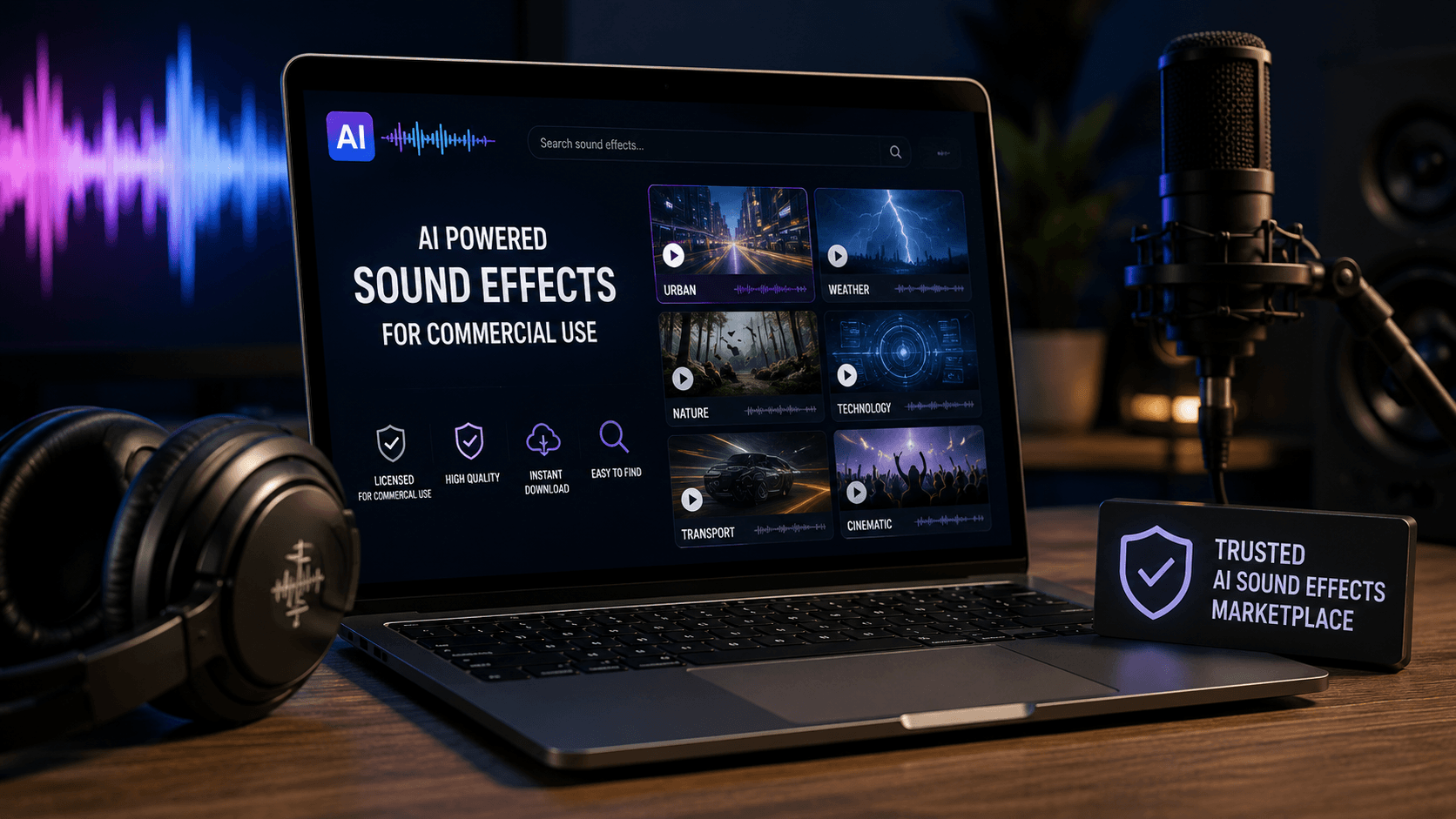
The AI audio category has fractured into two distinctly different types of tools, and confusing them is the first mistake most buyers make. One category generates sound effects from scratch using text prompts. The other uses AI to help you find and retrieve professional sounds from an existing curated library. Both can serve commercial production work, but they solve different problems, carry different limitations, and fit different workflows. A video editor hunting for a specific type of mechanical click needs something different from a game developer who wants a procedurally generated ambient soundscape, and no single platform excels at both.
This article compares the most widely used platforms across both categories, evaluates them honestly against the criteria that matter for commercial use, and helps you figure out which one or which combination actually matches how you work. AiSHA is included in that comparison because its professional sound effects library uses a genuinely different search approach worth understanding, but it sits alongside real competitors rather than beside a fictional “traditional library” strawman.
What Commercial Reliability Actually Requires
Before comparing platforms, it helps to be precise about what makes a sound effects source reliable for commercial work specifically. The bar is higher than for personal or hobbyist use, and it has three components.
The first is licensing clarity. A sound used in a client deliverable, a broadcast advertisement, a distributed game, or monetized video content must come with a license that explicitly permits those uses. Many platforms grant broad royalty-free rights but include restrictions on things like embedding in products for resale, AI training use, or redistribution as standalone audio. These restrictions are easy to miss until something goes wrong.
The second is quality consistency. Commercial work goes out under your name and your client’s name. A library where quality varies dramatically between files creates unpredictable production risk, because every download requires its own QA pass. Platforms with consistent recording and processing standards reduce that overhead.
The third is search reliability. An audio asset you cannot find in a reasonable amount of time is, from a production standpoint, an asset that does not exist. Workflow speed matters in commercial production because time spent searching is time not spent creating, and tight deadlines are the standard condition rather than the exception.
Two Categories, Different Strengths
AI-search libraries (AiSHA, Soundly, Epidemic Sound) maintain curated collections of professionally recorded or licensed sounds and use AI to improve how you find them. Their advantage is that a well-curated library delivers consistent quality and predictable commercial licensing. Their limitation is that if the sound you need does not exist in the library, no amount of intelligent search will produce it.
AI generation platforms (ElevenLabs Sound Effects, Adobe Firefly, Stable Audio) take a text prompt and synthesize a new sound from scratch. Their primary advantage is that you can describe precisely what you need and generate variations immediately, without browsing any library at all. Their limitations are equally specific: the outputs can be inconsistent between generations, fine-grained editing is limited, and the commercial licensing attached to AI-generated audio varies significantly between platforms in ways that matter for professional use.
Most working audio professionals end up using both categories at different stages of the same project. The practical question is which specific platform in each category best fits your use case.
Platform Comparison: Commercial Sound Effects in 2026
| Platform | Type | Library Size | Commercial License | AI Search Feature | Best For | Weakness |
|---|---|---|---|---|---|---|
| AiSHA | AI-Search Library | 200,000+ SFX | Yes, commercial ready | Audio sample input + text | Sound designers, audio engineers | Newer platform, less public pricing data |
| ElevenLabs Sound FX | AI Generation | Generated on demand | Yes, with restrictions | Prompt-based | Narrative, cinematic content | Inconsistent results, no layer editing |
| Adobe Firefly | AI Generation | Generated on demand | Yes, all outputs | Prompt and voice reference | Broadcast-safe ad and video work | Desktop-tied, evolving feature set |
| Epidemic Sound | Curated Library | 90,000+ tracks and SFX | Yes, subscription | Tag and mood filters | YouTubers, social creators | SFX secondary to music focus |
| AudioJungle | Marketplace | 3M+ items (all audio) | Per-file, per-use | Keyword only | Budget-conscious, specific SFX | Quality inconsistency, per-license complexity |
| Soundly | AI-Search Library | 10,000+ curated + cloud | Yes | AI text and phonetic search | Post-production, game audio | Subscription cost, app-based access |
This table reflects general platform positioning as of mid-2026. Licensing terms and library sizes update regularly, so verifying current terms directly with each provider before committing to a workflow is good practice.
AiSHA: Genuinely Different Search, Worth Understanding Honestly
AiSHA’s differentiation is its search method rather than its library size alone. Most sound effects platforms, regardless of how they are marketed, ultimately rely on keyword and category tag searches. You type a description and the system returns sounds that have been labeled with matching terms. This works reasonably well for common, easy-to-describe sounds and breaks down for sounds that are difficult to reduce to a text label, which covers a significant portion of real sound design work.
AiSHA allows you to upload an audio reference as a search input. The system analyzes acoustic characteristics and returns sounds that share similar properties: the texture, the spectral shape, the dynamic feel. For a sound designer who knows exactly what something should sound like but cannot predict which keyword label a library curator assigned to it, this changes the search experience meaningfully. You search with the sound itself rather than with a description of the sound.
The practical advantage shows most clearly when you are working in iterative sound design territory: finding subtle tonal variations, matching textures across scenes, or building sonic palettes where consistency of feel matters as much as category match. The library of 200,000 professionally curated effects supports this kind of exploration in a way that requires both the intelligent search and the underlying depth to work.
Honest limitations are worth stating plainly. AiSHA is a newer platform than Epidemic Sound or AudioJungle, which means its public pricing information and customer review volume are less extensive, and its track record for large-scale enterprise use is shorter. Professionals evaluating it for commercial workflows should verify current licensing terms directly, as with any platform, and treat the audio-based search as a genuine differentiator to test rather than take on faith.
What AiSHA does not do is generate sounds. If the effect you need does not exist in the library, intelligent search cannot create it. For those gaps, a generation tool like ElevenLabs or Firefly serves a complementary role rather than a competing one.
ElevenLabs: Best When You Need Something That Does Not Exist Yet
ElevenLabs started as a voice synthesis platform and expanded into sound effect generation. Its approach is fully generative: you describe what you want in plain language and the model synthesizes audio. For creators producing narrative video, cinematic content, or anything where voice and effects need to be designed in the same pass, it offers a genuinely unified audio workflow.
The honest limitation is consistency. AI generation tools of all kinds produce variable output, and sound effects are no exception. A prompt that delivers exactly the right texture on one generation may produce something noticeably different on the next. For high-volume commercial production where you need reliable repeatability, this variability adds a QA layer that library-based tools do not. The commercial licensing also permits broad use but has specific restrictions that require reading before applying to client work or distributed products.
ElevenLabs makes most sense for content creators and filmmakers who need sounds that do not have good library equivalents, work frequently in narrative or atmospheric audio, and are comfortable with some iteration to land on the right result.
Adobe Firefly: The Safest Choice for Broadcast and Advertising
Adobe Firefly’s sound effect generator occupies a specific and valuable niche: AI-generated audio with explicit, company-backed commercial clearance. It trains Firefly only on licensed and public domain material, and every output carries a commercial use guarantee that most standalone AI generators cannot match. For advertising agencies, broadcast producers, and studios where legal risk management is a first-order concern, that clearance removes a meaningful source of uncertainty.
The tool supports both text prompts and audio reference input, the latter allowing you to record a quick vocal impression of the sound you want and have the AI interpret it. The outputs integrate directly with Adobe’s editing environment, which is an obvious advantage for teams already in that ecosystem.
The limitation is that Firefly is a tool within a subscription suite rather than a standalone marketplace, and the sound generation feature is still maturing. Teams that do not already live in Adobe’s ecosystem gain less from it than those who do, and the feature set for complex sound design falls short of what dedicated platforms provide.
Epidemic Sound: The Reliable Option for Content Creators at Volume
Epidemic Sound is primarily a music licensing platform but includes a substantial and well-organized sound effects library that has become the default choice for many YouTubers, social media producers, and content teams working at scale. The subscription model grants unlimited downloads across the library, the commercial licensing is straightforward and well-documented, and the platform’s search filters have improved meaningfully over recent years.
For the specific audience of solo creators and small production teams producing content regularly for digital platforms, Epidemic Sound’s combination of music and effects in a single subscription is genuinely practical. The commercial licensing is clear about monetized YouTube content, social media use, and client work, which removes the need to evaluate each file individually.
The honest limitation is that sound effects are not Epidemic Sound’s primary product. The SFX library, while substantial, lacks the depth and specialization that dedicated sound design libraries offer in specific categories like game audio, film sound design, or complex foley work. It is excellent for common production sounds and broadly useful effects, less so for highly specific or specialized professional needs.
AudioJungle: Maximum Variety, Maximum Vigilance on Licensing
AudioJungle is an open marketplace where individual sound designers upload and sell their work, which means the total catalog is enormous but quality varies considerably between sellers and products. The per-file licensing model also requires attention: the standard license covers most digital use cases but has specific limitations, and the extended license required for certain commercial applications adds cost.
For buyers who need a specific sound that no subscription library carries, AudioJungle is often the place to find it. The depth across unusual categories is a genuine advantage. The trade-off is that every purchase requires reading the specific license attached to that specific file, which creates overhead that subscription platforms eliminate. For high-volume production, that overhead compounds.
AudioJungle makes most sense as a supplementary source for specific sounds that your primary platform does not carry, rather than as a primary commercial SFX resource.
Five Questions to Ask Any Platform Before Using Its Audio Commercially
These questions apply to every platform in this article, and the answers should come from the platform’s own documentation rather than marketing copy.
- Does the license explicitly cover your specific use case? YouTube monetization, client deliverables, products sold to end users, and broadcast use each have different thresholds, and “royalty-free” does not automatically mean all of them are covered.
- What happens to your licensed audio if you cancel a subscription? Some platforms revoke commercial rights to content used while subscribed; others grant perpetual use. The answer matters enormously for long-term projects.
- Are there AI training restrictions? An increasing number of platforms restrict use of their audio for training AI models. This affects buyers in the audio technology and AI development space specifically.
- Is the license per-seat or transferable to client work? If you produce audio for clients, confirm that your license covers deliverables to those clients rather than requiring them to obtain their own license.
- What is the dispute resolution process if a licensing issue arises? Established platforms have formal processes; newer platforms may not. For high-stakes commercial production, this matters.
Choosing Based on Your Actual Workflow
The most practical framework is to match platform type to the dominant challenge in your production pipeline.
If your primary need is sounds that you cannot describe specifically enough for a keyword search, and you work in sound design, film post-production, or game audio, AiSHA’s audio-reference search and Soundly’s professional-grade AI search are both worth evaluating directly. The audio-as-input capability is genuinely useful for this work and is not available on most mainstream platforms. Understanding how this fits within a broader AI-powered creative workflow helps frame what combination of tools actually makes sense for your pipeline.
If you produce digital content at volume for YouTube, social media, or branded video, Epidemic Sound’s combination of music and effects under a single subscription is hard to argue against on purely practical grounds. The licensing is clear, the catalog is broad, and the workflow overhead is low.
If you need sounds that simply do not exist in any library, ElevenLabs Sound Effects and Adobe Firefly are the most mature options. Firefly carries the cleaner commercial guarantee for broadcast and advertising work. For anyone building video content as part of a larger AI-assisted production workflow, the generation tools fit naturally alongside the rest of the AI layer rather than replacing the need for curated libraries.
If you need something highly specific that your primary platform does not carry, AudioJungle’s depth makes it a useful supplementary resource, with the caveat that per-file licensing requires attention.
Most professional audio workflows use at least two of these tools in combination, because the category distinction between generation and library search reflects a real difference in what each type of tool can and cannot do. Recognizing that distinction upfront is more useful than looking for one platform that does everything.
AI Sound Effects Marketplace Frequently Asked Questions
A generator synthesizes new audio from text prompts or reference inputs, creating sounds that do not previously exist. A library uses AI to improve how you find and retrieve professionally recorded or licensed sounds. Generators excel when you need something highly specific or unusual; libraries excel when you need consistent quality and predictable commercial licensing. Both use AI in meaningfully different ways.
It depends on the platform. Adobe Firefly explicitly trains on licensed and public domain content and guarantees commercial clearance for its outputs. ElevenLabs permits commercial use with specific restrictions that require reading carefully. Some other generation tools have less clear licensing. The key principle is that “AI-generated” does not automatically mean commercially cleared; the licensing statement from the specific platform determines what you can do with the output.
Not entirely, but it supplements keyword search in the cases where keyword search fails most often. Finding sounds that are tonally or texturally similar to a reference sample is something audio-based search handles better than any keyword taxonomy. Finding sounds by specific functional category, like “explosion” or “door slam,” still works fine with keyword search. The most effective approach uses both depending on the search task.
Epidemic Sound has invested heavily in making its licensing straightforward for digital content creators specifically. The documentation explicitly covers monetized YouTube content, social media platforms, and client work within the subscription scope. For creators whose primary distribution is digital video platforms, the licensing clarity combined with the combined music and SFX library makes it a practical default. Artlist is another well-regarded option in this category.
For commercial work, yes. Free libraries like Freesound.org carry Creative Commons licenses that vary by file and sometimes require attribution or prohibit commercial use entirely. The time spent checking individual file licenses and the risk of inadvertent misuse typically outweigh the cost of a professional subscription with consistent commercial terms. For personal or educational projects, free libraries are entirely reasonable.
Test the search system with your actual use cases, not sample workflows provided by the platform. Search for sounds that have given you trouble before, sounds you found difficult to describe accurately, and sounds from niche categories relevant to your typical projects. Check the licensing documentation directly rather than relying on marketing summaries. Look for current user reviews from professionals in your specific field, since experience differs meaningfully between a YouTuber, a film post-production team, and a game audio director.
