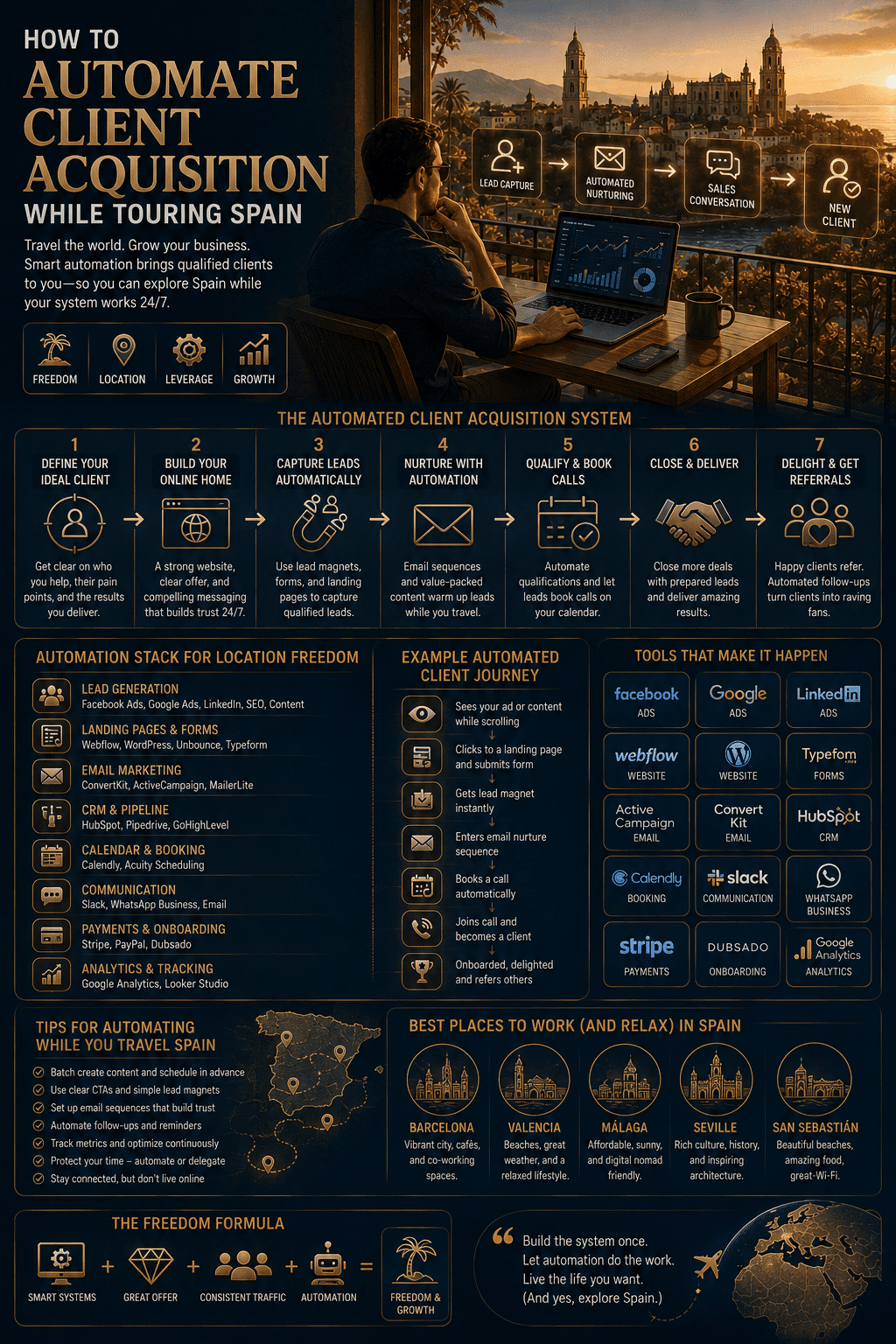
How to Automate Client Acquisition While Touring Spain
Full automation is a myth, but 80 percent of client acquisition genuinely runs itself. Here is how to build it before touring Spain by camper.

There’s a version of the location-independent business that gets sold on social media, and then there’s the version that actually works. The sold version involves a laptop on a beach and vague talk about passive income. The working version is considerably less photogenic: a set of systems that keep qualified prospects arriving in your pipeline whether you’re at your desk at 9am or parked at a mirador above Calpe watching the sun drop into the Mediterranean.
The difference between those two versions is almost entirely about what you build before you leave. Touring Spain in a campervan for six weeks does not create business freedom. Having a client acquisition system that runs without your hourly attention creates business freedom, and Spain simply happens to be an exceptionally good place to enjoy it. This guide covers how to build that system, what genuinely automates well, what stubbornly does not, and how the practical realities of Spanish road travel shape which approach actually holds up.
The Honest Constraint Nobody Mentions First
Let’s deal with the uncomfortable part upfront, because most advice on this topic skips it entirely: client acquisition never fully automates for high-value service businesses. The buying decision for a €5,000 consulting engagement or a €15,000 development project almost always involves a human conversation at some point. What automates is everything surrounding that conversation, which turns out to be roughly 80 percent of the work.
That distinction matters enormously for planning a trip. A consultant who automates lead capture, qualification, scheduling, and follow-up but still needs to take four calls a week is in a completely different position than one who imagines the entire funnel running unattended. The first person can genuinely tour the Costa Blanca, working two focused mornings a week from a café in Altea. The second person will discover somewhere near Valencia that the pipeline went quiet three weeks ago and nobody noticed.
Building for the realistic version means accepting that you’re automating the volume and the friction, not the relationship. That’s still transformative. It just requires designing your travel around a handful of genuine commitments rather than pretending they don’t exist.
Why Spain Specifically Works for This
Spain has become one of Europe’s most practical bases for location-independent work, and the reasons are structural rather than aesthetic. The country formalized remote work residency under the Startup Act, and Spain’s Ministry of Inclusion, Social Security and Migration maintains the official requirements for international teleworker authorization, including the specific provision that teleworkers may earn no more than 20 percent of their professional activity from Spanish companies. That rule matters directly for anyone building a client acquisition system: your automation should be targeting clients outside Spain if you’re operating under this framework.
The infrastructure supports the lifestyle better than most people expect. Mobile coverage across the Mediterranean coast is genuinely reliable, coworking spaces exist in nearly every mid-sized city, and the distances between meaningful destinations are short enough that you’re rarely more than two hours from a proper working environment. Alicante to Valencia is under two hours. Valencia to Barcelona is around three and a half. This is not a country where a client emergency leaves you stranded six hours from decent connectivity.
The campervan approach amplifies all of this rather than complicating it. Renting a camper en Alicante puts you at the northern edge of the Costa Blanca with the entire Mediterranean coast accessible in either direction, and Alicante Airport pickup means you can fly in on a Sunday and be parked beside a cove near Moraira by that evening. Modern rentals in this region typically include solar panels and lithium batteries, which is the practical detail that matters most for working travelers: it means you can hold a video call from a coastal parking spot without hunting for a campsite hookup.
What Actually Automates and What Does Not
Being specific about this prevents the most common planning mistake, which is assuming a tool solves a problem it does not actually address.
| Function | Automation Level | Practical Tool Category | Travel Impact |
|---|---|---|---|
| Lead capture from content | Fully automatable | Forms, landing pages, lead magnets | Runs entirely unattended |
| Initial qualification | Mostly automatable | Qualifying forms, AI screening | Filters out poor fits before they reach you |
| Discovery call scheduling | Fully automatable | Calendar tools with timezone logic | Books into your defined availability windows |
| Proposal delivery | Partially automatable | Templated proposals with variables | Reduces drafting to 15 minutes from 90 |
| The actual sales conversation | Not automatable | Video call, phone | Requires genuine scheduled commitment |
| Follow-up sequences | Fully automatable | Email sequences, CRM triggers | Prevents pipeline decay during travel |
| Contract and payment | Fully automatable | E-signature plus payment links | Removes admin bottleneck entirely |
| Onboarding | Mostly automatable | Intake forms, welcome sequences | New clients start without you present |
The pattern is clear enough to plan around. Everything before and after the sales conversation genuinely automates. The conversation itself does not, which means your entire travel schedule should be built around protecting a small number of reliable call windows rather than hoping to squeeze them in wherever connectivity allows.
Building the System Before You Leave
The mistake that ruins location-independent trips is attempting to build automation while traveling. Setting up a properly integrated system takes focused desk time, testing, and iteration, none of which happens well from a campsite in Denia during your first week away.
The sequence that works starts with content that attracts the right prospects, since automation amplifies whatever input you give it and amplifying poor-fit leads simply wastes your time faster. Then comes lead capture, connecting content to a form that gathers enough information to qualify meaningfully. Qualification questions should be genuinely useful rather than decorative: budget range, timeline, and the specific problem they’re trying to solve will filter more effectively than asking for a company size.
Scheduling automation deserves particular attention for travel, because this is where timezone logic either saves you or destroys you. Spain runs on Central European Time, which puts you one hour ahead of the UK, six ahead of New York, and nine ahead of California. A booking link that lets US West Coast prospects grab your 8pm slot will genuinely disrupt your evenings for weeks. Restricting availability to a narrow morning window in Spanish time, before the day opens up, protects the actual point of the trip. Understanding how AI agents now handle multi-step business workflows makes the technical side considerably more approachable than it was even two years ago, since much of what previously required custom integration now runs through configurable tools.
Follow-up sequences are the piece most people skip and most regret skipping. A prospect who inquires while you’re driving from Alicante to Granada and hears nothing for four days has usually moved on. An automated sequence that acknowledges, provides genuine value, and offers a scheduling link within minutes keeps that prospect warm without any action from you.
The Practical Realities of Working From a Campervan in Spain
Romantic descriptions of van life tend to omit the logistics that determine whether it actually works for a business owner. A few things genuinely matter.
Connectivity is better than expected but not uniform. Spanish mobile networks cover the coastal corridors well, and a local SIM with a generous data allowance handles video calls comfortably in most populated areas. Inland Andalusia, parts of Extremadura, and mountain routes through the Sierra Nevada will drop you to nothing. The practical approach is checking coverage before committing to a location for a call day rather than discovering the gap at 9:55am.
Power management shapes your daily rhythm more than anything else. A van with solar panels and a lithium battery can typically run a laptop, phone charging, and lighting indefinitely in Spanish sunshine, which is genuinely abundant along the Mediterranean coast even in winter. This is precisely why rental listings mentioning solar capacity matter for working travelers in a way they do not for holiday renters. Without it, you’re tethered to campsites with electrical hookups, which constrains exactly the flexibility you came for.
Working environments require some planning. A campervan is a fine place to answer email and a poor place to hold a two-hour strategy call in July heat. The workable pattern most people settle into involves using the van for movement, accommodation, and light work, while booking a coworking day or finding a reliable café in Alicante, Valencia, or Málaga for concentrated client-facing sessions.
Structuring a Trip Around Business Commitments
Here’s the framework that separates trips that work from trips that quietly damage a business.
- Define call windows before you book anything. Two mornings a week, fixed, in Spanish time. Everything else in the trip plans around those two commitments rather than the reverse.
- Front-load the system build by at least three weeks. Automation needs testing under real conditions, and discovering a broken form while parked near Cabo de Gata is a genuinely bad time to debug it.
- Batch your content before departure. Publishing consistently drives the lead flow your automation depends on, and creating good content while traveling is far harder than most people anticipate. Batching works best when the writing happens in protected, distraction-free blocks with a small set of tools you have already tested. This guide to building an AI productivity stack for focus and deep work shows how to set those blocks up before you leave.
- Choose one region rather than crossing the country. The Costa Blanca alone offers enough variation to fill a month, and constant long drives eat exactly the working hours you were protecting.
- Build a genuine emergency protocol. Decide in advance what actually justifies interrupting the trip, and make sure someone can reach you when it happens.
- Track pipeline weekly, not daily. Checking obsessively defeats the purpose, but a Friday review catches problems while they’re still fixable.
Measuring Whether It’s Actually Working
The temptation while traveling is to judge the system by whether anything has broken. That’s the wrong metric, since a quiet inbox can mean either healthy automation or a completely stalled pipeline, and those look identical from a beach.
The numbers worth watching weekly are new inquiries entering the system, qualified conversations booked, and proposals sent. If inquiries are steady but conversations are not being booked, the qualification or scheduling step is failing. If conversations happen but proposals stall, the issue is in your close, not your automation. Diagnosing this from a distance requires that the data exists somewhere you can see it in ten minutes, which means setting up simple reporting before departure rather than attempting to piece it together from three separate tools while connected to a campsite wifi network.
Setting realistic expectations about performance also matters. Automated systems typically produce somewhat lower conversion rates than high-touch manual outreach, because the personal attention that automation removes was doing genuine work. The tradeoff is volume and consistency, and for most service businesses that trade is clearly worth making. The broader pattern here mirrors what happens across the ways AI genuinely improves business returns: the gains come from sustained systematic execution rather than from any single clever tool.
The Version of Freedom That Actually Holds Up
What makes this work is not eliminating work. It’s compressing it into predictable windows and eliminating the anxiety of an unattended pipeline. A consultant with a functioning system can spend Tuesday morning on two client calls from a café in Jávea, close the laptop by noon, and genuinely stop thinking about business until Thursday, knowing that inquiries are being captured, qualified, and scheduled without them.
That’s a meaningfully different experience from both the fantasy and the failure mode. It requires accepting that some work remains, building the infrastructure before you leave rather than during, and structuring travel around a small number of real commitments. Do that, and Spain’s coastline, its short driving distances, and its genuinely good infrastructure make it about as forgiving a place as exists to test whether your business can run without you standing over it.
Automating Client Acquisition Abroad: Common Questions
Partially, and being precise about which parts matters. Lead capture, qualification, scheduling, follow-up sequences, contract delivery, and payment collection all automate reliably. The actual sales conversation for higher-value services rarely does, since most clients want a human discussion before committing significant budget. The practical result is that automation removes roughly 80 percent of the surrounding work while leaving a small number of genuine conversations that need scheduling around. Planning for that reality rather than expecting full automation is what separates trips that work from trips that quietly cost you clients.
For non-EU citizens staying beyond tourist visa limits, yes. Spain’s International Teleworking Visa, created under the Startup Act, allows remote workers to reside legally while working for companies or clients based outside Spain. A key restriction worth understanding is that no more than 20 percent of your professional activity may come from Spanish companies. EU citizens do not need this authorization due to free movement rules. Income thresholds are tied to Spain’s minimum wage and adjust annually, so checking current official requirements before applying is essential.
Along the Mediterranean coast and near mid-sized cities, mobile data connectivity is generally strong enough for video calls with a local SIM and reasonable data allowance. Coverage becomes unreliable in inland mountain regions, parts of rural Andalusia, and some national park areas. The practical approach is verifying coverage at a location before committing to hold calls there, and building your call schedule around days when you’re near a coastal town or city rather than deep in a remote area.
Solar panels with a lithium battery system matter more than almost anything else, since they let you work from remote locations without needing campsite electrical hookups, which is precisely the flexibility that makes van travel appealing. Beyond power, a genuine interior table and seating position that works for several hours of laptop use makes a substantial difference. Hot water and an onboard bathroom reduce dependency on facilities, which in turn expands where you can reasonably park overnight.
At least three to four weeks, and ideally longer. Automation systems need real testing under actual conditions, since forms break, email sequences misfire, and calendar integrations behave unexpectedly with timezone changes. Discovering these problems while parked somewhere with patchy connectivity is a genuinely frustrating way to spend a trip. Building the system, running real leads through it, and fixing what breaks while you still have reliable desk access is the difference between automation that supports the trip and automation that becomes the trip.
It’s among the more forgiving options in Europe for a first attempt. Alicante has an international airport with strong connections, campervan rental with airport pickup is readily available, connectivity along the coast is dependable, and the distances between towns are short enough that you’re rarely far from a proper working environment. The climate also supports year-round travel, with mild winters that make solar power genuinely viable even outside summer months. For someone testing whether their business can run remotely, that combination reduces the number of variables that can go wrong simultaneously.
Infographic