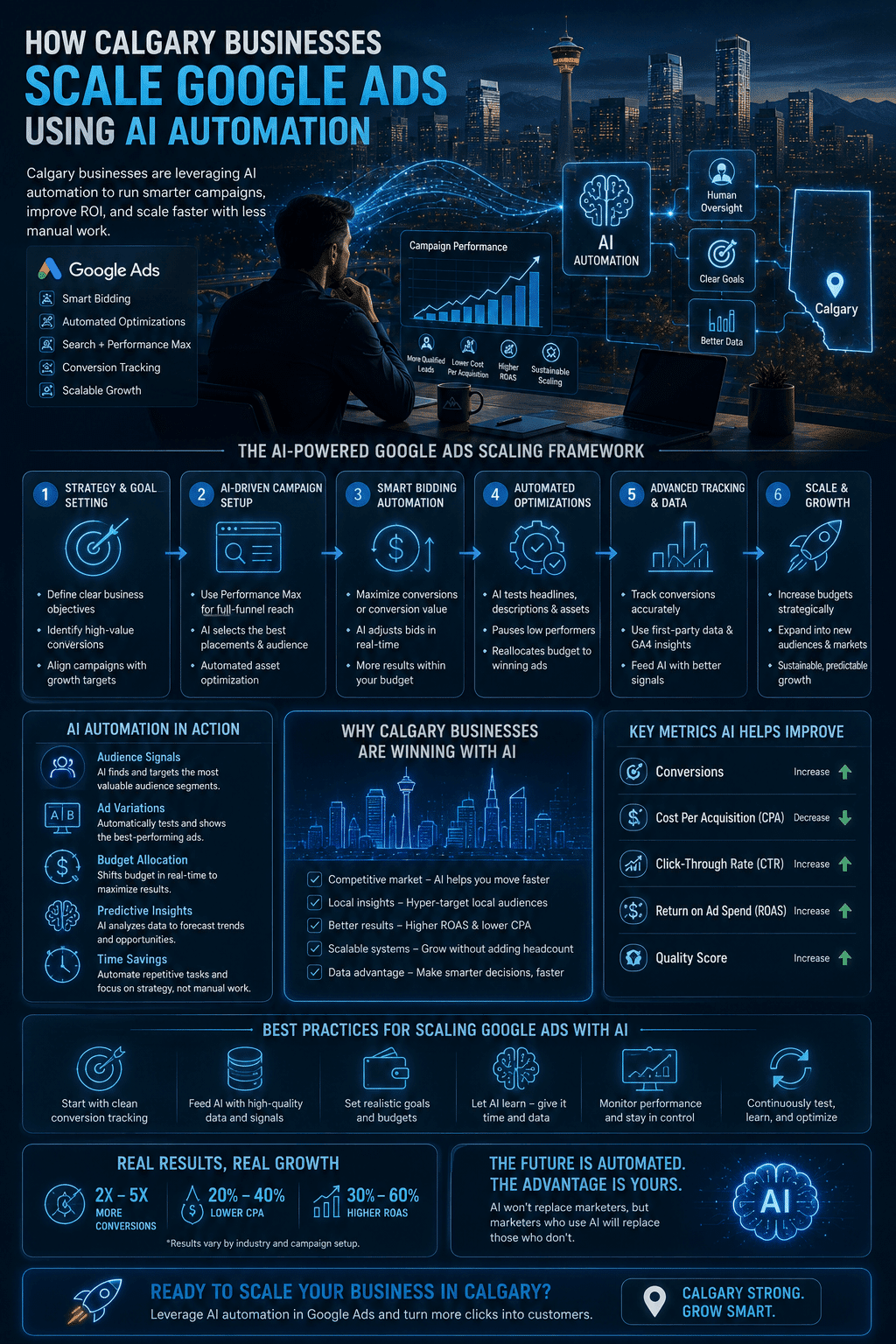
How Calgary Businesses Scale Google Ads Using AI Automation
Smart Bidding needs conversion volume to work. Here is how Calgary businesses scale Google Ads with AI automation without wasting budget.

There’s a specific frustration that shows up in Calgary boardrooms and home offices alike: the Google Ads account that worked fine at $2,000 a month starts wobbling at $8,000. Costs per lead creep up. The keyword list nobody has time to prune keeps swallowing budget. The business owner or the one-person marketing team manages what they can, and the account quietly plateaus well below what the market could actually deliver.
Google’s answer to that ceiling is automation, and over the past two years the company has moved decisively from offering AI as an option to building it into the foundation of how campaigns run at all. Smart Bidding, Performance Max, and now AI Max for Search campaigns all shift meaningful decisions away from the advertiser and toward Google’s models. For Calgary businesses specifically, that shift carries real opportunity and some real risk, because automation rewards accounts with strong data and punishes accounts without it. Understanding which category you’re in before you flip the switch matters more than any tactic in this guide.
This isn’t an argument that automation solves everything. It’s a practical breakdown of what these systems genuinely do well, where they fail, and how businesses across Alberta can scale spend without losing control of what they’re actually paying for. Many local companies eventually reach the point where they need an experienced search engine marketing company in Calgary to handle campaign architecture and measurement properly, and knowing what to expect from automation makes that a far better-informed conversation when it happens.
Why Calgary’s Market Changes the Math
Generic Google Ads advice tends to assume a large, stable, year-round market. Calgary is neither uniformly large nor especially stable, and that shapes what automation can realistically do here.
The city’s economy remains heavily weighted toward energy, with 42 of the top 50 highest-revenue Calgary companies tied to oil, energy, or utilities according to recent FP500 data. That concentration creates a distinct advertising environment: B2B service providers targeting the energy sector face small, high-value audiences where a handful of conversions per month is normal, not a sign of failure. Meanwhile, Calgary’s professional, scientific, and technical services sector alone accounts for roughly 10,457 small businesses, about 21 percent of the city’s small business base, meaning competition for the same narrow B2B search terms is genuinely fierce.
Then there’s seasonality that no national playbook accounts for. Stampede week reshapes consumer behavior across hospitality, retail, and entertainment every July. Winter drives predictable surges in home services, HVAC, and automotive repair. Energy sector hiring and procurement cycles follow commodity prices rather than calendar quarters. Automation handles seasonality well once it has learned a pattern, but it needs at least one full cycle of clean conversion data to recognize that a July spike is normal rather than an anomaly worth bidding down.
What Google’s AI Automation Actually Does Now
The automation available in Google Ads today operates across several distinct layers, and conflating them leads to poor decisions about which to adopt first.
Smart Bidding is the foundation. Rather than setting manual bids, you set a goal and Google’s models adjust bids in every individual auction based on signals about the user, device, time, location, and query context. Google’s own documentation describes this as auction-time bidding, where strategies including Target CPA, Target ROAS, Maximize conversions, and Maximize conversion value optimize for conversions in every single auction. The practical advantage is scale: no human team can evaluate signals across thousands of daily auctions, and this is genuinely where automation outperforms manual management by a wide margin.
Performance Max extends that logic across Google’s entire inventory, running a single campaign across Search, YouTube, Display, Discover, Gmail, and Maps simultaneously. You supply conversion goals, budget, creative assets, and audience signals, and Google’s AI decides where and when your ads appear. For Calgary retailers and service businesses with broad appeal, this can genuinely expand reach into channels a small team would never manage separately.
AI Max for Search represents the newest layer, applying AI to how search queries match to your campaigns and how ad text gets generated. Google’s documentation on setting up AI Max for Search campaigns notes explicitly that features like search term matching, final URL expansion, and text customization require conversion-based Smart Bidding strategies to function effectively. That dependency matters enormously, and it’s the crux of whether automation will work for a given Calgary business at all.
The Conversion Data Problem Nobody Mentions Upfront
Here’s the honest limitation that most agency pitches skip: Google’s AI needs conversion volume to learn, and many Calgary businesses simply don’t generate enough of it for these systems to perform well.
A Smart Bidding strategy optimizing toward Target CPA is building a statistical model of what a converting user looks like. With 200 conversions a month, that model gets sharp quickly. With eight conversions a month, which is entirely normal for a Calgary B2B engineering consultancy or a specialized industrial supplier, the model is working with too little signal to make confident decisions, and performance can genuinely get worse rather than better after switching from manual bidding.
The same constraint applies even more severely to Performance Max. Google recommends allowing a new Performance Max campaign to run for at least six weeks before evaluating results, with a ramp-up period of one to two weeks excluded from analysis. For a business spending $3,000 a month, that means committing roughly $4,500 to a learning period before you can meaningfully judge whether it worked. That’s an acceptable investment for a company with runway and patience. It’s a genuinely risky bet for a business that needs leads this quarter to make payroll.
The practical implication is that low-volume advertisers often do better starting with a broader conversion definition, counting qualified form fills, phone calls over 60 seconds, and quote requests rather than only closed deals, specifically to feed the algorithm enough data to learn from. That’s not gaming the system. It’s giving the model a signal it can actually work with while your true conversion volume builds.
Comparing Automation Levels by Business Type
Different Calgary business profiles get genuinely different results from the same automation features, and matching approach to profile prevents expensive mistakes.
| Business Profile | Monthly Conversions | Recommended Approach | Primary Risk |
|---|---|---|---|
| Local home services (HVAC, plumbing, roofing) | 40 to 200+ | Smart Bidding plus Performance Max | Seasonal swings confusing early learning |
| B2B energy sector services | 5 to 25 | Manual or Maximize Clicks first, then Target CPA | Insufficient data for reliable Smart Bidding |
| Retail and ecommerce | 100+ | Performance Max with strong asset feeds | Losing visibility into channel-level performance |
| Professional services (legal, accounting) | 15 to 60 | Target CPA with tight geographic controls | Broad match expansion wasting budget |
| Restaurants and hospitality | 50 to 300 | Smart Bidding with Stampede-period adjustments | Automation slow to adapt to event spikes |
| Multi-location franchises | 200+ | Performance Max plus local campaigns | Cannibalization between location campaigns |
| New businesses with no history | Under 5 | Manual bidding until data accumulates | Automation cannot learn from nothing |
The pattern worth noticing is that automation genuinely favors businesses that already have volume. This creates an uncomfortable dynamic where the companies best positioned to benefit from AI automation are the ones already succeeding, while smaller advertisers face a genuine chicken-and-egg problem that no amount of feature adoption solves on its own.
Where Human Judgment Still Beats the Algorithm
Automation optimizes toward the goal you give it, which means the quality of that goal determines everything downstream. This is where local knowledge and human judgment remain genuinely irreplaceable, and where Calgary businesses most often go wrong.
Conversion tracking accuracy is the first and largest issue. If your Google Ads account counts every form submission as a conversion, including spam, job applicants, and vendors pitching services, then Smart Bidding is optimizing toward attracting more of those. The algorithm has no way to know a lead was worthless unless you tell it. Feeding offline conversion data back into the account, so Google learns which leads actually became customers, consistently produces better results than any bidding strategy change.
Geographic targeting deserves real attention in a market like Calgary. Automated systems will happily spend budget reaching users in Airdrie, Okotoks, and Cochrane if the signals suggest conversion potential, which is genuinely valuable for some businesses and complete waste for others. A downtown Calgary law firm serving corporate clients has different geographic realities than a Bowness-based contractor whose service radius is genuinely limited by drive time.
Creative and messaging quality remains fully human territory. AI Max can generate ad text variations from your landing page content, but it cannot know that your differentiator is 24-hour emergency response, or that Calgary customers specifically care about winter readiness. The businesses seeing the strongest results from automation are pairing it with genuinely strong human-written asset foundations rather than delegating messaging entirely. The broader pattern here mirrors what happens across the tools that actually drive measurable business growth, where the platform matters far less than the quality of inputs and the discipline of the person managing it.
A Practical Sequence for Scaling With Automation
Calgary businesses that successfully scale Google Ads spend using AI automation tend to follow a recognizable progression rather than adopting everything at once.
- Fix conversion tracking before touching bidding. Verify that every counted conversion represents genuine business value, remove duplicate and low-quality conversion actions, and confirm phone call tracking captures calls of meaningful duration rather than every ring.
- Build conversion volume on simpler strategies first. Maximize Clicks or manual CPC with tight keyword control accumulates the conversion history that Smart Bidding needs, and rushing past this step is the single most common cause of automation underperforming.
- Move to Target CPA once you have consistent monthly conversion volume. Set the initial target close to your current actual cost per acquisition rather than your aspirational target, since aggressive targets restrict delivery and starve the model of learning data.
- Layer Performance Max only after Search is performing. Running Performance Max alongside a healthy Search campaign gives Google a stronger foundation, while launching it as a first campaign in a new account rarely produces reliable results.
- Feed offline conversion data back into the account. Importing which leads actually closed teaches the algorithm to find more of the right customers rather than simply more leads, and this single change often outperforms months of bidding adjustments.
- Review search terms monthly even with automation running. Automated matching expands reach in ways that occasionally surprise, and negative keyword lists remain a genuinely necessary control that no current automation replaces.
Measuring What Automation Is Actually Delivering
The reporting challenge with AI-driven campaigns is real and worth planning for. Performance Max in particular provides less granular visibility than traditional campaign types, showing aggregate results across channels rather than clean channel-by-channel breakdowns. Businesses accustomed to knowing exactly which keyword drove which conversion often find this genuinely uncomfortable.
The practical response is shifting measurement upward, focusing on account-level cost per acquisition, total qualified lead volume, and eventual revenue attribution rather than keyword-level minutiae. This is a legitimate adjustment rather than a workaround, since automation is optimizing across signals no human dashboard could display anyway. What matters is whether total profitable volume is increasing at an acceptable cost, and that question remains fully answerable.
Setting realistic expectations about timeline also prevents premature abandonment. The learning period is not a marketing euphemism, it’s a genuine statistical reality, and accounts that get switched between bidding strategies every three weeks never accumulate the stable data any of those strategies need. Calgary businesses that commit to a strategy for a full quarter consistently outperform those constantly adjusting, even when the constant adjusting feels more proactive. The same discipline applies across the ways AI genuinely improves business returns, where sustained implementation almost always beats scattered experimentation.
Deciding Whether to Manage This Internally
There’s a genuine threshold question every growing Calgary business eventually faces. Below roughly $3,000 in monthly ad spend, internal management with careful attention often makes economic sense, since agency fees would consume a meaningful share of the budget itself. Above roughly $10,000 monthly, the complexity of conversion tracking implementation, feed management, offline data integration, and cross-campaign strategy typically exceeds what someone managing ads alongside other responsibilities can maintain well.
The middle range is genuinely ambiguous and depends more on internal capability than budget size. A business with someone who genuinely understands conversion tracking and enjoys the analytical work can run a sophisticated automated account at $6,000 monthly. A business where ads are the fourth priority of an already-stretched marketing coordinator will likely underperform at the same spend regardless of which automation features are enabled. Being honest about internal capacity, rather than optimistic about it, prevents the slow drift where an account technically runs but nobody is genuinely accountable for its performance.
Google Ads Automation in Calgary: Common Questions
Not reliably, at least not immediately. Smart Bidding strategies build statistical models from conversion data, and accounts generating fewer than roughly 15 to 30 conversions monthly often see worse performance after switching from manual bidding because the model lacks sufficient signal. Businesses in this position typically do better accumulating conversion history on simpler bidding strategies first, or broadening what counts as a conversion to include qualified calls and quote requests rather than only closed sales.
Google recommends allowing at least six weeks before evaluating a new Performance Max campaign, with the first one to two weeks of ramp-up excluded from analysis entirely. That means committing meaningful budget to a learning period before results become interpretable. For Calgary businesses with tight cash flow or urgent lead requirements, this timeline is worth weighing honestly against alternatives that produce faster, if less scalable, results.
Yes, though the adjustment is usually budget rather than bidding strategy. Automation adapts to seasonal patterns once it has learned them across at least one prior cycle, but a first-year advertiser during Stampede week will have an algorithm treating the surge as an anomaly. Increasing daily budgets ahead of known demand spikes, while leaving bidding strategy stable, generally produces better results than switching strategies mid-season.
Performance Max is a separate campaign type running across all of Google’s inventory including YouTube, Display, Gmail, and Maps, with Google’s AI deciding placement. AI Max is a set of features applied within existing Search campaigns, improving how queries match to your ads and generating additional ad text variations. They serve different purposes: Performance Max expands reach across channels, while AI Max improves performance within search specifically.
For simple accounts with strong conversion volume and clear goals, automation genuinely reduces the hours required to maintain performance. What it does not replace is the judgment work: verifying conversion tracking accuracy, defining what counts as a valuable conversion, writing genuinely differentiated ad copy, managing geographic strategy, and integrating offline sales data back into the account. These inputs determine what automation optimizes toward, and getting them wrong means the algorithm efficiently pursues the wrong outcome.
This varies enormously by industry and competition level. Home services and legal categories in Calgary carry high click costs, often making $3,000 to $5,000 monthly a realistic floor for consistent lead flow. Less competitive B2B niches can generate meaningful results at $1,500 monthly. The more useful question is whether your budget generates enough monthly conversions for automation to learn from, since a budget too small to produce consistent conversion volume will underperform regardless of which features are enabled.
Infographic