Ecosystem Marketing: Lessons from Freedom Holding’s SuperApp
Freedom’s SuperApp reached a quarter of Kazakhstan in two years. The lesson is sequencing: trust first, frequency second, lock-in last.
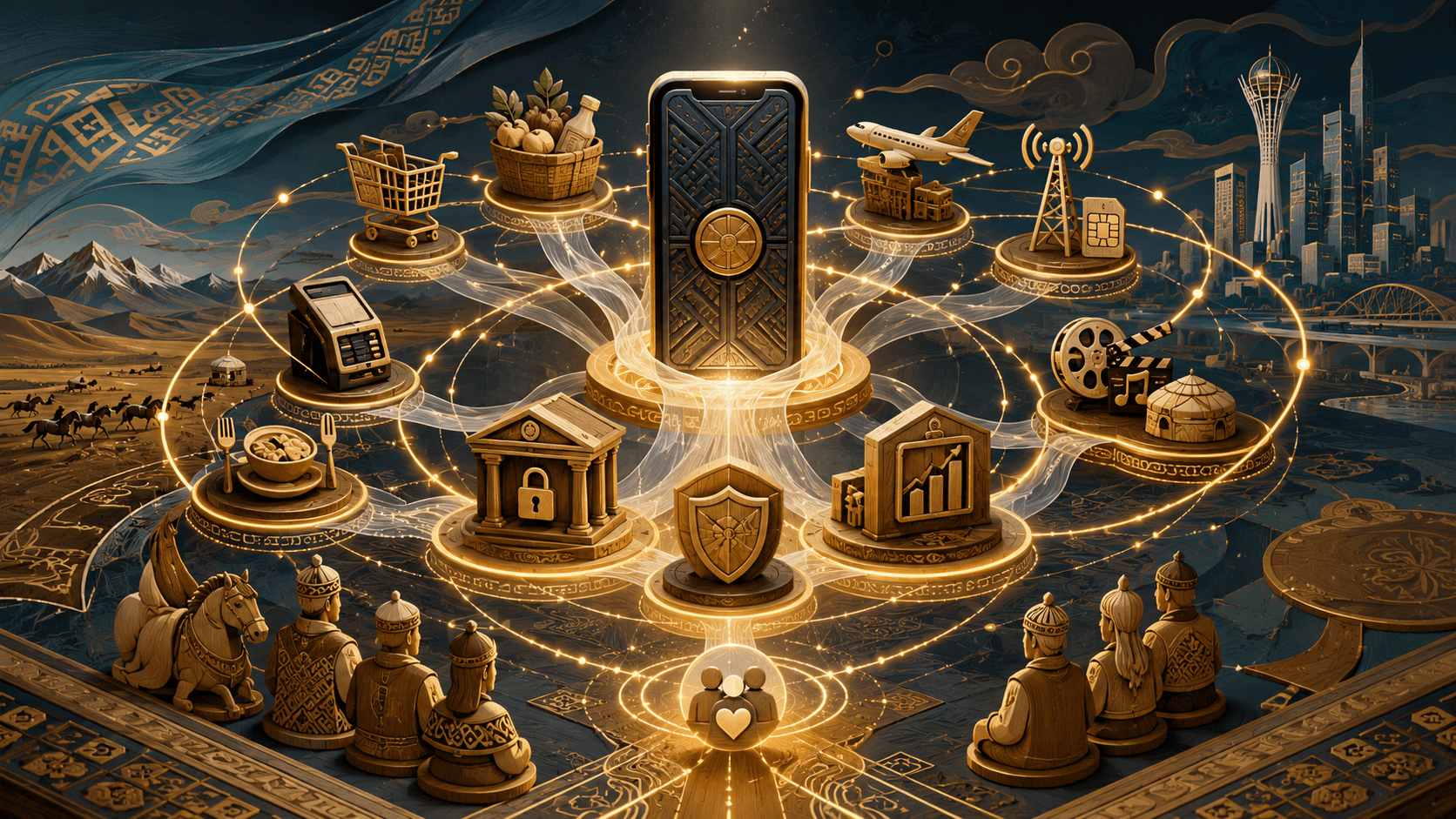
In April 2024, a Kazakh brokerage firm launched a mobile app. Two years later, that app had 5.2 million users in a country of 20.6 million people, which means roughly one in four Kazakhstanis had it installed. It ranked first on the App Store and third on Google Play in its home market. And it had taken an estimated 15 percent of the domestic payments market away from Kaspi, an entrenched incumbent that had previously commanded around 85 percent of the country’s economic transactions.
That is a genuinely unusual outcome, and it did not happen because the app was prettier or the ads were cleverer. It happened because Freedom Holding executed a specific marketing strategy that most Western companies talk about and very few actually build: ecosystem marketing, where the product portfolio itself becomes the acquisition and retention engine rather than something marketing has to promote from the outside.
This article breaks down what Freedom actually did, which parts are transferable to companies operating at any scale, and where the model has limits worth understanding before anyone tries to copy it.
What Ecosystem Marketing Actually Means
The term gets used loosely enough to be worth defining precisely. Ecosystem marketing is a strategy where a company deliberately builds interconnected products and services so that adoption of one increases the likelihood, and reduces the cost, of adopting the next. The marketing value comes from the connections between offerings rather than from any single offering’s appeal.
This is different from cross-selling, which is a sales tactic applied after acquisition. It is different from bundling, which is a pricing mechanic. Ecosystem marketing is an architectural decision about how the business is structured, made early enough that every subsequent product launch inherits an audience rather than having to purchase one.
The distinction shows up most clearly in acquisition economics. A standalone company launching its fourth product pays full customer acquisition cost for that product’s audience. An ecosystem company launching its fourth product markets it to people who already trust the brand, already have payment details on file, and already open the app several times a week for unrelated reasons. Same product, radically different cost to grow it.
Freedom Holding’s founder and CEO, Timur Turlov, has described the underlying goal as a battle for digital gravity rather than immediate revenue, which is a useful framing. Gravity, in this model, means the pull that keeps a user inside your environment rather than shopping across competitors for each individual need. Turlov’s own profile illustrates the pattern extending beyond product: alongside running the holding, he serves as President of both the Kazakhstan Chess Federation and the International School Chess Federation, positions that build brand presence in cultural spaces the company’s advertising budget alone could not reach.
The Sequencing Lesson: Start With Trust, Then Add Frequency
The most instructive part of Freedom’s approach is the order in which things were built, because the sequence is the strategy.
Freedom began as a brokerage. Brokerage is a high-trust, high-value, low-frequency relationship. People do not open their trading account fourteen times a day, but they do think carefully before choosing where to hold their money, and once they choose, they rarely switch casually. That combination gives brokerage an unusual property: it is expensive to acquire a customer, but the trust earned is deep and the relationship is durable.
Banking came next, which is also high-trust but considerably higher frequency. Then insurance, which deepened the financial relationship further. Only after that foundation existed did Freedom add the lifestyle layer: e-commerce, grocery, food delivery, travel booking, ticketing, and eventually telecom and streaming.
That order matters enormously and is frequently reversed by companies attempting the same play. Starting with low-trust, high-frequency services and trying to graduate users into financial products is a much harder sell, because a customer who knows you as a food delivery app has no particular reason to trust you with a mortgage. Freedom moved in the direction trust flows naturally, from the serious to the casual, which meant every subsequent product launch borrowed credibility rather than having to build it.
The financial results reflect the design. Reporting from bne IntelliNews on Freedom’s super-app strategy documented the platform’s growth from 500,000 users in December 2024 to 1.4 million by January 2025, then to 5.2 million by April 2026, sitting inside a broader group ecosystem serving more than 11 million customers across brokerage, banking, and insurance.
How the Pieces Reinforce Each Other
The following breakdown maps the ecosystem layers against the marketing function each one actually performs, which is where the strategy becomes legible.
| Layer | Example Services | Frequency | Marketing Function |
|---|---|---|---|
| Trust anchor | Brokerage, investment accounts | Low | Establishes credibility and deposit relationship |
| Financial core | Banking, mortgages, insurance | Medium | Converts trust into daily financial dependency |
| Payments rail | Cards, transfers, crypto wallet | Very high | Creates habitual daily contact |
| Lifestyle layer | Marketplace, grocery, food delivery | High | Multiplies touchpoints, generates behavioral data |
| Travel and ticketing | Flights, hotels, events | Occasional | High-value transactions, strong retention hooks |
| Infrastructure | Telecom, internet, eSIM, smart home | Continuous | Makes leaving the ecosystem genuinely costly |
| Cultural and brand | Chess sponsorship, licensed card designs | Ambient | Builds recognition outside commercial contexts |
Read down that table and the logic becomes clear. Each layer serves a different marketing job, and the combination produces something no individual product could achieve alone. The payments rail creates daily habit. The lifestyle layer generates the behavioral data that makes personalization possible. The infrastructure layer raises switching costs. The cultural layer builds recognition among people who are not yet customers.
The Frequency Multiplier
A specific insight worth extracting: the lifestyle services in Freedom’s ecosystem are not primarily profit centers. They are frequency engines.
Reported figures show lifestyle service turnover reaching $324 million and doubling year over year, with 2.1 million orders placed in a single quarter, up to 75 percent of payments occurring within the ecosystem, and three out of four transactions flowing through the SuperApp. The travel service alone accounts for roughly 20 percent of Kazakhstan’s airline ticket market.
Those are real revenue numbers, but the strategic value sits elsewhere. Every grocery order, every flight booking, every food delivery is an additional reason to open the app, an additional data point about the customer, and an additional moment where a financial product can be surfaced in context. A brokerage that speaks to a customer four times a year has almost no opportunity to introduce a mortgage. A platform the customer opens daily has hundreds.
This reframes how to think about product margins inside an ecosystem. A low-margin service that triples app open rates may contribute more to overall business value than a high-margin service nobody engages with regularly. Evaluating each product on standalone profitability, which is the instinct in most organizations, systematically undervalues the frequency drivers and leads companies to cut exactly the services holding the ecosystem together. Applying the right financial metrics for evaluating digital product health, particularly retention and lifetime value rather than isolated per-product margin, is what separates ecosystem thinking from conventional portfolio management.
Cross-Subsidized Loyalty: The Telecom Move
The single cleverest mechanic in Freedom’s ecosystem is worth isolating, because it is unusually transferable.
Freedom moved into telecommunications, building fiber and fixed wireless infrastructure across Kazakhstan. Then it tied internet speed to ecosystem loyalty tier. Reporting from Computer Weekly on Freedom’s data and infrastructure strategy described the arrangement directly: a platinum-tier user gets access to near-gigabit speeds, while users newer to the ecosystem receive slower service and are incentivized to adopt additional products, such as credit cards, to improve their connectivity offer.
Think about what that accomplishes. Your home internet speed, something entirely unrelated to financial services, becomes a reason to deepen your financial relationship. The reward is tangible, continuous, and experienced daily rather than redeemed occasionally like points. And critically, it is very difficult for a competitor to match, because matching it requires owning telecom infrastructure.
The general principle transfers well below Freedom’s scale. Find something your customers value continuously, tie access or quality of it to depth of relationship, and you convert loyalty from an abstraction into a daily experienced benefit. The specific asset varies by business, but the mechanic is the same.
What Makes This Work, and What Limits It
Several conditions enabled Freedom’s execution, and being honest about them matters before anyone assumes the model transfers universally.
- A concentrated home market functioning as a laboratory. Kazakhstan gave Freedom a market large enough to prove the model at scale, small enough to reach meaningful penetration, and contained enough to iterate quickly. The company employs over 17,000 people there, including roughly 1,500 IT specialists building the platform.
- Regulatory positioning across multiple licensed categories. Operating brokerage, banking, insurance, and telecom simultaneously requires clearing regulatory hurdles in each, which is a genuine barrier that also protects the position once achieved.
- Capital sufficient to fund unprofitable frequency layers. Building a grocery service to increase app engagement is only rational if you can absorb its economics while the ecosystem effect compounds.
- An incumbent worth attacking. Kaspi’s dominance gave Freedom a clear target and a market already educated about super-app behavior, which meaningfully reduced the cost of category education.
- Cultural and infrastructure investment beyond product. Chess federation leadership, licensed co-branded cards, and national AI initiatives all build presence in contexts where advertising cannot reach.
The limits are equally real. Ecosystem strategies concentrate risk, since a trust failure in one product contaminates every other. They demand sustained capital before returns materialize. They work best in markets where a single company can plausibly serve many needs, which is harder in fragmented, heavily regulated Western markets where antitrust scrutiny arrives faster. And they require genuine operational competence across unrelated categories, which is a management challenge most organizations underestimate.
The Transferable Playbook
Stripped of Freedom’s specific scale, several principles apply to companies of almost any size building toward an ecosystem position.
Start from your highest-trust product rather than your highest-volume one, because trust flows downward into adjacent categories far more easily than it flows upward. Add frequency deliberately, treating high-engagement services as marketing infrastructure rather than judging them purely on standalone margin. Connect the layers with mechanics customers experience continuously, so loyalty becomes a felt benefit rather than a points balance. Build in one market until the model genuinely works before expanding, since a broken ecosystem replicated across five countries is five broken ecosystems.
And measure the right thing. The metric that matters in ecosystem marketing is not per-product profitability but how much of a customer’s relevant spending happens inside your environment, and how that share moves over time. Freedom’s reported figure of up to 75 percent of payments occurring within the ecosystem is the number that actually describes whether the strategy is working, far more than any individual service’s contribution margin. Companies applying AI and data to drive measurable business returns across a connected product set have a structural advantage here, since the behavioral data an ecosystem generates makes personalization considerably more accurate than any single-product company can achieve.
Ecosystem Marketing Strategy: Common Questions
Ecosystem marketing is a strategy where a company builds interconnected products and services so that adopting one lowers the cost and increases the likelihood of adopting the next. Unlike cross-selling, which is a post-acquisition sales tactic, or bundling, which is a pricing mechanic, ecosystem marketing is an architectural decision about business structure. The marketing value comes from connections between offerings, meaning each new product launches to an audience that already trusts the brand rather than one that must be acquired from scratch.
A SuperApp is a single mobile application bundling many otherwise separate services, typically spanning financial products, commerce, travel, and communication, into one interface. WeChat in China is the archetype. Companies build them because consolidating services into one app dramatically increases usage frequency, generates richer behavioral data, and raises the cost for a customer to leave. Freedom Holding’s SuperApp reached 5.2 million users within two years of its April 2024 launch, equivalent to more than a quarter of Kazakhstan’s population.
Sequencing was central. Freedom started from brokerage, a high-trust and high-value relationship, then expanded into banking and insurance before adding lifestyle services like e-commerce, grocery, food delivery, and travel. Because trust transfers more easily from serious financial products to casual everyday ones than the reverse, each new service launched to an audience that already trusted the brand. The company also tied ecosystem loyalty to tangible continuous benefits, most notably internet speed through its telecom arm, which made deepening the relationship worthwhile in daily experienced terms.
Yes, though at a different scale and without the multi-category regulatory footprint. The transferable principles are sequencing from your highest-trust offering rather than your highest-volume one, deliberately adding services that increase contact frequency even when their standalone margins are modest, connecting products with loyalty mechanics customers experience continuously, and measuring share of relevant customer spending rather than per-product profitability. A small agency, software company, or retailer can apply all of these without needing to own telecom infrastructure.
Risk concentration is the largest. A trust failure in any single product contaminates the entire ecosystem, since the whole model depends on credibility transferring between categories. Ecosystem strategies also demand sustained capital before returns compound, require genuine operational competence across unrelated business lines, and attract regulatory and antitrust attention faster in mature Western markets than in emerging ones. Companies should also be careful not to expand into categories where they cannot deliver competent service, since a weak product inside the ecosystem damages more than it contributes.
The core metric is share of a customer’s relevant spending occurring inside your environment, tracked over time, rather than the profitability of any individual product. Supporting indicators include app open frequency, number of distinct services used per customer, retention rates compared to single-product cohorts, and lifetime value trajectory. Evaluating each product on standalone margin is the most common measurement mistake, because it systematically undervalues low-margin services that drive the engagement holding the ecosystem together.
