How To Use AI For Instant Appliance Repair Diagnostics & Error Codes
The refrigerator stops cooling at midnight. The dishwasher flashes F2 on a Saturday morning when no technician is available until Monday. The washing machine beeps in a pattern that means absolutely nothing without a manual you cannot find. For most households, an appliance breakdown used to mean either calling for emergency service, hunting through outdated […]
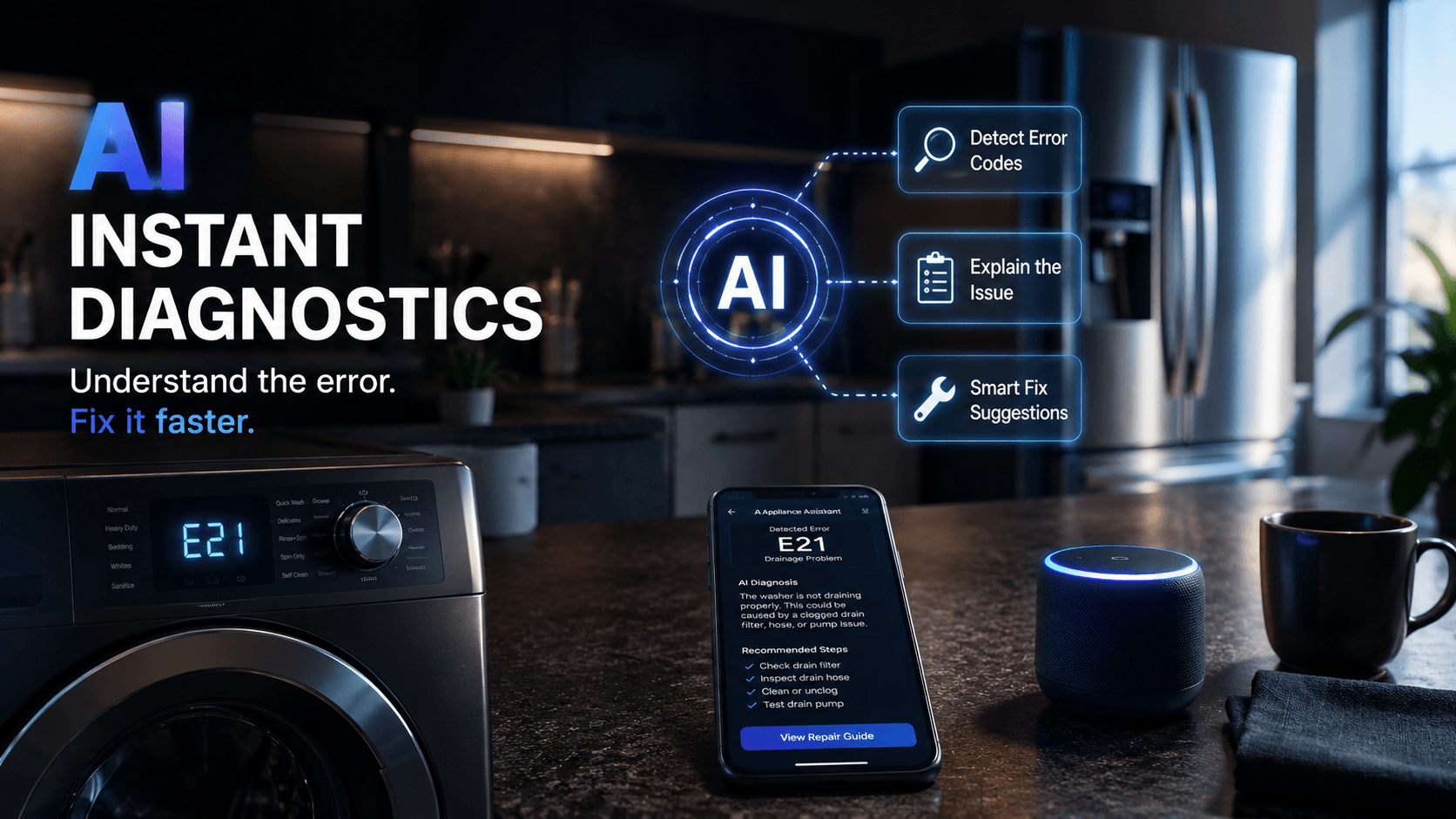
The refrigerator stops cooling at midnight. The dishwasher flashes F2 on a Saturday morning when no technician is available until Monday. The washing machine beeps in a pattern that means absolutely nothing without a manual you cannot find. For most households, an appliance breakdown used to mean either calling for emergency service, hunting through outdated PDF manuals, or simply guessing. That middle ground between “appliance broken” and “technician arriving” has historically been a stressful, expensive nowhere. Learn here how to use AI for instant appliance repair, diagnostics, and error codes.
AI has changed that specific experience more quietly and more practically than almost any other home application. Today, you can photograph an error code, describe a symptom to a chatbot in plain language, and receive an accurate diagnosis, a likely cause, a ranked list of possible fixes, and a clear answer on whether you need a professional. So, all within two minutes. This guide covers exactly how to do that, which AI tools work best for which appliances, and what AI genuinely cannot do so you avoid the mistake of trusting it too far.
What AI Can Actually Do for Appliance Diagnostics
Appliance diagnostics is one of the most natural fits for AI because the underlying knowledge is structured, stable, and well-documented. Manufacturers produce service manuals and error code tables. Technicians develop standard diagnostic sequences. Forums accumulate thousands of solved cases. Large language models trained on this data develop a genuinely useful understanding of what E1 means on a Samsung dryer, what F01 means on a Whirlpool washer, and what the symptom of ice building up on a freezer coil actually indicates about the defrost cycle.
The diagnostic workflow AI supports includes identifying what an error code means in plain language, suggesting the most probable components responsible for a symptom, walking through a simple DIY test sequence to confirm a diagnosis, estimating repair complexity and whether a part is user-replaceable, and flagging when the issue involves gas lines, electrical panels, or sealed refrigerant systems that legally require a licensed technician. This is not vague advice. When you tell Claude or ChatGPT that your LG washing machine is displaying IE with no water filling the drum, it knows that IE indicates an inlet error, that the most common cause is a kinked or frozen inlet hose or a failed water inlet valve, and that testing involves checking water pressure at the valve, inspecting the hose for blockage, and listening for the valve clicking when the cycle starts.
The Most Common Appliance Error Code Reference
Before working with AI, it helps to understand the landscape of appliance error codes. Manufacturers use different formats, but the logic behind them is consistent. The table below covers the most searched error codes across the most common major appliances and what they signal.
| Appliance | Error Code | Common Meaning | Likely DIY Fix | Call a Tech? |
|---|---|---|---|---|
| Washer (Samsung) | 4E / E4 | Water supply issue | Check hoses, water valve | No unless valve fails |
| Washer (Whirlpool) | F21 | Drain pump blockage | Clean pump filter, check hose | No |
| Dryer (LG) | tCL | Drum needs cleaning | Run tub clean cycle | No |
| Dryer (Samsung) | HE / HC | Overheating | Clean lint trap and duct | No, unless repeated |
| Refrigerator (GE) | E0 / E1 | Thermistor fault | Replace thermistor | Maybe |
| Refrigerator (LG) | Er dH | Defrost heater failure | Defrost manually, test heater | Yes |
| Dishwasher (Bosch) | E15 | Anti-flood activated | Tilt unit, dry float switch | No |
| Dishwasher (Whirlpool) | F6E4 | Water inlet blocked | Check valve and supply line | No |
| Oven (Samsung) | SE | Button stuck or shorted | Clean control panel | No, unless persistent |
| Oven (GE) | F7 | Stuck key in control | Clean or replace keypad | Maybe |
| AC Unit | E1 | Sensor or refrigerant issue | Check filter first | Yes if filter is clean |
This is a starting framework, not an exhaustive list. Your specific model, production year, and regional firmware version can shift what a code means, which is exactly why asking an AI with your full model number produces far more accurate results than searching a generic code table.
Step-by-Step: How to Get an Accurate AI For Appliance Repair Diagnostics
The quality of an AI appliance diagnosis depends almost entirely on how clearly you describe the situation. Vague inputs produce vague outputs. The technician who comes to your home will ask specific questions before touching anything, and a well-prompted AI should receive the same level of detail.
Here is the sequence that consistently produces the best results. First, locate the model number. It is almost always on a label inside the door frame for washers and dryers, inside the refrigerator near a shelf, inside the dishwasher door, or behind the lower drawer on ovens. Include this model number in every AI prompt. Second, describe exactly what happened and in what order. The dishwasher ran normally until the drying cycle, then stopped and displayed F6. That gives the AI far better signal than “my dishwasher stopped working.” Third, describe any sounds, smells, or physical symptoms you noticed. Buzzing and no drum movement is a different problem from drum movement with no heat. Fourth, describe what you have already tried, including any reset sequences, because AI can skip those suggestions if you tell it upfront.
A strong prompt looks like this: “My Whirlpool dishwasher model WDT750SAHZ is displaying F6E4 during the fill cycle. The water supply valve is open and the hose is not kinked. I already ran a hard reset by cutting power at the breaker for two minutes. What should I check next?” That prompt will generate a specific, step-by-step response.
AI-Powered Diagnostic Apps Worth Knowing
Beyond general-purpose AI chatbots, a small number of specialized apps and tools have emerged specifically for appliance troubleshooting.
PartSelect and RepairClinic integrate AI-assisted symptom guides that walk you through a decision tree of questions and arrive at part recommendations. They are particularly useful because they connect diagnosis directly to verified parts with your model number, eliminating the uncertainty of whether a suggested component actually fits.
Manufacturer apps from Samsung, LG, and Whirlpool have integrated AI diagnostic modes that can communicate directly with smart appliances via Wi-Fi. These tools pull actual error logs from the appliance’s control board, which is considerably more reliable than a user-described symptom. If your appliance is connected and your manufacturer offers an app, this should be the first diagnostic step.
Professional appliance brands like Wolf Appliance Repair operate in a category where general AI guidance and standard consumer troubleshooting tools have real limitations. Professional-grade ranges, ovens, and cooktops are built to different engineering specifications than consumer appliances, which means error codes, component behavior, and repair procedures do not always map to what generalist AI systems have learned from broader internet documentation. AI diagnostics work best as a first orientation to understand what a symptom likely indicates and what questions to ask, rather than as a complete repair guide. Many repairs involve components and calibration procedures that require brand-certified service, making AI a smart triage tool here rather than a DIY roadmap.
General AI assistants including ChatGPT, Claude, and Gemini are best used for interpretation, second opinions, and guidance when manufacturer-specific tools are not available. They are particularly effective for older appliances without connectivity where the error code documentation is scattered.
Smart Appliances That Self-Diagnose with AI
The landscape of appliances that carry onboard AI diagnostics has expanded significantly. Modern Samsung Family Hub refrigerators monitor compressor performance, temperature consistency, and ice maker cycles continuously, sending push notifications when anomalies appear. LG ThinQ-enabled washers and dryers run internal diagnostics and transmit results to the ThinQ app, which can distinguish between a sensor fault and a physical component failure before you call anyone.
These capabilities represent the next evolution of what the most forward-thinking smart home device integrations are already doing in the energy monitoring space — connecting devices to continuous AI-assisted monitoring so that unusual patterns surface before they become failures. Understanding how AI-powered home gadgets actively monitor appliance energy use and alert homeowners to anomalies puts appliance self-diagnosis in a broader context: the same AI layer that watches your home’s energy use can flag when a refrigerator is drawing 40% more power than its baseline, which typically precedes a compressor or condenser coil failure by days or weeks.
Even without manufacturer apps, smart home gadgets like monitored smart plugs can spot unusual power draw from any appliance and trigger an alert long before the appliance displays a fault code. A washing machine motor drawing unusual current during spin is diagnosable via a smart plug before it fails midcycle and locks a load of wet laundry inside.
The technical layer underlying many of these smart appliance apps connects to the same IoT architecture that has driven broader adoption of connected home automation systems and their companion mobile apps, where app design and connected device protocols determine how accurately an appliance can communicate its status to the homeowner.
The Limits of AI: When to Stop Diagnosing and Call a Professional
Every honest guide on AI appliance repair must include this section, and here is where most internet content fails by omission. AI is useful for diagnosis and guidance on user-serviceable repairs. It is not a replacement for a licensed technician when the problem involves specific categories of risk or complexity.
Here is what AI cannot safely help you resolve at home:
- Gas appliance repair of any kind. If your gas oven, gas dryer, or gas range is leaking, not igniting properly, or producing unusual odors, close the gas supply valve, ventilate the room, and call a certified gas technician. AI can explain what the symptoms mean. It cannot tell you the current state of a gas connection in your specific installation.
- Sealed refrigerant systems. Refrigerators and air conditioners use refrigerants that require EPA certification to handle. A refrigerator that is not cooling despite a working compressor may have a refrigerant leak. AI can confirm this as the likely diagnosis. The repair requires a certified technician with proper equipment.
- Electrical panel involvement. If tripped breakers are involved, if you smell burning from inside an appliance, or if an appliance has visible scorching on its electrical components, professional diagnosis is mandatory. A correctly AI-diagnosed burnt control board still requires someone with electrical competence to replace safely.
- Water damage spread. A dishwasher or washing machine leak that has already reached flooring or walls is a water damage problem first and an appliance problem second. The appliance repair can wait until the water issue is assessed.
- Warranty-active appliances. Most manufacturer warranties are voided by user disassembly beyond the level described in the owner’s manual. AI guidance that involves removing panels, accessing components, or replacing internal parts may cost you warranty coverage. Confirm warranty status before opening anything.
How to Write AI Prompts That Get Better Appliance Answers
The difference between a mediocre AI appliance diagnosis and a genuinely useful one is the prompt. AI systems give specific answers to specific inputs and general answers to vague inputs. Here are the patterns that consistently work:
- Include the model number every time. Different models from the same brand and year can use completely different control boards with different error code dictionaries. The model number eliminates ambiguity at a stroke.
- Describe the timeline. Did the error appear immediately when you started the cycle, midway through, or at the end? Did it appear after a power outage or a specific event? Timeline tells the AI whether to suspect a sensor, a mechanical failure, or a software issue.
- State what you already tried. “I already reset the breaker and ran the diagnostic cycle” prevents AI from suggesting these steps again and pushes it toward the next tier of troubleshooting.
- Ask for ranked probabilities. Asking “what are the three most likely causes of this symptom” produces more actionable output than “what is wrong with my dryer.” Ranking helps you decide which component to check first.
- Ask explicitly about safety. “Is this safe to repair myself?” should be in every prompt before you open any appliance. AI will tell you when a repair involves electrical, gas, or refrigerant risks that exceed DIY.
AI as a Preventive Maintenance Partner
The same AI tools you use to diagnose a broken appliance can help you build a maintenance schedule that prevents breakdowns in the first place. Providing your appliance inventory, age, and usage patterns to an AI assistant produces a personalized maintenance calendar: when to clean dryer ducts, when to inspect water inlet valves, when to replace refrigerator door gaskets, when to descale a dishwasher based on your water hardness.
Preventive use is arguably more valuable than reactive diagnosis, because a properly structured maintenance routine extends appliance life by years and eliminates the specific frustration of failure at the worst possible moment. AI-assisted maintenance scheduling works particularly well because manufacturers document maintenance intervals and procedures, which can be cross-referenced with your specific models with high accuracy. The practical guide to choosing the right AI tools for each specific job applies just as directly to home maintenance as it does to any other systematic workflow: the best tool is the one matched to the exact task, whether that is a manufacturer-connected app for smart appliances or a general AI assistant for older units without connectivity.
Frequently Asked Questions
For connected smart appliances from LG, Samsung, or Whirlpool, the manufacturer’s app is the most accurate starting point because it directly accesses the appliance’s diagnostic logs. For older or non-connected appliances, general AI assistants like ChatGPT, Claude, and Gemini perform excellently when given a specific model number and a clear symptom description. RepairClinic and PartSelect also offer AI-guided symptom trees that connect diagnosis to verified parts.
Yes. Error codes are helpful but not required. Symptom descriptions work extremely well with AI because large language models have been trained on enormous amounts of appliance repair documentation, forum discussions, and technician guides. Describing what you hear, what is or is not happening, and when the symptom appears provides enough information for a reliable differential diagnosis in most cases.
For common problems with widely owned appliances from major brands, AI accuracy is high. A 2024 analysis by appliance repair professionals found that AI chatbots correctly identified the primary cause of common appliance failures between 70 and 85 percent of the time when given sufficient detail. Accuracy drops for rare failures, unusual symptom combinations, and very old appliances with sparse documentation. Always treat an AI diagnosis as a strong starting hypothesis rather than a definitive finding, especially before purchasing parts.
For user-serviceable repairs that involve no gas, refrigerant, or panel-level electrical work, AI instructions are generally safe when followed carefully. Always unplug any electrical appliance before accessing internal components. Always turn off the water supply before inspecting water-connected components. Always confirm your model number before assuming instructions apply to your specific unit. If any step in an AI repair guide involves cutting wires, handling gas connections, or accessing sealed systems, stop and call a professional.
Yes, and this is one of the most practically useful things AI can do. Given an appliance’s age, brand reliability data, the cost of the required repair, and current replacement costs, AI can calculate whether repair makes economic sense using the standard “50 percent rule,” as well as more nuanced factors such as energy-efficiency differences between the old unit and a new equivalent. This analysis takes about two minutes and is frequently more useful than the advice you would receive from a parts retailer with inventory to move.
Provide the full model number, a clear description of the symptom, including when in the cycle it appears, any error codes displayed, any sounds or smells accompanying the problem, your water and electricity setup if relevant, and what you have already tried. Asking for ranked probable causes rather than a single answer gives you more practical information. Asking explicitly about safety before attempting any repair prevents both physical harm and voided warranties.
