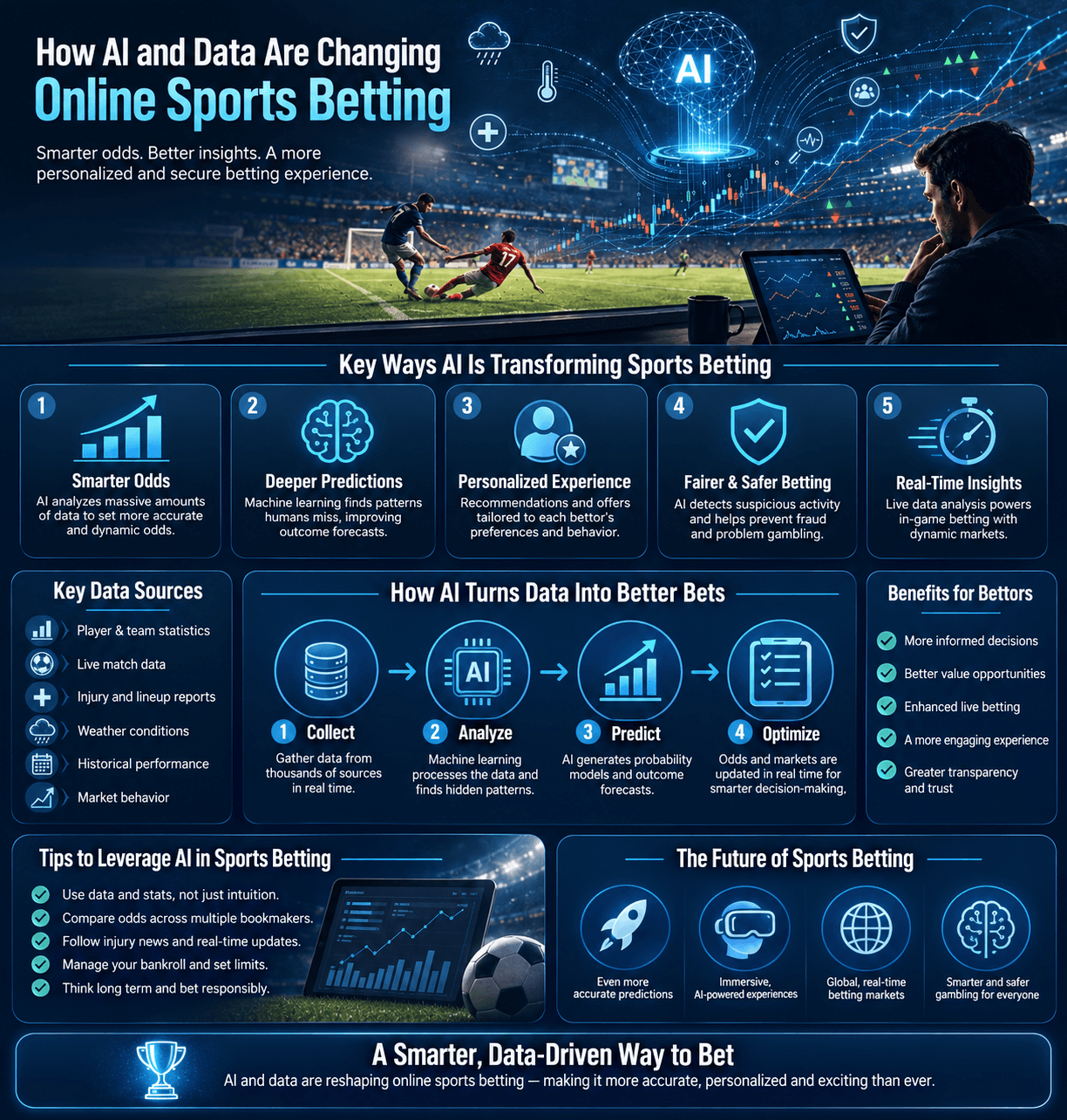
How AI and Data Are Changing Online Sports Betting
Sportsbooks use AI to set and defend odds in real time. Here is what that means for bettors, and what AI tools genuinely cannot do.

Somewhere behind every odds board you see on a sportsbook app, a system is quietly repricing thousands of markets a second, reacting to bet flow, injury reports, and weather updates faster than any human trader ever could. That’s the part of this story most coverage misses. When people talk about “AI in sports betting,” the conversation almost always drifts toward prediction apps and betting bots marketed to individual users. The bigger, more consequential shift has actually happened on the other side of the transaction, inside the sportsbooks themselves, and understanding that difference is the key to understanding what AI can and genuinely cannot do for anyone placing a bet.
This isn’t a story about beating the system. It’s a story about how data changed an entire industry’s operating model, what that means for the odds you see, and what the honest limits are for anyone hoping a tool or algorithm gives them an edge. If you’re trying to understand this space seriously, whether as a bettor, an operator, or just someone curious about where sports and technology are colliding, the details below cover exactly how this shift happened and what it actually changes. Since odds and terms vary meaningfully between operators, and that variation is one of the few places a bettor captures real, measurable value, resources like GlobeWager betting guides are worth bookmarking for comparing platforms directly once you understand what’s actually driving the numbers you’re looking at.
The Sportsbook Side of the Story: Where AI Actually Runs the Show
For most of sports betting’s history, setting odds was a slower, more manual craft. A trading team assessed a matchup, built a line based on statistical models and experience, and adjusted it gradually as money came in. That process has been almost entirely rebuilt around automated systems over the past several years. Publicly traded sportsbook operators now describe this shift plainly in their own regulatory filings. Flutter Entertainment, the parent company of FanDuel, states directly in its most recent annual report that odds compilation and risk management rely on a dedicated risk department using extensive mathematical models and information technology, with formal, board-approved limits on how much exposure the company accepts across sports, events, and bet types. That’s not marketing language. It’s a legal disclosure describing how the business actually operates.
The scale this reaches in practice is significant. Industry reporting on major sportsbook technology providers describes systems managing odds across tens of thousands of events every month, repricing markets in under a second when new information arrives or when bet flow shifts. This matters directly for anyone placing a wager: the odds you’re looking at were very likely generated and are being continuously adjusted by an automated system, not hand-set by a single trader reacting on instinct. When a star player is ruled questionable twenty minutes before kickoff, or when a sudden wave of money hits one side of a line, the system reprices the market in real time, often before a human trader could react at all.
What This Means for the Betting Experience
The shift toward automated, data-driven trading has changed more than just how fast odds move. It’s reshaped the entire product. Personalization is now standard across major platforms, with promotions, odds boosts, and featured markets tailored to individual betting patterns rather than shown identically to every user. Fraud detection and compliance monitoring increasingly run on machine learning models trained to flag unusual account behavior, a genuinely important development for platform integrity, even as it raises its own questions about how much of a user’s betting behavior is being profiled and for what purpose.
In-play betting has grown into the dominant form of engagement on many platforms specifically because live, automated repricing makes it viable at scale. A system that can update a moneyline within a second of a turnover or a red card is what makes constantly-updating, in-game markets possible in the first place. This has pushed the entire industry closer to what looks more like a live entertainment product than the pre-match wagering that defined sports betting for most of the twentieth century, and that shift itself has drawn scrutiny from public health researchers concerned about the pace and intensity of engagement it encourages.
Tools Marketed to Bettors: What They Actually Do
On the other side of this equation sit the AI tools marketed directly to bettors, ranging from prediction apps to chatbot-style assistants that summarize player data and flag statistical trends. These genuinely do something useful. They process far more historical data, injury reports, and situational statistics than any individual could reasonably track by hand, and they remove some of the emotional noise, the hometown bias, the tendency to overweight a recent highlight, that skews casual betting decisions.
What they don’t do, and what a responsible resource on this topic should be honest about, is guarantee an edge against a market that’s now priced and defended by exactly the same category of technology on a vastly larger scale. A detailed breakdown of how AI-assisted betting actually works and where its real limits are makes this point directly: sports outcomes involve human unpredictability, incomplete information, and last-minute variables that no dataset fully captures, and the honest conclusion from serious analysis of this space is that no algorithm can guarantee wins. The bettor-side tools that hold up best under scrutiny are the ones honest about this limitation, positioning themselves as decision-support aids rather than a shortcut to guaranteed profit.
Comparing How AI Shows Up on Each Side of the Transaction
The table below breaks down where AI and data actually operate across the sports betting ecosystem, since the technology’s role looks very different depending on which side of the transaction you’re standing on.
| Application | Who Uses It | Primary Purpose | Real-World Impact |
|---|---|---|---|
| Odds compilation & pricing | Sportsbooks | Set and continuously adjust betting lines | Faster, more precise, harder-to-exploit markets |
| Risk & liability management | Sportsbooks | Control exposure across markets and bet types | More predictable operator profitability |
| Fraud & compliance detection | Sportsbooks | Flag suspicious account or betting patterns | Better platform integrity, regulatory compliance |
| Personalization engines | Sportsbooks | Tailor promotions and content to individual users | Higher engagement, increased scrutiny from regulators |
| Prediction & analytics apps | Bettors | Process historical data and stats faster than manual research | Better-informed decisions, no guaranteed edge |
| Bankroll & stake management tools | Bettors | Calculate optimal stake sizing (e.g. Kelly Criterion) | More disciplined, rational bet sizing |
| Live betting algorithms | Both sides | React to real-time game events | Faster market moves, less time for bettors to react |
The pattern in this table is worth sitting with directly: the sportsbook side of the ledger has more data, more computing resources, and a structural mathematical edge built into every line it sets. That imbalance existed before AI, and sophisticated technology hasn’t closed it. If anything, it’s sharpened it, because both the market-setting side and the bet-placing side are now operating with more precise tools, and the side with more resources and more data almost always benefits more from that precision.
Where This Genuinely Helps a Careful Bettor
None of this means data and AI offer no legitimate value to someone betting recreationally or semi-seriously. Used honestly, the practical benefits are real and worth naming directly rather than dismissing wholesale.
- Faster, broader research. Reviewing player trends, matchup histories, and situational statistics across dozens of games takes minutes instead of hours, freeing up time for actual analysis rather than data collection.
- Reduced emotional decision-making. Structured, data-driven tools help separate genuine analytical edges from the biases that consistently cost casual bettors money: recency bias, loyalty to a favorite team, chasing losses after a bad outcome.
- Bankroll discipline. Tools that calculate stake sizing using formulas like the Kelly Criterion encourage sustainable, proportional betting rather than the impulsive, escalating wagers that tend to accompany emotional decision-making.
- Line shopping efficiency. Aggregators and comparison tools now surface the best available odds across multiple books almost instantly, a genuinely useful, low-risk application of data aggregation. Odds and terms vary meaningfully between operators, and comparing them properly, rather than sticking with a single default sportsbook, is one of the few places a bettor can capture real, measurable value with essentially no downside.
- Pattern recognition at scale. AI can surface subtle statistical trends, a team’s performance against a specific style of opponent, for instance, that would take a human analyst considerably longer to notice manually.
The Regulatory and Ethical Questions This Raises
The same technology that makes betting markets more efficient has drawn real, credible concern from public health and policy researchers, and a genuinely balanced treatment of this topic needs to include that perspective rather than presenting AI-driven betting purely as a technical success story. Dr. Harry Levant, Director of Gambling Policy at the Public Health Advocacy Institute, has argued publicly that AI-driven personalization and algorithmic odds-setting have transformed sports betting into something meaningfully different from the product it used to be, one engineered for engagement and continuous play rather than the more occasional wagering that characterized the industry a decade ago. Multiple U.S. states have introduced legislation directly addressing this, including proposals that would require transparency in AI-driven odds-setting and restrict specific engagement tactics like algorithmically-timed push notifications.
This tension, between an industry becoming more efficient and precise through data, and the genuine public health concerns that same efficiency raises, is likely to define much of the regulatory conversation around sports betting over the next several years. It’s a legitimate, unresolved debate, and any bettor engaging seriously with this space should understand both sides of it rather than only the technology’s marketed benefits.
Practicing Genuinely Responsible Engagement
Given everything above, the most honest advice for anyone betting with the help of AI or data tools is to treat them as exactly what they are: research aids that can improve the quality of a decision, not devices that overcome a market built and defended by more sophisticated systems than any individual tool provides. Setting a fixed budget before betting, treating losses as final rather than something to chase, and using stake-sizing discipline consistently matter more to long-term outcomes than any single predictive edge a tool claims to offer.
If betting ever stops feeling like entertainment and starts feeling compulsive or financially stressful, that’s worth taking seriously and addressing directly rather than working around. The National Council on Problem Gambling operates a confidential, free helpline at 1-800-522-4700, available by call, text, or chat, connecting anyone affected, bettors and their families alike, with local resources and support regardless of where they’re located.
AI Sports Betting: Common Questions
AI tools can meaningfully improve the quality of research by processing far more historical and situational data than a person could manually track, and they can identify statistical patterns that casual analysis might miss. What they cannot do is guarantee accurate predictions, because sports outcomes involve genuine unpredictability, incomplete information such as unreported injuries or last-minute lineup changes, and human factors like motivation and momentum that no dataset fully captures. Serious analysis of AI betting tools consistently concludes that no algorithm can guarantee wins, and tools claiming otherwise should be treated with real skepticism.
Yes, extensively, and this is now disclosed directly in the public regulatory filings of major operators. Modern sportsbooks rely on automated systems combining mathematical models and real-time data to compile and continuously adjust odds across thousands of markets, often repricing lines in under a second in response to new information or shifting bet volume. This represents a significant shift from the more manual, trader-driven odds-setting process that characterized the industry for most of its history.
Not in any guaranteed sense. Sportsbooks operate with significantly more data, computing resources, and a structural mathematical edge built into every line they set, and they use sophisticated automated systems of their own to defend against exploitable pricing gaps. AI tools marketed to individual bettors can improve research quality and decision discipline, which matters for long-term outcomes, but they don’t overcome the house’s inherent structural advantage. Any tool claiming to guarantee an edge against the market deserves significant scrutiny.
Sportsbooks primarily use AI for odds compilation, risk management, fraud detection, and personalization at a scale and speed no individual could replicate, operating with access to aggregate data across their entire user base. Bettors typically use AI-powered tools for research, statistical analysis, and bankroll management, working with a fraction of the data and computing power available to the operator side. This resource and scale imbalance is a central reason why bettor-facing AI tools should be understood as decision aids rather than a path to a reliable, guaranteed advantage.
Yes, and they’re substantive. Public health researchers and policymakers have raised concerns that AI-driven personalization and algorithmic odds-setting have made betting products more engagement-optimized and potentially more prone to encouraging harmful patterns of play. Several U.S. states have introduced or are considering legislation addressing AI transparency in odds-setting and restricting certain engagement tactics. This regulatory conversation is ongoing and unresolved, and it represents a genuine tension between market efficiency and consumer protection that the industry and lawmakers are actively working through.
Set a fixed budget before betting and treat it as a hard limit rather than a suggestion. Use bankroll and stake-sizing tools consistently to avoid impulsive, escalating wagers, particularly after a loss. Treat AI predictions and statistical tools as one input among several rather than a guaranteed signal, and remain skeptical of any tool or service claiming certainty in an inherently uncertain activity. If betting starts to feel compulsive, financially stressful, or difficult to control, the National Council on Problem Gambling’s confidential helpline at 1-800-522-4700 connects individuals and family members with free, local support resources.
Infographic