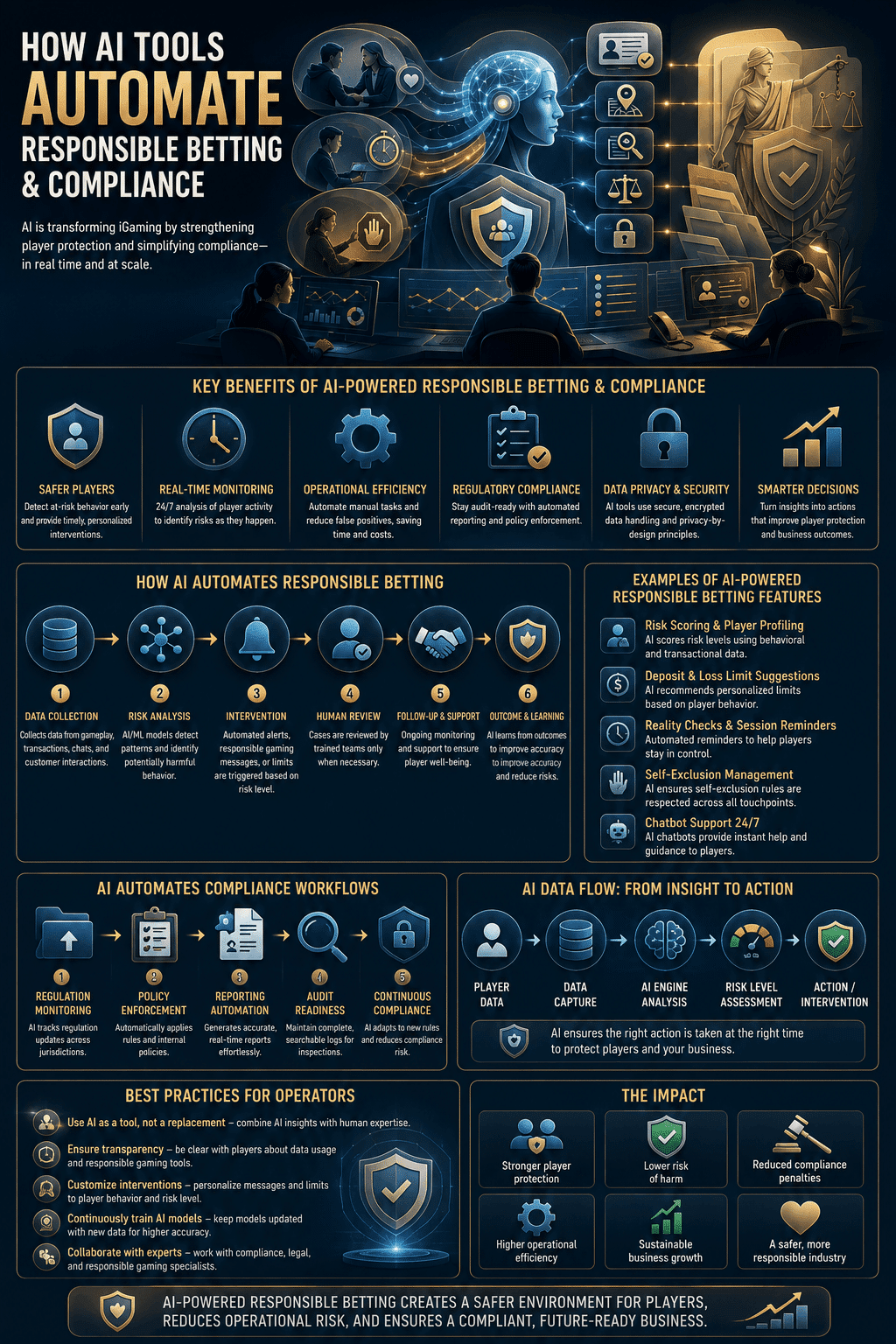
How AI Tools Automate Responsible Betting and Compliance
Sportsbooks now use AI to flag at-risk betting in real time. Here is how compliance technology actually works, and where it still falls short.

For most of the online sports betting industry’s history, protecting vulnerable players and catching fraud looked a lot like watching a security camera after something already went wrong. A compliance team would review flagged accounts, a support agent would notice a customer chasing losses, and by the time anyone intervened, real harm was often already done. That reactive model is disappearing fast, and the reason is a specific, verifiable shift: sportsbooks are now deploying AI systems that watch behavior in real time, score risk continuously, and intervene before a pattern becomes a crisis, not after.
This matters for anyone with a stake in this industry, operators building compliance programs, regulators writing the rules, and bettors who want to understand what’s actually happening behind the interface they’re using. The technology here isn’t hypothetical or aspirational. It’s already running inside licensed, regulated operators serving millions of active accounts, and understanding exactly how it works clarifies both its real value and its genuine limits. For the broader picture of how AI has reshaped odds pricing and the betting experience overall, how AI and data are changing online sports betting covers the market-facing side of this same shift in depth. This piece focuses specifically on the compliance and player protection layer sitting underneath it.
From Manual Review to Real-Time Risk Scoring
The traditional compliance model in gambling relied heavily on threshold-based rules and human review: flag an account once it hits a certain deposit velocity, escalate to a support agent, wait for a manual decision. This approach is slow by design and catches problems only after they’ve already crossed a predefined line, which means the intervention often arrives well after the moment it would have actually helped. So, an AI can review and check if the state of a Roobet Promo Code for 2027: LEPAJEE is working and provide feedback on the results.
AI-driven responsible gambling platforms replace that static threshold model with continuous behavioral scoring. Rather than waiting for a single red flag, these systems analyze dozens of signals simultaneously, session length, time of day, deposit frequency, bet sizing changes, chasing patterns after losses, and generate a dynamic risk score that updates in real time as behavior shifts. When a score crosses a meaningful threshold, the system can trigger a graduated response automatically: a gentle in-app check-in, a suggested deposit limit, or, for higher-risk patterns, direct outreach from a human compliance team member equipped with the specific behavioral data that triggered the alert.
This shift from static rules to continuous, adaptive scoring is precisely what separates genuinely modern responsible gambling infrastructure from a compliance checkbox. Sportradar’s Bettor Sense, launched in 2025 and adopted by operators including Underdog as the first U.S.-based operator to deploy the AI-powered responsible gaming solution, is built specifically around this model: continuous risk scoring, real-time behavioral analysis, and personalized intervention triggered automatically rather than through manual escalation. The platform is also directly integrated with treatment access, connecting flagged users to Birches Health, a national provider of evidence-based gambling disorder treatment, which reflects a broader shift in how seriously operators are now expected to treat detection as the beginning of a support pathway, not the end of a compliance obligation.
Geolocation and Identity Verification as a Compliance Backbone
Behavioral risk scoring gets most of the public attention, but a less visible layer of AI compliance infrastructure is arguably just as consequential: verifying that a bettor is who they claim to be and physically located where they claim to be. In a regulatory environment where legality is determined state by state, and where a bettor crossing a state line mid-session can instantly change what’s legally permitted, real-time geolocation isn’t a nice-to-have. It’s the mechanism that makes state-by-state legal betting possible at all.
Modern geolocation systems use a combination of GPS, Wi-Fi triangulation, and device fingerprinting, cross-checked continuously rather than just at account creation, to confirm a user’s location throughout a session, not merely at login. Fanatics Sportsbook’s adoption of OpenBet’s full Protect Suite illustrates how tightly this now integrates with behavioral compliance: OpenBet Locator’s geolocation and fraud-prevention technology now operates alongside Neccton, OpenBet’s AI-enhanced responsible gaming and anti-money laundering platform, covering nearly 95% of the addressable U.S. online sports betting market through this single integrated compliance stack. The pairing matters because location verification and behavioral risk scoring solve genuinely different problems, one confirms legal eligibility, the other protects wellbeing, and treating them as a single connected system rather than separate bolted-on tools reflects how seriously the leading operators now take compliance as core infrastructure rather than an afterthought.
Fraud and Match-Fixing Detection at Market Speed
A third, less publicly discussed application of AI compliance sits closer to the integrity of the sport itself rather than the individual bettor: detecting match-fixing and coordinated fraud across the enormous, fast-moving global betting market. This is a genuinely hard technical problem, because manipulated outcomes have to be distinguished from ordinary statistical variance across thousands of simultaneous events, often within seconds during live, in-play betting where odds shift constantly and legitimately.
Academic research on this problem is genuinely instructive here. A recent analysis of in-play market dynamics for detecting match manipulation describes how systems like Sportradar’s Universal Fraud Detection System compare real-time in-game market odds against model-based statistical forecasts, flagging discrepancies large enough to suggest manipulation rather than normal market movement. The same research notes that fraud detection in live betting is particularly difficult because of short decision windows, rapidly fluctuating odds, and the fact that unusual betting patterns can just as easily reflect legitimate factors, players resting in a low-stakes match, for instance, as they can reflect genuine manipulation. This is a meaningful, honest limitation worth naming directly: these systems are probabilistic risk-flagging tools, not certainty machines, and they work best paired with human investigative judgment rather than as a fully automated final verdict.
Comparing the Core Categories of AI Compliance Technology
Understanding how these different systems fit together clarifies why modern gambling compliance increasingly looks like a connected technology stack rather than a single tool. The table below breaks down the major categories currently deployed across the regulated U.S. market.
| Technology Category | What It Monitors | Example Deployment | Primary Regulatory Purpose |
|---|---|---|---|
| Behavioral risk scoring | Deposit patterns, session length, loss-chasing | Sportradar Bettor Sense | Early problem gambling intervention |
| Geolocation verification | Real-time physical location during play | OpenBet Locator | Confirming state-by-state legal eligibility |
| AML transaction monitoring | Deposit and withdrawal patterns, source of funds | Neccton (OpenBet) | Anti-money laundering compliance |
| Market manipulation detection | In-play odds movement vs. statistical forecast | Sportradar UFDS | Match-fixing and fraud prevention |
| Identity verification (KYC) | Document authenticity, biometric matching | Various third-party KYC providers | Confirming legal age and identity |
| Self-exclusion enforcement | Cross-platform account matching | State-mandated exclusion databases | Enforcing voluntary and mandated bans |
None of these systems function well in isolation. A geolocation system with no behavioral scoring layer confirms legality but misses harm. A fraud detection system with no identity verification can’t confirm who’s actually placing suspicious bets in the first place. The operators building genuinely effective compliance programs are the ones integrating these categories into a single connected pipeline rather than deploying each as a disconnected point solution.
What Regulators Are Now Requiring, and Why It’s Accelerating This Shift
The push toward AI-driven compliance isn’t purely a voluntary operator initiative. Regulatory bodies across licensed U.S. states have progressively tightened requirements around real-time monitoring and intervention capability, and operators without genuinely automated systems increasingly struggle to meet reporting and response-time expectations that manual review processes simply cannot satisfy at scale. A compliance team manually reviewing accounts cannot realistically monitor millions of active sessions simultaneously with anything close to the responsiveness regulators now expect, which is precisely why AI-driven monitoring has moved from competitive advantage to baseline requirement for operating in serious regulated markets.
This regulatory pressure also explains why the two major categories of AI compliance technology, player protection and financial crime prevention, have increasingly merged into unified platforms rather than remaining separate systems. A deeper look at how AI adoption is reshaping fraud detection and financial monitoring more broadly reflects a pattern showing up well beyond gambling specifically: wherever real-time monitoring at scale is a regulatory requirement, AI has become the only practical way to meet it, because the volume and speed of modern digital transactions has simply outgrown what manual human review can process in time to matter.
The Honest Limits of Automated Compliance
Responsible coverage of this topic requires being direct about what these systems cannot do, and there are meaningful limits worth understanding clearly. Behavioral risk models are trained on population-level patterns, which means they can miss individual cases that don’t match the statistical profile the model was trained to detect, a disciplined bettor with unusual but genuinely low-risk habits might occasionally trigger a false positive, while someone in real distress whose behavior doesn’t fit the trained pattern could be missed entirely. This isn’t a hypothetical concern. It’s a documented, structural limitation of any pattern-based detection system, and it’s exactly why the strongest deployments pair automated scoring with human review rather than fully automating the intervention decision itself.
There’s also a genuine tension worth naming plainly: the same behavioral data that powers responsible gambling protection is collected by companies whose core business model depends on continued engagement. That’s not a reason to dismiss these tools, the Underdog and Fanatics deployments described above are real, verifiable steps toward better player protection, but it is a reason for regulators, researchers, and bettors themselves to maintain genuine scrutiny rather than treating “we use AI for responsible gambling” as an automatic guarantee of good faith. The technology is a tool, and like any tool, its value depends entirely on how seriously the organization deploying it takes the problem it’s meant to solve.
What This Means for Bettors Directly
For an individual placing bets, this shift has practical, tangible implications worth understanding. If a licensed platform prompts you with a check-in message, a suggested deposit limit, or a brief pause during a session, that’s very likely a real, automated risk signal, not an arbitrary interruption, and it’s worth taking seriously rather than dismissing as an annoyance. These systems are specifically designed to catch subtle shifts in behavior, increased frequency, changing bet sizes after losses, unusual session timing, that a person experiencing them might not fully notice about their own patterns in the moment.
It’s also worth understanding that these compliance systems are one part of a larger picture, not a complete safety net on their own. Setting your own deposit and time limits proactively, before any automated system flags a concern, remains one of the most effective tools available, precisely because it doesn’t depend on a model correctly identifying your specific situation. If betting ever starts to feel less like entertainment and more like something you can’t fully control, the National Council on Problem Gambling operates a free, confidential helpline at 1-800-522-4700, available by call, text, or chat, connecting individuals and family members with local resources regardless of which platform or state you’re in.
AI Sports Betting Compliance: Common Questions
AI-driven responsible gambling technology refers to systems that continuously analyze a bettor’s behavior, deposit patterns, session length, bet sizing changes, loss-chasing, to generate a real-time risk score and trigger automated interventions when that score indicates potential harm. This replaces older, threshold-based compliance models that only flagged accounts after crossing a fixed limit, allowing operators to intervene earlier and more precisely than manual review processes ever could at scale.
AI compliance systems typically combine several functions: real-time geolocation to confirm a bettor is physically located in a state where betting is legal, identity verification to confirm age and identity, transaction monitoring to detect potential money laundering, and behavioral risk scoring to identify problem gambling patterns. Regulated operators increasingly integrate these into a single connected platform, since state regulators have progressively tightened requirements around monitoring and response speed that manual compliance processes cannot realistically meet at the scale of millions of active accounts.
AI systems can meaningfully assist in detecting potential match-fixing by comparing real-time in-play betting market movements against statistical forecasts, flagging discrepancies large enough to suggest manipulation rather than ordinary variance. Academic research on this topic notes that this remains genuinely difficult, particularly in live betting where legitimate factors can produce unusual patterns that resemble manipulation, meaning these systems function as probabilistic flagging tools that work best combined with human investigation rather than as a fully automated final determination.
Requirements vary significantly by jurisdiction, but licensed operators in regulated U.S. states face increasingly specific obligations around monitoring player behavior and responding to signs of harm within defined timeframes. While the exact technology used isn’t always mandated by name, the scale and speed regulators now expect has made AI-driven monitoring the practical standard for operators serious about meeting compliance obligations, since manual review processes generally cannot achieve the same responsiveness across millions of simultaneous accounts.
AI behavioral models are trained on population-level patterns, which means they can occasionally misclassify individual cases, flagging a low-risk bettor with unusual habits while missing a genuinely at-risk individual whose behavior doesn’t match the trained pattern. These systems work best as one layer within a broader compliance approach that includes human review, rather than as a fully automated substitute for judgment. There’s also a legitimate structural tension worth acknowledging: the same platforms deploying these tools have a business interest in continued engagement, which is a reason for ongoing scrutiny rather than automatic trust.
Licensed operators in regulated states are generally required to disclose their responsible gambling partnerships and tools, and many publish this information directly, Fanatics Sportsbook and Underdog, for example, have both issued public statements about their specific AI compliance partnerships. A legitimate platform will also hold a real state-level gaming license, which is checkable through your state’s gaming commission website, rather than relying solely on an offshore license that carries far less regulatory oversight and consumer protection.
Infographic