A Complete Guide to ERP Systems for Growing Companies
ERP implementation runs $150K to $750K for mid-market companies and takes 3 to 9 months. Here’s what actually drives that number, and the risk.

As businesses expand, managing finances and operations becomes increasingly complex, and disconnected systems can quickly create inefficiencies. Data inconsistencies, manual processes, and slow reporting often limit visibility and make it harder for growing companies to make timely, confident decisions. In this article, we’ll share a complete guide to ERP (Enterprise Resource Planning) systems for growing companies.
This is where ERP systems become essential. By integrating financial and operational processes into one platform, ERP improves data accuracy, boosts efficiency, and gives growing companies real-time insights to support smarter decisions as they scale.
Understanding ERP Systems and Their Role in Business Growth
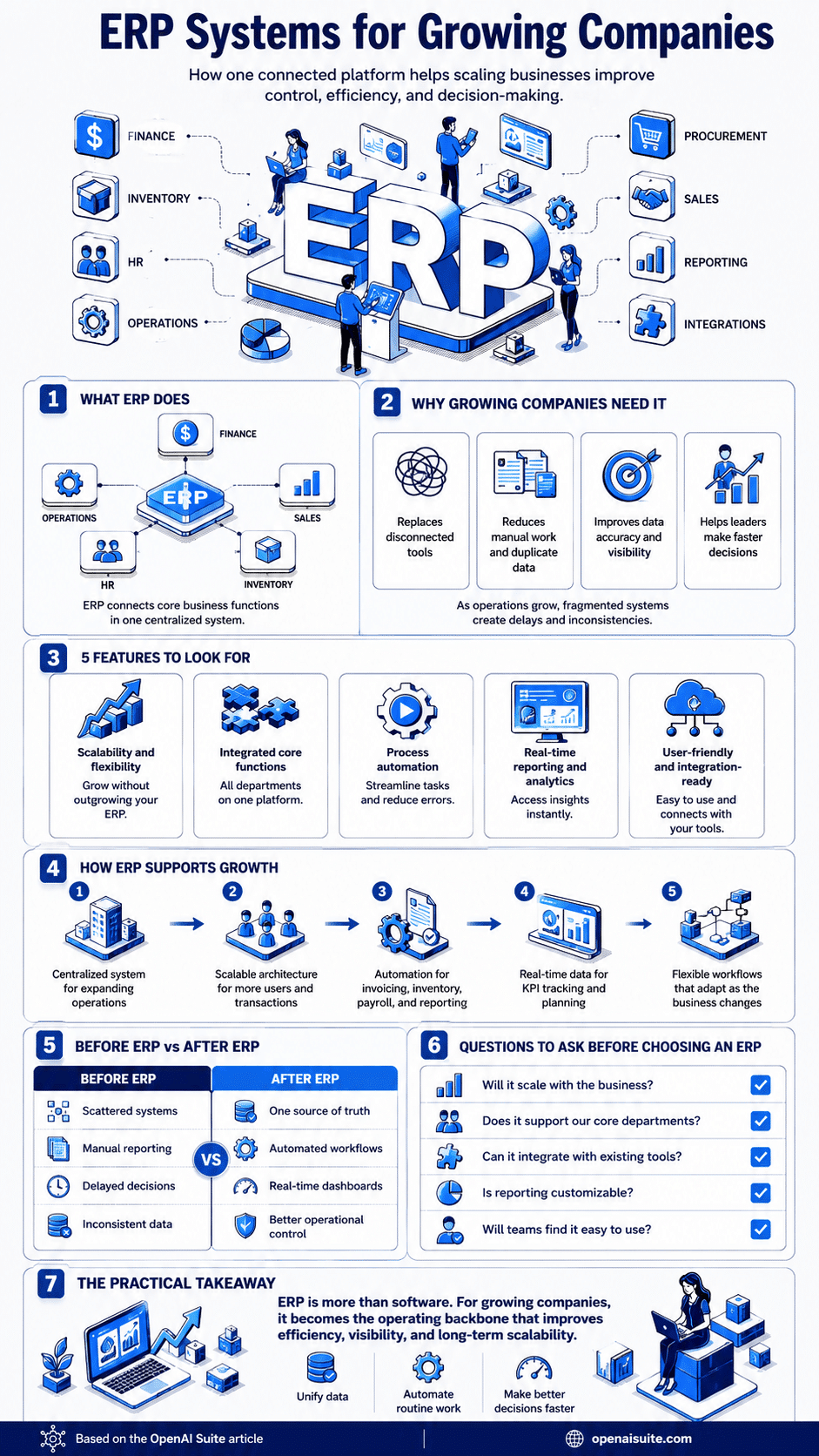
Enterprise Resource Planning (ERP) systems are integrated platforms that connect core business functions such as finance, operations, inventory, human resources, and sales into a single, centralized system. By unifying data and processes, ERP helps organizations reduce manual work and maintain consistency across departments.
For growing businesses, ERP plays a critical role in supporting scalability and operational control. An ERP system provides real-time visibility into business performance, enabling management to monitor operations, allocate resources more effectively, and respond quickly to changes.
What ERP implementation actually costs and how long it takes
This is the single most important information missing from a guide aimed at growing companies making this decision, so it’s worth addressing directly with real numbers rather than vague reassurance.
For a small business, ERP implementation, including software, services, and training, typically runs $10,000 to $150,000. For a mid-market company, the more common range for growing businesses reading this guide, total year-one investment typically falls between $150,000 and $750,000, according to benchmark research from Panorama Consulting Group, an independent ERP research and advisory firm. Enterprise deployments routinely exceed $1,000,000. Software licensing itself is usually only 20 to 30 percent of the total first-year cost, the majority goes to implementation services: data migration, system integrations, customization, and training.
On timeline, small and midsize businesses typically complete implementation within three to nine months, while larger, more complex deployments commonly run six to eighteen months or longer. It’s worth planning around the higher end of these ranges rather than the lower end: research consistently finds that 50 to 75 percent of ERP projects exceed their original budget, most commonly due to underestimated staffing needs, expanding project scope after the project starts, and data quality issues discovered during migration, not because the software itself was the wrong choice. Planning ERP investment as part of a broader technology roadmap, rather than an isolated purchase, connects directly to how growing companies are structuring their broader technology stack as they scale.
Key Features Growing Companies Should Look for in an ERP System
As companies scale, operational complexity increases and scattered systems can slow growth. Choosing the right ERP for growing businesses starts with matching the platform to company size rather than evaluating features in isolation.
For small to mid-market companies, NetSuite, Acumatica, and Microsoft Dynamics 365 Business Central are among the most commonly deployed cloud ERP platforms, each offering pre-built industry templates that reduce implementation complexity compared to heavily customized legacy alternatives. For larger enterprises with more complex, multi-entity, or global operations, SAP S/4HANA and Oracle Fusion Cloud remain the dominant options, though they typically involve substantially longer implementation timelines and higher cost. Getting detailed quotes from at least three vendors, and comparing total implementation cost rather than just the software subscription price, is standard practice for good reason, given how much of the total cost sits in services rather than licensing.
Below are the key features to prioritize when evaluating any of these platforms for your specific situation:
- Scalability and flexibility: The ERP should grow with the business, supporting more users, transactions, and changing workflows without sacrificing performance or requiring a system overhaul.
- Integrated core business function: A reliable ERP connects finance, sales, inventory, procurement, and HR in one system, and ensures consistent, real-time information across departments.
- Process automation for efficiency: Automating routine tasks like invoicing, inventory updates, and reporting reduces manual work, minimizes errors, and allows teams to focus on strategic activities.
- Real-time reporting and analytics: Access to real-time dashboards and customizable reports helps management monitor KPIs, identify trends, and make faster, data-driven decisions.
- User-friendly and integration-ready: An intuitive interface improves user adoption, while strong integration capabilities ensure smooth data flow with existing tools such as e-commerce platforms or banking systems.
Cloud versus on-premise: a decision that affects cost more than most buyers expect
Beyond choosing a platform, the deployment model itself has a significant impact on total cost of ownership, and it’s worth deciding deliberately rather than defaulting to whatever a vendor proposes first.
Cloud ERP, delivered as a subscription with vendor-managed infrastructure and maintenance, generally carries lower upfront cost and, over a five-year period, commonly delivers 30 to 50 percent lower total cost of ownership for mid-market organizations compared to on-premise deployment, largely because it eliminates hardware investment and dedicated internal IT maintenance staffing. On-premise ERP requires a larger upfront perpetual license fee and ongoing internal resources to maintain it, but some companies still choose it for specific data residency, security, or regulatory requirements that a cloud deployment can’t fully satisfy. Cloud ERP adoption has grown substantially in recent years precisely because the cost and maintenance advantages outweigh these concerns for most growing companies, but it’s worth confirming directly whether your specific industry has compliance requirements that make on-premise the better fit before assuming cloud is automatically right, the same infrastructure-decision logic covered in how AI-driven operations are reshaping broader IT infrastructure decisions.
How ERP Systems Support Scalability and Long-Term Efficiency
As business operations become more complex over time, managing growth with fragmented tools can limit efficiency and visibility. To sustain expansion and maintain control, companies need a system that can adapt, integrate, and scale seamlessly.
Centralized system for expanding operations
An ERP system brings all core business functions into a single integrated platform. As the business expands by adding new departments or branches, this centralized structure ensures all data remains connected and consistent. Instead of managing multiple disconnected systems, companies can maintain full visibility and control.
Scalable architecture that grows with the business
ERP systems are designed to scale as businesses grow, allowing more users and higher transaction volumes without disrupting operations. This flexibility ensures consistent performance and makes the ERP a long-term solution that adapts to changing business needs.
Process automation to handle higher workloads
As businesses grow, ERP systems automate routine tasks like invoicing, inventory updates, payroll, and reporting. This reduces manual work and errors, helping teams handle higher workloads efficiently while focusing on strategic growth activities.
Real-time data for better control and planning
With all data stored and updated in real time, ERP systems provide management with accurate and up-to-date insights into business performance. Leaders can monitor key metrics, track operational trends, and identify issues early before they escalate.
Flexible workflows for long-term adaptability
Business processes rarely stay the same as a company evolves. ERP systems offer configurable workflows that can be adjusted to support new approval structures, operational methods, or organizational changes. This flexibility allows companies to adapt quickly to market demands or internal growth without major system disruptions.
Conclusion
In summary, ERP systems play a vital role in helping growing businesses manage increasing complexity while maintaining efficiency and control. By integrating core functions into a centralized platform, ERP enables better visibility and more informed decision-making, all of which are essential for supporting sustainable business growth.
More than just an operational tool, an ERP system also provides a long-term foundation for scalability and adaptability. With features such as automation, real-time insights, and flexible workflows, ERP empowers companies to respond to change, optimize resources, and build long-term efficiency.
ERP systems FAQ
For a mid-market company, total year-one investment, including software, implementation services, data migration, and training, typically ranges from $150,000 to $750,000, according to Panorama Consulting Group’s benchmark research. Small businesses can expect $10,000 to $150,000. Software licensing is usually only 20 to 30 percent of the total; the majority of the cost is implementation services.
Small and midsize businesses typically complete implementation within three to nine months. Larger or more complex deployments commonly run six to eighteen months or longer. Planning around the longer end of the applicable range, rather than the shortest possible estimate, is the more realistic approach given how often projects run past their original timeline.
Research consistently finds that 50 to 75 percent of ERP projects exceed their original budget. The most common causes are underestimated project staffing, scope expansion after the project begins, and data quality or migration issues discovered during the process, not the underlying choice of software.
For most growing companies, yes, cloud ERP typically delivers 30 to 50 percent lower total cost of ownership over five years due to eliminated hardware costs and vendor-managed maintenance. On-premise remains the right choice for organizations with specific data residency, security, or regulatory requirements that cloud deployment can’t fully satisfy, which is worth confirming directly for your industry before defaulting to either option.
Infographic