Island Hopping by Boat: How to Plan Your Route, Pace, and Safety
Ferry or charter, best seasons, how many islands fit in a week, and how to plan an island-hopping route with AI without trusting it blindly.
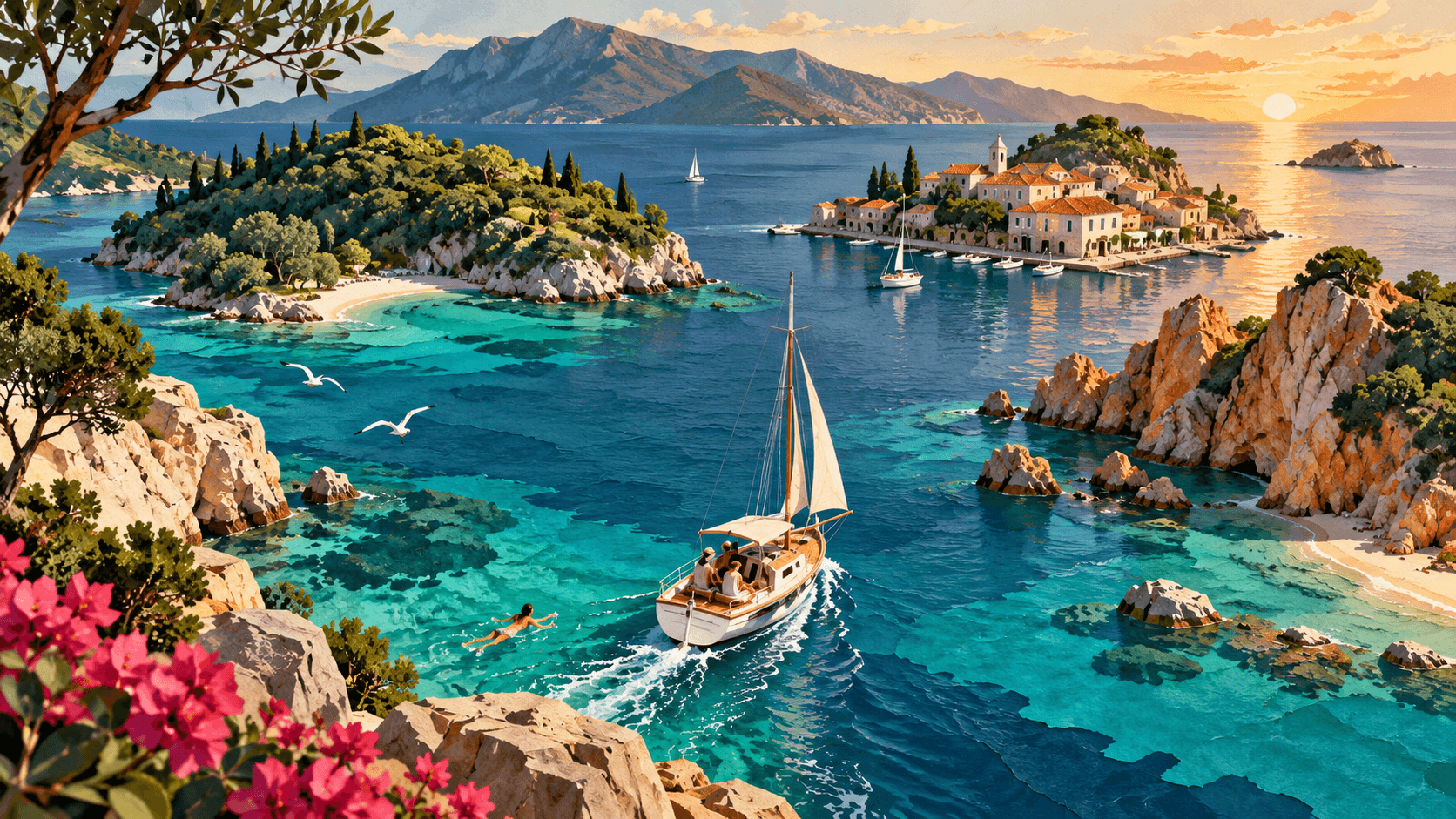
Island hopping by boat is one of the few ways to travel where the journey between places is as good as the places themselves. In a single week you can wake up on three or four different islands, each with its own harbor, food, and rhythm, while the open water in between becomes part of the trip instead of dead time spent in transit.
That freedom depends on planning most travel content skips. Ferries run on seasonal timetables, wind can close a crossing for a day, and a tired outboard can leave you stuck in a cove with no chandlery for miles. This guide covers both sides of boat-based journeys: what makes them special, and how to plan them so they stay that way, from choosing between a ferry and a charter and understanding the real costs to pacing your island-hopping itinerary, using AI to draft a route, and the safety habits experienced boaters never skip.
Table of contents
- Island Hopping by Boat at a Glance
- What Island Hopping by Boat Really Means
- Ferry, Day Boat, or Charter: How to Choose
- What Island Hopping by Boat Costs
- Best Places for Island Hopping by Boat, and When to Go
- How Many Islands Can You Visit in a Week?
- Planning an Island-Hopping Route with AI
- Getting the Boat Ready: Spares, Fuel, and Power
- Safety Basics Every Island Hopper Should Know
- What to Pack and How to Stay Connected Between Islands
- Life on the Move: Harbors, Local Culture, and Nature
- Seasickness, Skipper Licenses, Costs, and Other Island-Hopping Questions
- Your First Island-Hopping Trip Starts with a Short Route
- How This Guide Was Researched
Island Hopping by Boat at a Glance
- Ferry or charter: ferries are usually cheapest for one or two travelers, while a skippered charter often makes sense for groups of four to eight because the boat is also your accommodation.
- Pace: plan about three islands per week by ferry, or five to seven stops by charter, plus one spare day for weather.
- Season: timing matters as much as place. Avoid the July and August meltemi peak in the Greek Cyclades and the June to November hurricane season in the Caribbean.
- AI planning: use AI to draft routes and checklists, then confirm ferry timetables, crossing times, and weather with operators and official forecasts.
- Safety: leave a float plan with someone ashore, check the forecast twice a day, and carry spares matched to your engine.
What Island Hopping by Boat Really Means
Island hopping by boat means visiting several islands in one trip and moving between them by water, whether on public ferries, day-trip boats, or a chartered yacht where you sleep aboard. The term covers everything from a budget ferry route through the Greek Cyclades to a week-long sailing charter in the British Virgin Islands.
What sets it apart from other travel is the arrival. Approaching an island by sea is gradual: the outline sharpens, landmarks appear, and you can read the place, its harbor, its beaches, the way the town faces the water, before you step ashore. Boat travelers tend to settle in first, with a swim at anchor or a walk along the quay, and let the island introduce itself on its own terms.
The second difference is variety without distance. Within one region, islands a few miles apart can differ sharply in language, food, architecture, and mood. A quiet nature island may sit an hour from a lively cultural hub, and on a charter your accommodation travels with you, so you see both without packing and unpacking every day.
Ferry, Day Boat, or Charter: How to Choose
The ferry vs charter question is the single biggest decision in any island-hopping trip. It sets your budget, your flexibility, and how much boating skill you need. Here is how the main options compare.
| Option | Best for | Flexibility | Skills needed | Relative cost | Watch out for |
|---|---|---|---|---|---|
| Public ferries | Solo travelers, couples, tight budgets | Low, fixed timetables | None | $ | Seasonal schedules, cancellations in strong wind, early port check-in |
| Day-trip boats and tours | Staying on one island and seeing several nearby | Low to medium | None | $ to $$ | Crowded boats, short stops at each island |
| Skippered charter | Groups and families without boating experience | High, the skipper adapts to the weather | None, a professional skipper is aboard | $$$ split across the group | Skipper fee, provisioning, cabin space |
| Bareboat charter | Experienced sailors and powerboaters | Highest | Recognized skipper certificate, often a VHF radio license | $$ to $$$ split across the group | Security deposit, you make every weather and docking call |
| Crewed yacht or gulet | Groups who want hotel-level comfort at sea | Medium to high | None | $$$$ | Price, and a crew routine you fit into |
For couples and solo travelers, ferries are usually the cheapest way to cover several islands, and in places like Greece and Croatia the network is dense enough to build a whole trip around it. For groups of four to eight, a skippered charter can come close to the per-person cost of ferry tickets plus hotel rooms once accommodation is counted, and it buys the freedom to change plans when the wind does. A bareboat charter gives you the most freedom of all, but only if someone aboard genuinely has the skills to handle docking, anchoring, and weather decisions.
What Island Hopping by Boat Costs
Prices swing widely by region, season, and boat size, so instead of quoting numbers that will be out of date by next summer, here is what you actually pay for and how to compare the options fairly.
- Ferries: priced per person and per leg. Fast catamarans usually cost more than slower conventional ferries, and cars, cabins, and reserved seats are extra. Popular high-season sailings can sell out, so book the key legs early.
- Day-trip boats and tours: usually a per-person price that may include lunch and snorkel gear. Some islands and marine parks add environmental or entry fees on top.
- Charters: the weekly boat rate is only the start. Add the skipper’s daily fee and meals if you hire one, fuel, marina and mooring fees, any local tourist tax, end-of-charter cleaning, and a refundable security deposit or damage waiver.
- Hidden extras: transfers between airport and port, an unplanned hotel night when a crossing is cancelled, luggage storage, and travel insurance.
To compare fairly, work out the cost per person per night with accommodation included. A ferry trip looks cheap until you add a hotel on every island, and a charter looks expensive until you remember the boat is also your hotel. Whichever wins, the flight to your first island is usually the largest single fixed cost, and fare alerts and flexible-date search are where AI booking tools cut travel costs most reliably, so set them up as soon as your dates are roughly known.
Best Places for Island Hopping by Boat, and When to Go
Island hopping works best where islands sit close together, sheltered water links them, and there is enough infrastructure (ferries, marinas, mooring buoys) to move without drama. Season matters as much as place: the same route can be a gentle cruise in June and a hard, bumpy slog in August.
| Region | How people usually hop | Typical best months | Weather to watch |
|---|---|---|---|
| Greek Cyclades | Ferries from Piraeus and Rafina, sailing charters | May to June, September to October | The meltemi, a strong north wind that peaks in July and August and can disrupt ferries |
| Greek Ionian Islands | Sailing charters with short hops | May to October | Lighter, more predictable winds than the Aegean, which makes it popular for first charters |
| Croatia’s Dalmatian coast | Jadrolinija ferries and catamarans, charters from Split | May to September, with June and September calmer | The bora, a sudden northeasterly wind, plus summer thunderstorms |
| British Virgin Islands | Bareboat and skippered charters, short line-of-sight hops | December to May | Atlantic hurricane season, June 1 to November 30 |
| Thailand’s Andaman coast | Ferries and speedboats linking Phuket, Krabi, Koh Phi Phi, and Koh Lanta | November to April | The southwest monsoon, May to October, brings rougher seas and fewer routes |
| Palawan, Philippines | Day-tour boats from El Nido and Coron, fast ferries between them | December to May | Typhoon season, roughly June to November |
| Brazil’s Costa Verde (Angra dos Reis, Ilha Grande, Paraty) | Schooner day trips, water taxis, ferries and fast boats to Ilha Grande | May to September is usually drier | Summer heat, afternoon storms, and holiday crowds from December to March |
| Hawaii | Short flights between islands, boats for day trips | Year-round | Only one regular passenger ferry route, Maui to Lanai |
Treat the months in the table as typical patterns, not guarantees. In the Caribbean, NOAA defines the Atlantic hurricane season as running from the first day of June through the last day of November, so a charter outside those months carries far less storm risk. Wherever you go, check current conditions and timetables for your exact dates before you book anything non-refundable.
A Note on Hawaii
Hawaii surprises a lot of first-time planners. Since the Hawaii Superferry stopped running in 2009, the only regular passenger ferry links Maui and Lanai, so moving between Oahu, Maui, Kauai, and the Big Island means short flights. Boats come into their own for day trips instead, from snorkel cruises to shark diving off Oahu’s North Shore, so plan Hawaii as a fly-and-explore trip with boat days built in.
How Many Islands Can You Visit in a Week?
Fewer than you think, if you want to enjoy them. Every move between islands costs more time than the crossing itself: packing, getting to the port, check-in, waiting, and settling in again at the other end. On ferries, a single move usually eats half a day.
- By ferry: three islands in seven days feels relaxed, four is busy, and five means you spend more time in ports than on beaches.
- By charter: you can call at five to seven harbors or anchorages in a week because you are not packing, but keep most legs to two to four hours so your afternoons stay free.
- Either way: keep one spare day in reserve for every week of travel. Wind and swell will eventually close a crossing, and a spare day turns a cancellation into a lazy beach day instead of a missed flight.
A comfortable charter week follows the same shape almost everywhere: a short first leg to get used to the boat, a longer passage early in the week while energy is high, at least one full day without moving, and a final night close to the return marina so a bad forecast cannot trap you on the wrong side of a channel.
A Sample Week: The Split Island Loop
Croatia’s central Dalmatian islands show that shape in practice. This is a classic first charter loop from Split, and it keeps every stop within easy reach of the base marina.
- Day 1: Split to Šolta, a short first leg to learn the boat.
- Day 2: Šolta to Vis, the longest crossing of the week, ideally in the morning before the afternoon breeze builds.
- Day 3: stay on Vis, explore Komiža, or take a tour boat to the Blue Cave on nearby Biševo.
- Day 4: Vis to the Pakleni Islands, just off Hvar.
- Day 5: Hvar, as a rest day or your spare weather day.
- Day 6: Hvar to Brač, anchoring near Milna or Bol.
- Day 7: Brač back to Split, close to the marina for check-out.
By ferry, trim the same region to two or three islands. Some island pairs have no direct connection, so you may need to route back through Split between them, which is exactly the kind of detail to confirm with the operator before you book.
Planning an Island-Hopping Route with AI
Whether you use ChatGPT, Claude, Gemini, or a dedicated AI trip planner, AI is genuinely useful for the messy first stage of planning: turning a vague idea into concrete route options, comparing trade-offs, and building checklists. It is much less reliable on the details that actually strand travelers, such as current ferry timetables, which operators still run a route, and how long a crossing takes in real conditions.
A Prompt That Gets a Usable First Draft
Give the assistant constraints, not just a destination. The rule behind any good prompt applies here, and our guide on how to write the perfect ChatGPT prompt explains why clear limits produce more useful answers. For a trip, it looks like this:
I have 7 days in the Dalmatian islands of Croatia in early June, traveling with 4 adults, two of whom get seasick. Suggest 3 island-hopping routes starting and ending in Split, with no single crossing longer than 3 hours, one full rest day, and one spare weather day. For each route, list which legs depend on a ferry or catamaran that may run less often at that time of year, and what I must confirm directly with the operator.
That prompt forces the answer to respect your real limits and, just as important, makes the assistant tell you what it does not know.
What to Verify Before You Book
- Ferry timetables and operators: check the operator’s own website or the port authority for your exact dates.
- Crossing times and distances: measure them in nautical miles on a chart or navigation app instead of trusting a chatbot estimate.
- Weather: use an official marine forecast or a dedicated marine weather service. Never treat an AI chat answer as a forecast.
- Local rules: marine park fees, anchoring restrictions, and mooring buoy bookings change by island and by season.
Before you lean on one assistant for the whole trip, run a quick test: ask it for the ferry timetable on a route you already know, then compare the answer with the operator’s site. Our guide on how to evaluate an AI assistant shows how to spot confident answers that fall apart when you check them.
Getting the Boat Ready: Spares, Fuel, and Power
Island hopping feels effortless when it is done well, but that ease rests on preparation nobody sees. Frequent short passages mean more engine starts, more anchoring, and more docking than a typical cruise, so equipment that is merely okay at home gets tested hard.
On a charter, the company maintains the boat, but it is still worth checking a few things at handover: engine oil and coolant levels, the bilge pump, the anchor windlass, the condition of the tender and its outboard, and which spares and tools are actually aboard. Photograph any existing damage before you leave the dock.
If you run your own boat, carry a spares kit matched to your exact engine rather than generic parts. Outboards tend to fail in predictable places: the water pump impeller, fuel filters, spark plugs, and propeller hardware. If your boat or tender runs an outboard from Selva, the Italian maker whose range starts with small tender motors, order Marine Parts Selva before departure instead of counting on a small island chandlery to stock parts for your brand. Pack the engine manual too, because the right part number saves a wasted trip ashore.
- Fuel: follow the rule of thirds, one third to get there, one third to get back, and one third in reserve.
- Water and diesel: top up whenever you can, not when you must. Small island fuel docks can have short hours or long queues in peak season.
- Power: find out how the boat charges its batteries at anchor (engine, solar, or shore power) and plan phone, fridge, and navigation use around it.
Safety Basics Every Island Hopper Should Know
Most island-hopping trips are calm and uneventful, and a handful of habits keep them that way. None of them require advanced seamanship.
- Leave a float plan. Tell someone ashore your route, your boat, who is aboard, and when you expect to arrive. The U.S. Coast Guard recommends a float plan for every kind of boat, from a kayak to a large cruiser, because it gives rescuers the details they need if you are overdue.
- Read the forecast twice a day. Decide before you leave harbor what wind and sea state would make you stay put, and stick to it.
- Wear life jackets on the tender, especially after dark. Short dinghy rides back from dinner are a classic source of accidents.
- Know VHF channel 16, the international distress and calling channel, and make sure at least two people aboard can use the radio.
- Check that the anchor has set, by snorkeling over it or watching your position, and run an anchor alarm app overnight.
- Anchor on sand, not seagrass or coral. In parts of the Mediterranean, anchoring on protected Posidonia seagrass is restricted or banned, so look for sand patches or mooring buoys.
What to Pack and How to Stay Connected Between Islands
Storage on a boat is tight and ferries reward light travelers, so pack for movement rather than for a hotel wardrobe.
- A soft duffel bag instead of a hard suitcase, which is hard to stow aboard
- Reef-safe sunscreen, a hat, and polarized sunglasses with a strap
- A motion sickness remedy you have tested before the trip
- A dry bag and a waterproof phone pouch
- A warm layer and a windproof jacket for evening crossings
- Water shoes for rocky beaches and slippery docks
- A headlamp, a power bank, and a 12V or USB charger
- Cash in small notes, since card readers on small islands can be unreliable
- Offline or printed copies of bookings and charter documents
Mobile coverage is usually good in harbors and patchy in the channels between them. Download offline maps, charts, and the day’s forecast before you cast off, and consider a regional eSIM so you are not hunting for Wi-Fi to confirm a ferry. If you rely on AI apps for translation or planning on the go, it helps to understand why mobile connectivity still matters for AI tools and how to set up offline fallbacks before you need them.
Life on the Move: Harbors, Local Culture, and Nature
Once the logistics are settled, life during island hopping finds a comfortable rhythm. Mornings often start with a swim and breakfast on deck, a few hours on the water bring you to the next island, and afternoons go to exploring, a long lunch, or simply resting at anchor. Evenings bring calmer water and shared meals.
Harbors are where you meet the islands. They are working spaces where fishers, traders, ferry crews, and travelers cross paths, and because boat travelers tend to stay longer and move more slowly, conversations go further than a quick tourist exchange. A tip on a better anchorage, a recommendation for a family taverna, bread from a bakery that opens at dawn: those small moments often become the most memorable part of the trip. Where language is a barrier, a translation app goes a long way, and our roundup of AI travel tools for translation and navigation covers the ones worth installing before you leave.
Nature is never far away either. Clear water, reefs, and coastal wildlife become part of daily life rather than a booked excursion, and that closeness tends to make travelers more careful. Spend your money with local businesses, keep noise down in quiet anchorages, use pump-out stations instead of discharging near shore, take your trash with you, and never stand on or touch coral.
Not everything goes to plan. Weather shifts, supplies run short, and unfamiliar harbors test your patience. Yet solving those problems together, finding a sheltered cove when the wind turns or nailing a smooth crossing, is part of what makes the trip feel earned.
Seasickness, Skipper Licenses, Costs, and Other Island-Hopping Questions
Yes, if you match the format to your experience. Ferries and day-trip boats need no boating skills at all, and a skippered charter lets complete beginners live aboard while a professional handles navigation and docking. Bareboat charters, where you are the skipper, are only for people with real sailing or powerboat experience.
Only for a bareboat charter. Charter companies, and many Mediterranean countries, usually require the skipper to hold a recognized certificate such as the International Certificate of Competence (ICC) or an equivalent national license, and often a VHF radio license. Guests on skippered and crewed charters need no license. Requirements vary by country and company, so confirm them when you book.
Take any motion sickness remedy before departure, not once you already feel ill. Stay on deck in fresh air, sit near the middle of the boat where movement is smallest, and keep your eyes on the horizon. Eat light, skip alcohol the night before a long crossing, and plan shorter legs early in the trip while your body adjusts.
It depends on the region, the season, and how you travel. Ferries are priced per person and per leg and are usually cheapest for one or two travelers. Charters combine a weekly boat rate with extras such as a skipper, fuel, marina fees, and a security deposit, and they can be competitive for groups of four or more because the boat is also your accommodation. Compare options by cost per person per night, including where you sleep.
Yes, for drafting route options, comparing trade-offs, and building packing lists. Do not rely on it for ferry timetables, crossing times, or weather. Confirm those with operators and official marine forecasts, since schedules change by season and AI answers can be outdated or simply wrong.
It depends on the region. The Mediterranean is at its best in late spring and early autumn, the Caribbean from December to May outside hurricane season, and Thailand’s Andaman coast from November to April. Shoulder seasons usually bring calmer seas, fewer crowds, and lower prices.
You stay put and wait it out, which is exactly why a spare day in your itinerary matters. Book flexible tickets where you can, spend your last night close to your departure airport or marina, and check what your travel insurance covers for weather delays before you go.
Your First Island-Hopping Trip Starts with a Short Route
The magic of island hopping lies in its balance of movement and stillness. Each island offers something new, while the boat, or the ferry deck, provides continuity between them. It rewards curiosity, patience, and a plan loose enough to bend with the weather.
If this is your first trip, start small: two or three islands, short crossings, one spare day, and a format that matches your experience. Get that right once, and you will understand why so many travelers keep coming back to boat-based journeys as their favorite way to see the world.
How This Guide Was Researched
This guide draws on official safety guidance from the U.S. Coast Guard and NOAA, public information on ferry services, and widely used boating practice. Seasonal patterns, timetables, and charter rules change, so treat the tables as a planning starting point and confirm the details for your dates with the operators involved.
We mention Marine Parts Selva as an example of a brand-specific parts source for owners of Selva outboards. OpenAI Suite has no commercial arrangement with that retailer, and the mention is editorial.
