Flexible LED Screen for Exhibition Booths: Avoid 7 Design Mistakes
Avoid 7 common flexible LED screen mistakes and design exhibition booths with better viewing, visitor flow, motion and maintenance.
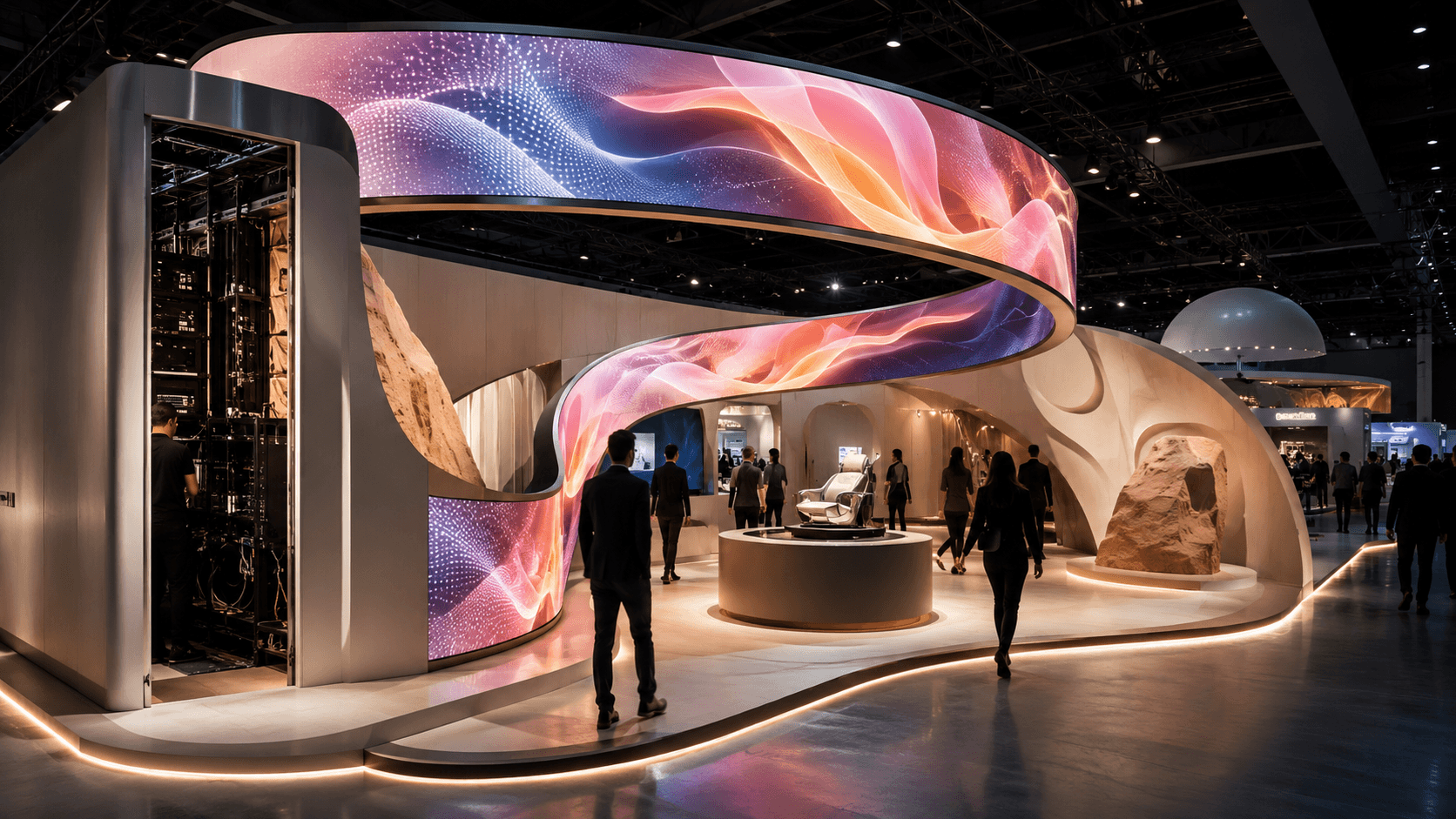
At a trade show, the booth across the aisle has exactly three seconds to become forgettable. Flexible LED screens can help, but only when the display supports the booth story instead of becoming expensive wallpaper.
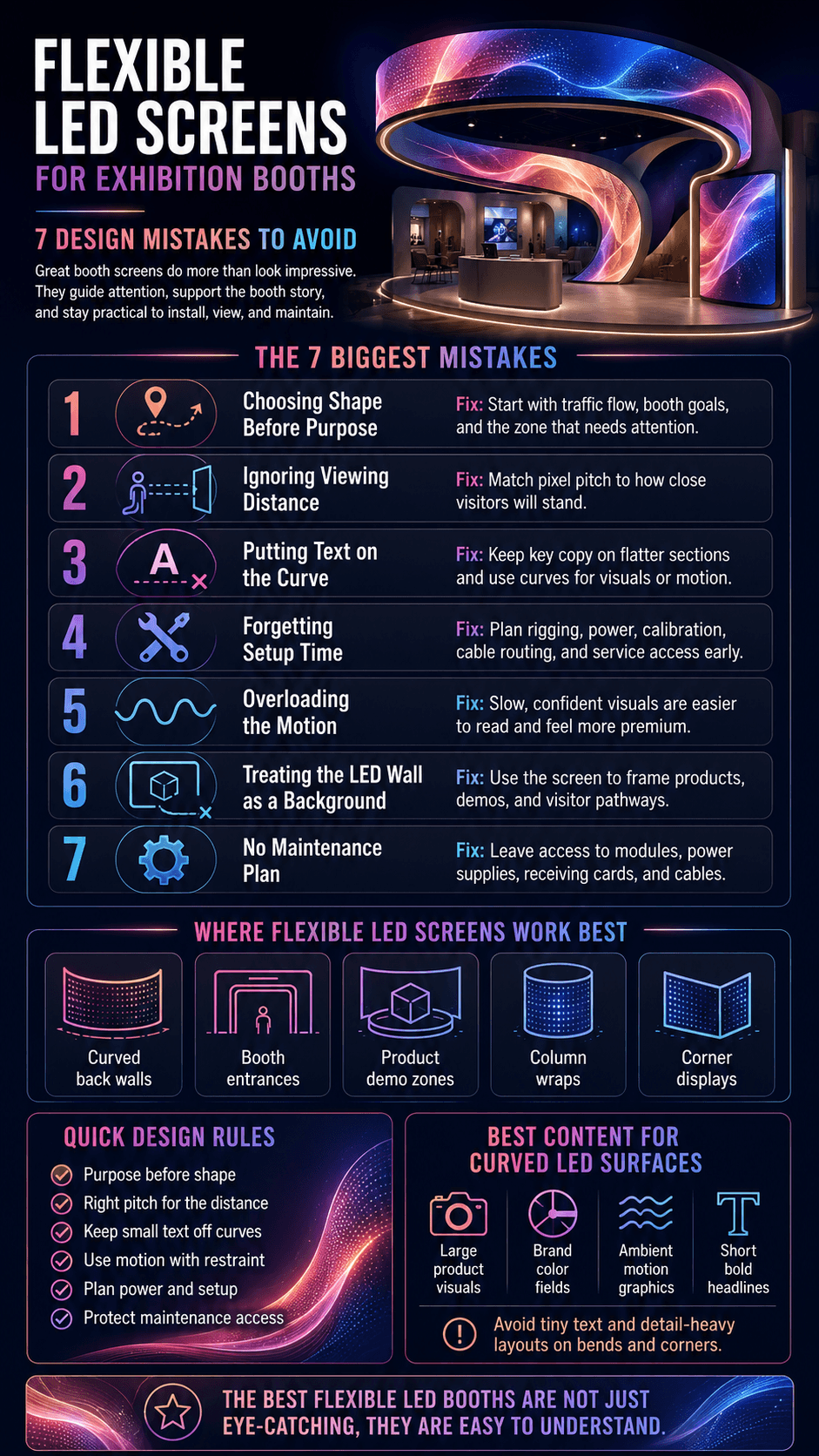
A flexible LED screen can bend, curve, or fit creative booth structures. That makes it useful for exhibition entrances, product demo zones, curved back walls, and corner displays.
Mistake 1: Choosing Shape Before Purpose
A curved screen should have a job. It might guide visitors toward a demo, wrap around a hero product, or make the booth visible from two aisles. If the shape exists only because it looks different, the result can feel forced.
Start with traffic flow. Where do people enter? Where do they pause? Which side faces the busiest aisle?
The screen isn’t the only visual element a booth needs on short notice. For the printed signage, banners, and handouts that round out the same show, AI design tools built for fast trade show turnarounds cover the collateral side of the same deadline.
Mistake 2: Ignoring Viewing Distance
Pixel pitch should match how close visitors will stand. A booth screen seen from six feet away needs a different pitch than a screen viewed from across a hall.
Industry display guides often use viewing distance as the first filter for pixel pitch. The basic idea is simple: closer viewers need tighter pixel spacing.
AVIXA’s 10x Rule, the audiovisual industry’s standard shorthand, estimates ideal viewing distance in feet as pixel pitch in millimeters multiplied by 10. A P2.5 panel, common for booths viewed from a few feet away, has an ideal viewing distance around 25 feet, while a P4 panel pushes that closer to 40 feet. Most exhibition booths fall into P1.8 to P2.5 for close demo zones and hero walls, since visitors regularly stand within arm’s reach. Specifying a tighter pitch than the actual viewing distance requires just pays for resolution nobody in the booth can perceive.
Mistake 3: Putting Text on the Curve
Large product images, abstract motion, and brand color fields work well on curves. Small text often does not. If the screen wraps around a corner, some visitors will see the message from an angle.
Keep important copies on flatter sections. Let the curved area carry motion, atmosphere, or product visuals.
Mistake 4: Forgetting Setup Time
Trade show labor windows are tight. A beautiful LED concept can become stressful if the booth team underestimates rigging, calibration, cable routing, and service access.
Indoor LED walls typically draw 150 to 400 watts per square meter at peak brightness, with real-world content usually landing closer to 100 to 200 watts per square meter since full-white, full-brightness content is rare in practice. A standard 20-amp, 120-volt circuit safely supports roughly 1,900 watts, which means a single circuit can run a modest demo wall but not a full backdrop without splitting the load. For a booth in the 10 to 20 square meter range, that usually means planning for at least two to three dedicated circuits rather than assuming the venue’s standard power drop will cover it. This is what turns Mistake 4 from a scheduling problem into an electrical one: rigging and cable routing can be fixed with an extra hour of labor, an undersized circuit trips a breaker mid-show, with no fast fix once doors are open.
Mistake 5: Overloading the Motion
A flexible LED booth does not need constant fast animation. People are already surrounded by movement. Slow, confident visuals often feel more premium and are easier to read while walking.
A practical pacing rule: content built for a walk-by audience should hold each major visual for at least three to five seconds before transitioning, long enough to register while moving past at a normal pace, without feeling static. Rapid strobing or flashing effects deserve more caution than most booth designers realize: broadcast guidelines commonly cap flashing imagery at three flashes per second specifically because faster flash rates can trigger seizures in people with photosensitive epilepsy, a real consideration for a screen running continuously in a crowded hall, not just a broadcast concern.
Mistake 6: Treating the LED Wall as a Background
The best exhibition screens interact with the booth layout. A curved LED wall can frame a product. A corner LED screen can pull attention from two directions. A column wrap can turn a structural obstacle into signage.
The test worth applying during design: cover the screen and look at the booth layout alone. If visitor flow, product placement, and sightlines still make sense without it, the screen is decoration. If removing it leaves a gap in how the space actually functions, the content mapping is doing real design work rather than sitting on top of a layout that was finished without it.
The screen should shape the visitor path, not sit behind it.
Mistake 7: No Maintenance Plan
LED modules, power supplies, receiving cards, and cables all need access. If a booth structure blocks maintenance, a small issue can become a show-floor headache.
A rental-focused page like Esdlumen rental LED displays is useful because event displays need to survive shipping, setup, teardown, and repeated use.
Flexible LED screens can make an exhibition booth easier to notice, but the real win is making the booth easier to understand.
Frequently Asked Questions About Flexible LED Screens for Exhibition Booths
For close viewing zones, within a few feet, P1.8 to P2.5 is standard. Using AVIXA’s 10x Rule, a P2.5 panel has an ideal viewing distance around 25 feet, so matching pitch to actual booth traffic avoids overpaying for resolution nobody stands close enough to see.
Indoor LED walls typically draw 150 to 400 watts per square meter at peak brightness, with real content usually running 100 to 200 watts per square meter. A standard 20-amp circuit supports roughly 1,900 watts, so most booth-sized walls need at least two dedicated circuits.
Several weeks minimum, especially for popular show dates, since rigging crews, rental inventory, and content approval all need lead time. Booking last minute usually means settling for whatever pixel pitch and shape happens to be available.
On flat sections, yes. On curved or corner sections, small text and logos can distort or become hard to read from an angle, so it’s safer to keep detailed copy on flatter areas and let curves carry motion or large visuals.
Renting makes sense for occasional shows, since it avoids storage, transport, and maintenance between events. Buying only pays off for exhibitors running the same or similar booth build at multiple shows per year.
This varies by size and complexity, but rigging, calibration, cable routing, and content testing all need to be budgeted separately, not assumed to happen simultaneously, exactly the mistake covered earlier in this guide.
Infographic