Physical Requirements for AI Data Centers
AI workloads are radically transforming the requirements for the physical infrastructure of data centers. While traditional data centers were designed for variable loads and moderate power consumption, modern GPU clusters and AI server systems operate under high and constant load, putting pressure on all engineering systems simultaneously. In this article, we’ll explore the physical requirements […]

AI workloads are radically transforming the requirements for the physical infrastructure of data centers. While traditional data centers were designed for variable loads and moderate power consumption, modern GPU clusters and AI server systems operate under high and constant load, putting pressure on all engineering systems simultaneously. In this article, we’ll explore the physical requirements for AI data centers.
The key difference lies in density. Previously, 5–10 kW per rack was considered standard, but for AI infrastructure, 20–60 kW has become the norm, and in some cases – 80–100 kW or more. This means that the approach of “deploy now and scale later” no longer works. Mistakes at the design stage lead to infrastructure becoming a bottleneck from the very beginning.
In AI data centers, the physical environment directly affects training speed, system stability, and the overall economics of the project.
Why AI Data Centers Require a Different Approach
The key factor is the nature of computation. GPU clusters perform parallel operations with high intensity and virtually no downtime. Unlike traditional servers, where workloads may fluctuate, AI systems generate constant power consumption and heat output.
This creates several critical characteristics:
- no “peaks and drops” in workload – the system operates under constant pressure
- high heat concentration in a limited space
- sensitivity to network latency
- direct dependency of performance on physical infrastructure
Even minor deviations – such as increased latency or overheating of individual nodes – scale across the entire cluster and directly impact model training time.
Power Supply: The Primary Limiting Factor
In AI data centers, power supply becomes the key resource. Unlike traditional scenarios where space was often the constraint, here the main factor is available electrical capacity.
Key requirements for the power system:
- support for high density (20–60+ kW per rack)
- redundancy schemes such as N+1 or 2N
- stable power delivery without fluctuations
- scalability without full reconstruction
- proper load distribution
It is important to consider that AI workloads create constant power consumption. This means the power system must operate under sustained high load without degradation.
A typical issue is when a data center is physically capable of hosting equipment but cannot supply the required power. As a result, infrastructure becomes the bottleneck.
Cooling: Transition to Liquid Solutions
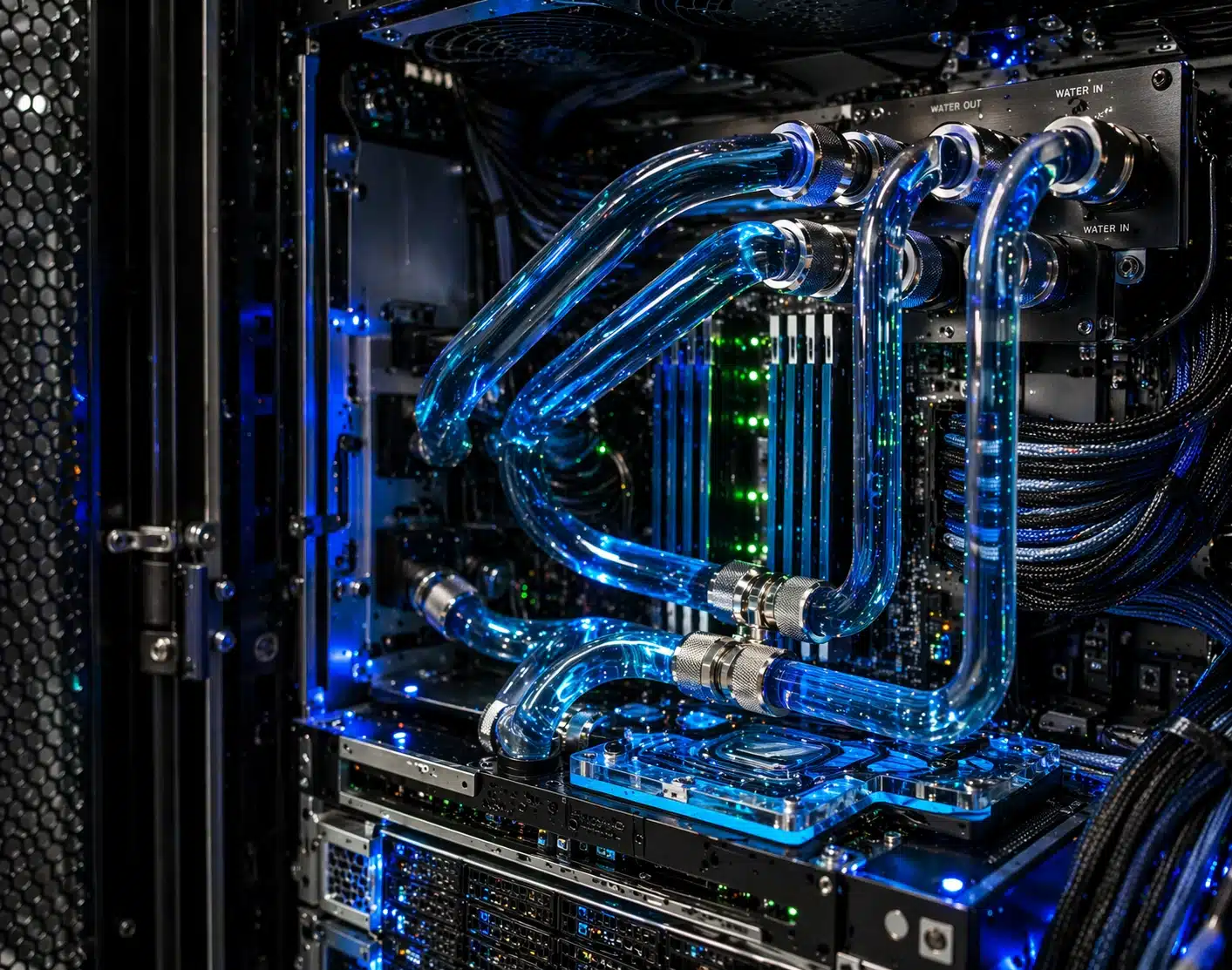
The higher the power consumption, the greater the heat output. At densities of 40–80 kW per rack, traditional air cooling becomes insufficient.
The main limitation of air is its low heat removal efficiency. Even with properly organized airflow, it cannot ensure stable operation of equipment at high density.
That is why AI data centers increasingly rely on liquid cooling systems, particularly direct-to-chip cooling, where heat is removed directly from GPUs and CPUs.
Key cooling requirements:
- support for high-density workloads (40–80+ kW)
- uniform temperature distribution
- integration with the power system
- fault tolerance and redundancy
Attempts to use traditional cooling systems in AI infrastructure lead to overheating, hardware throttling, and reduced performance.
Space and Layout: Impact on Efficiency
The physical organization of a data center directly affects the performance of an AI cluster. It is not enough to simply deploy equipment – it is essential to create conditions for its efficient operation.
Particular attention is paid to:
- zoning for high-density workloads
- spacing between racks to ensure proper cooling
- floor load capacity (due to the weight of equipment)
- cable infrastructure
- service accessibility
AI racks are significantly heavier than standard ones, especially when liquid cooling is used. This requires reinforced flooring and well-planned deployment logistics.
Mistakes at the layout stage lead to local overheating, cable congestion, and limited scalability.
Physical Requirements for AI Data Centers – Network Infrastructure: A Critical Element for AI
In AI clusters, the network plays a key role. During distributed model training, nodes continuously exchange data, and latency directly impacts performance. Even a small increase in latency scales across thousands of operations and can significantly extend training time.
Key requirements:
- minimal latency
- high bandwidth
- optimal placement of network equipment
- minimized connection length
The physical implementation of the network – including cabling, routing, and equipment placement – becomes just as important as the network technologies themselves.
System Interconnection: A Unified Engineering Model
The main characteristic of an AI data center is the interdependence of all systems. Power supply, cooling, networking, and physical space cannot be considered separately.
For example:
- increasing power raises heat output
- layout changes affect cooling efficiency
- cable length impacts latency
- deployment density influences all systems simultaneously
This requires a comprehensive design approach where all components are treated as part of a single architecture.
AI Data Centers Infrastructure Requirements as a Competitive Advantage
In AI projects, infrastructure is not just a foundation – it becomes a competitive advantage. Companies that design data centers specifically for high density and AI workloads achieve higher efficiency and better scalability.
Ignoring these requirements leads to:
- limited infrastructure growth
- reduced GPU cluster performance
- equipment overheating
- increased operational costs
With the growing demand for AI computing, the physical readiness of a data center determines whether a business can scale effectively or will face technical limitations.
