10 Best AI Visibility Tools in 2026 (Pricing Compared)
AI visibility tools compared for 2026: pricing, engine coverage, free tiers and what every platform still cannot measure.

Ask ChatGPT, Perplexity or Google AI Mode to recommend a product in your category. Whatever comes back is a first impression you did not write, cannot see in Google Search Console, and probably do not control. AI visibility platforms exist to make that invisible layer measurable.
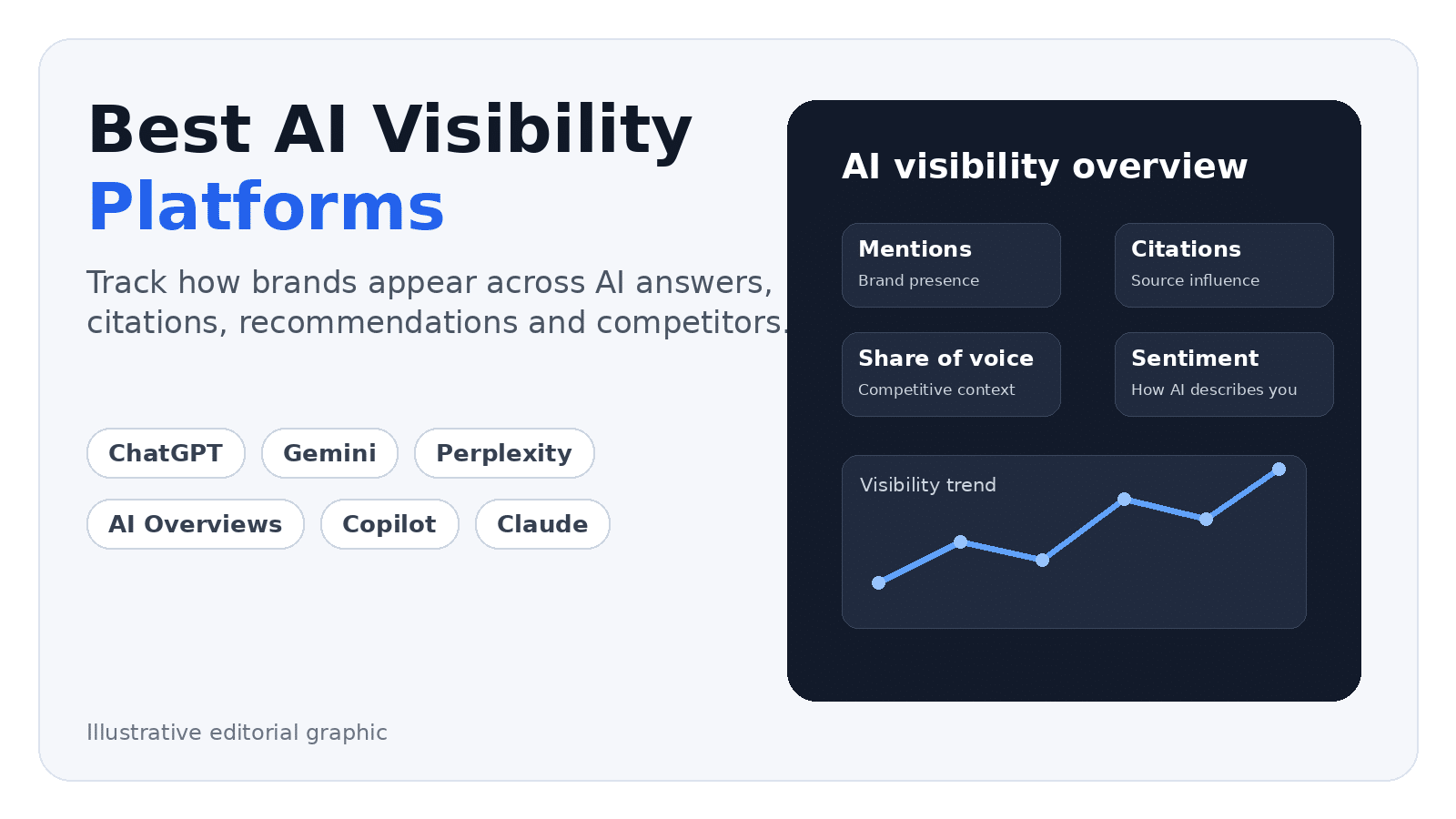
The category answers to several names. Vendors sell it as AI visibility tracking, answer engine optimization (AEO), generative engine optimization (GEO) or LLM visibility monitoring. The job underneath the labels is identical: run a fixed set of buyer questions through ChatGPT, Gemini, Perplexity, Microsoft Copilot and Google AI Overviews on a schedule, then record whether your brand was named, which URLs the model cited as sources, which competitors appeared instead of you, and how the framing shifted over time.
One thing the word “tracking” hides: a single AI answer is not a ranking. Ask the same question twice and you can get two different brand lists. Measurement here is statistical, because you are sampling a distribution rather than reading a position. Any tool that shows you one lookup and calls it a score is selling you noise. If you want the strategy layer that sits behind the numbers, our guide on how LLMs describe your brand covers what actually changes an answer once you can finally see it.
A company can rank first in classic search and still be absent from every generated answer in its category. That gap is what these tools price, and it is why AI visibility tools now sit in budget lines that did not exist eighteen months ago.
This comparison covers the ten AI visibility platforms worth shortlisting in 2026, what each one costs, which engines it reaches, and where each one stops being useful.
Table of contents
- What separates a real AI visibility platform from a dashboard
- How this comparison was put together
- Top AI visibility platforms at a glance
- AI visibility platform pricing compared in 2026
- The 10 best AI visibility platforms
- 1. Llumo — best overall for value and flexibility
- 2. Profound — best for enterprise AEO programs
- 3. Peec AI — best for clean, focused analytics
- 4. OtterlyAI — best for accessible daily monitoring
- 5. Promptwatch — best for end-to-end optimization
- 6. Scrunch AI — best for technical AI readiness
- 7. Writesonic — best for combining visibility with execution
- 8. AthenaHQ — best for GEO strategy and action planning
- 9. SE Ranking — best for SEO teams that want AI visibility in the same stack
- 10. AIclicks — best for monitoring plus practical recommendations
- What bring-your-own-key pricing actually costs
- How to choose the right AI visibility platform
- What AI visibility platforms cannot tell you
- Notable AI visibility tools that did not make the top ten
- How to run your first AI visibility baseline in 30 days
- Frequently asked questions about AI visibility platforms
- Final verdict
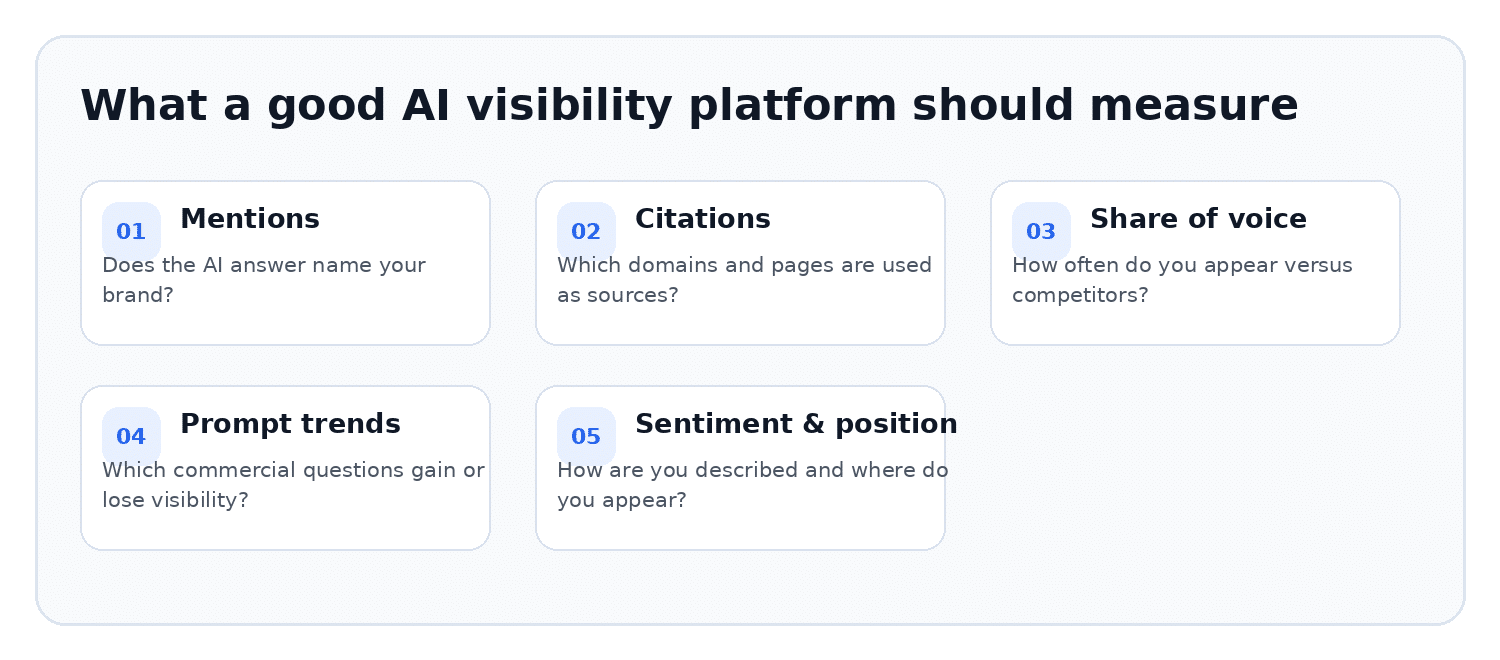
What separates a real AI visibility platform from a dashboard
- Broad coverage of the AI engines that customers actually use.
- Prompt-level brand mentions, citations and source analysis.
- Competitor benchmarking and share-of-voice reporting.
- Clear actions that connect measurement to content, technical or off-site improvements.
- A pricing model that can scale without making useful prompt coverage prohibitively expensive.
How this comparison was put together
Being direct about method, because this is a commercial shortlist and you should know what it is worth.
This is a documentation and pricing review, not a hands-on bake-off. Every platform below was assessed against its own public product pages, published pricing and documentation, checked in September 2026, with dated third-party roundups used only where a vendor publishes no price at all. Nothing here is a benchmark of accuracy, because no independent accuracy benchmark for AI visibility exists yet. Two tools running the same prompt on the same morning can disagree, and neither one can prove it is right.
Prices in this category move faster than in almost any other software market. Treat every figure as the starting point for your own check rather than a quote.
We also kept vendor claims labelled as vendor claims. Where a capability is stated by the company and cannot be verified from outside, it is described that way. That distinction is the entire difference between a comparison and an advertisement, and it is the failure mode we wrote about in why most AI companion reviews fail users: a feature list, a price, a score, and no evidence anyone opened the product.
Editorial note on the ranking. No vendor paid for inclusion, placement or a link in this article, and nothing was received from any company named here. Llumo ranks first on one criterion only: cost per tracked AI response. It is the only platform in this comparison structured so that the software itself carries no license fee, which changes the arithmetic for anyone tracking large prompt sets. It is not the deepest product on this list, and the bring-your-own-key section below sets out exactly where that advantage stops applying. Llumo is also the only vendor we link to, for the narrow reason that its published cost figures are the ones the analysis depends on.
Top AI visibility platforms at a glance
| # | Platform | Best for | Why it stands out |
|---|---|---|---|
| 1 | Llumo | Best overall value and flexibility | Free hosted BYOK; broad tracking workflow |
| 2 | Profound | Enterprise AEO programs | Deep analytics, demand data and agent workflows |
| 3 | Peec AI | Clean AI search analytics | Simple dashboards and competitive visibility |
| 4 | OtterlyAI | SMBs and straightforward monitoring | Accessible daily tracking and citation reporting |
| 5 | Promptwatch | End-to-end AI search optimization | Monitoring, sources, content and agent analytics |
| 6 | Scrunch AI | Technical AI readiness | Visibility plus agent and crawler experience |
| 7 | Writesonic | Content teams that want execution built in | Tracking plus content, outreach and action workflows |
| 8 | AthenaHQ | GEO strategy and operational action | Monitoring, prompt demand and action center |
| 9 | SE Ranking | SEO teams and agencies | AI visibility inside a broader SEO toolkit |
| 10 | AIclicks | Growth teams combining tracking and content | Daily monitoring with recommendations and content |
AI visibility platform pricing compared in 2026
Sticker price is the least useful number in this category. What you are actually buying is AI responses, which is prompts multiplied by engines multiplied by run frequency multiplied by markets. A $95 plan covering 50 prompts on three models and a $399 plan covering 350 prompts on seven can land at a similar cost per response, and the cheaper one can be worse value.
Published entry pricing, checked September 2026. Verify on the vendor page before you buy.
| Platform | Published entry price | What the entry tier buys | Genuinely free option |
|---|---|---|---|
| Llumo | $0 software fee (BYOK) | Unlimited prompts, you pay AI providers directly | Software yes, usage no |
| Otterly.ai | From about $29/mo | Around 15 prompts, daily runs, four engines | 7-day trial |
| Peec AI | From about $95/mo | Around 50 prompts, three chosen models | Trial only |
| Profound | From about $99/mo | Starter covers ChatGPT only; Growth about $399/mo widens engines | No |
| Promptwatch | From about $99/mo | Around 6,000 AI responses per month | Trial only |
| AIclicks | From about $189/mo | Around 18,600 responses plus recommendations | Trial only |
| Scrunch AI | From about $250/mo | Around 125 prompts plus monthly site audits | 7-day trial |
| AthenaHQ | From about $295/mo | Around 3,600 credits across engines | No |
| Writesonic | From about $399/mo | Around 18,000 responses plus content workflows | Limited trial |
| SE Ranking | Add-on to an existing SEO plan | AI mention and link tracking inside the wider toolkit | Trial only |
Two traps worth naming. First, entry tiers routinely gate engines: several of the cheapest plans above start on ChatGPT alone, and Google AI Overviews or Perplexity sit one tier up. Second, “credits” and “prompts” are not the same unit across vendors, so a 3,600-credit plan and a 350-prompt plan are not comparable until you work out how many responses each produces per month. Divide the monthly fee by the responses you will actually generate, then compare.
The 10 best AI visibility platforms
1. Llumo — best overall for value and flexibility
Best for: Agencies, SEO teams and brands that want broad AI visibility tracking without being locked into expensive prompt bundles.
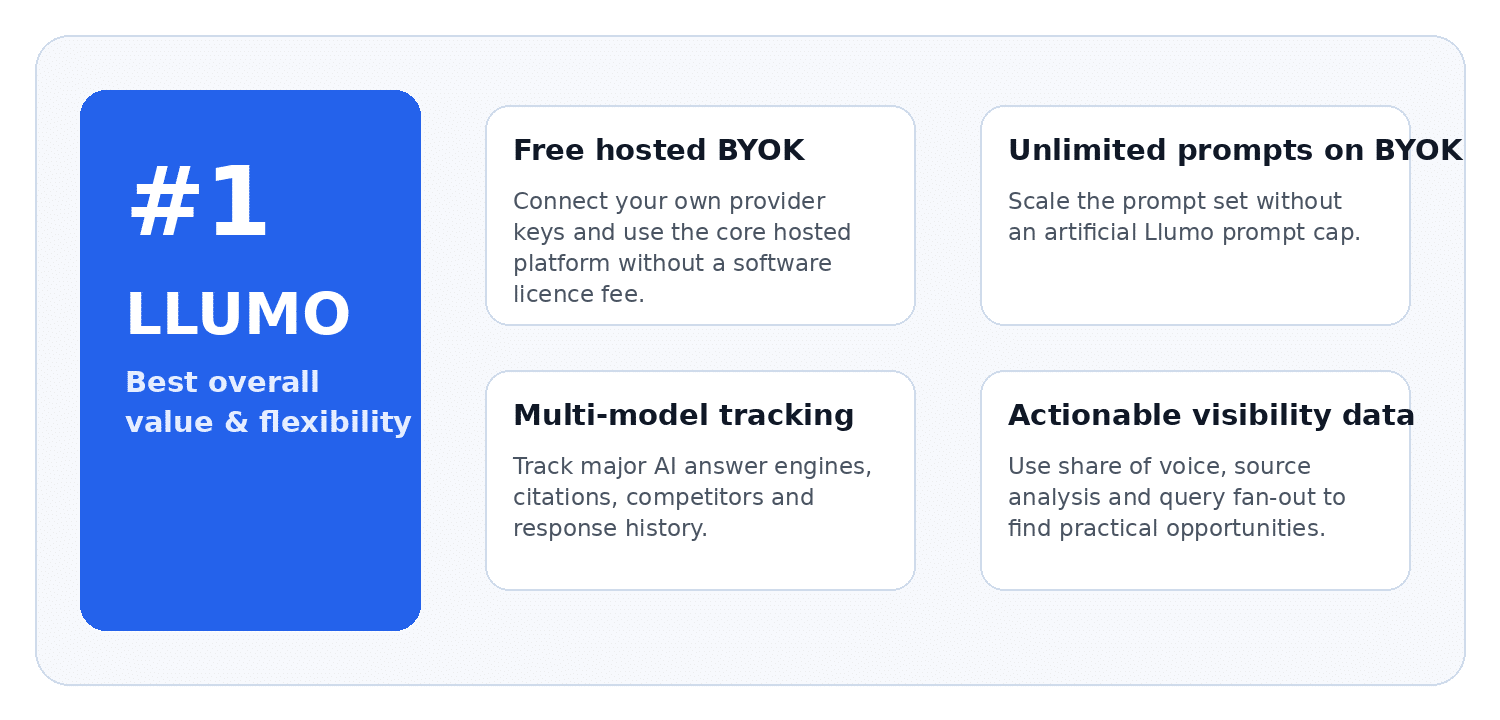
Llumo takes the top spot because it approaches the cost problem differently. The hosted platform can be used with your own provider keys, so teams pay the underlying AI providers directly rather than buying a fixed software bundle for every response. Llumo states that its BYOK setup has no artificial prompt limit, which makes it especially attractive when you need to track many prompts, brands or models.
The product covers the core workflow expected from a dedicated AEO platform: prompt-level visibility, competitor share of voice, citation and source analysis, historical trends, full response drill-down and query fan-out. It supports major answer engines including ChatGPT, Gemini, Perplexity, Copilot, Google AI experiences and additional models through supported providers.
The honest limit: free software is not free monitoring, and the section on bring-your-own-key economics further down works through what the provider bill actually looks like at scale. Llumo is also a younger product than Profound or Peec, with a smaller public track record and no third-party security certification published at the time of writing. If procurement will ask for SOC 2, start further down this list.
Key strengths: Citation and source analysis • Competitor tracking • Query fan-out • Full response drill-down • Multi-model coverage • No software license fee
2. Profound — best for enterprise AEO programs
Best for: Large organizations that want deep measurement, demand intelligence and automated workflows.
Profound is one of the most complete enterprise platforms in the category. Its Answer Engine Insights product measures visibility, sentiment, citations and competitor performance, while Prompt Volumes helps teams understand what people are asking AI. Agent Analytics adds crawler and referral intelligence, and its agent workflows connect research to content and execution.
Key strengths: Enterprise-grade analytics • Prompt demand intelligence • AI crawler and referral data • Content and agent workflows
Watch out: the depth described above is not what the entry price buys. The Starter tier covers ChatGPT alone, and multi-engine coverage begins at the Growth plan around $399 a month.
3. Peec AI — best for clean, focused analytics
Best for: Marketing and SEO teams that value a simple interface and clear reporting.
Peec AI focuses on the measurement layer: visibility, position, sentiment, sources and competitor performance. The product is easy to understand quickly, which is useful for teams introducing AI-search reporting to stakeholders. It is a strong choice when you want dedicated AI visibility analytics without a much larger marketing suite around it.
Key strengths: Clear dashboards • Daily tracking • Source analysis • Competitive benchmarking
Watch out: entry plans cap you to three models of your choosing, so full engine coverage means upgrading. It is also measurement only, with no execution layer, so budget separately for the work the data points to.
4. OtterlyAI — best for accessible daily monitoring
Best for: Smaller teams and agencies that want an uncomplicated SaaS starting point.
OtterlyAI makes AI search monitoring approachable. It tracks brand mentions, citations, rankings and sentiment across major answer engines on a daily basis, with straightforward reports that do not require a large implementation project. Its modular model coverage can work well for teams that want to begin with a smaller prompt set and expand later.
Key strengths: Simple setup • Daily monitoring • Citation tracking • Useful entry point for smaller teams
Watch out: the $29 tier tracks roughly 15 prompts, which is enough for a trend line on one brand and not enough to read a category. API and integration access sits several tiers higher.
5. Promptwatch — best for end-to-end optimization
Best for: Teams that want monitoring, source analysis and content execution in one platform.
Promptwatch goes beyond a visibility dashboard. It tracks prompts and citations, analyzes the sources influencing AI answers, monitors AI crawler activity and includes content-focused workflows for closing gaps. That wider scope makes it a good fit for teams trying to turn AI-search data into an operating process rather than a monthly report.
Key strengths: Prompt tracking • Citation analysis • Agent analytics • Content gaps and execution
Watch out: breadth costs depth. The content and agent-analytics features are shallower than what a dedicated tool in either area gives you, which is the usual trade when one platform covers four jobs.
6. Scrunch AI — best for technical AI readiness
Best for: Brands that care about how AI agents access, understand and use their websites.
Scrunch combines brand visibility monitoring with a broader agent-experience approach. In addition to tracking how a brand appears in generated answers, it focuses on crawler behavior, site readiness and the way content is delivered to AI agents. That makes it particularly relevant when engineering and technical SEO teams are involved in the AI-search strategy.
Key strengths: AI visibility monitoring • Crawler and agent insights • Technical readiness • Agent experience focus
Watch out: the entry price is high relative to its prompt allowance because part of what you are buying is the site-audit and agent-experience layer. If crawler access is not your actual bottleneck, you are paying for capability you will not use.
7. Writesonic — best for combining visibility with execution
Best for: Content-heavy teams that want research, monitoring and optimization inside one workflow.
Writesonic now includes a substantial AI visibility layer alongside its content and SEO products. It monitors brand visibility, citations, sentiment and share of voice across multiple AI platforms, then connects those findings to an action center covering content, citations and technical improvements. The advantage is reducing the distance between seeing a gap and producing the work needed to address it. Writesonic’s AI visibility layer sits on its Growth tier at around $399 a month, so it is priced as a content platform with tracking attached rather than as a tracker.
Key strengths: Multi-platform tracking • Sentiment and citations • Action center • Content creation and optimization
Watch out: you are buying a content platform to get the tracker. If measurement is all you need, the same money buys considerably more tracked responses elsewhere.
8. AthenaHQ — best for GEO strategy and action planning
Best for: Teams that want a command center for monitoring and prioritized GEO work.
AthenaHQ combines cross-platform AI visibility tracking with prompt demand, citation analysis and an Action Center designed to turn findings into next steps. It is positioned around the full GEO workflow, making it useful for dedicated AEO managers, brand teams and agencies that need to organize strategy rather than simply collect mentions.
Key strengths: Cross-platform monitoring • Prompt demand • Citation analysis • Action-oriented recommendations
Watch out: no free trial is published, so evaluation runs through a sales demo. Credit-based pricing also makes monthly cost harder to forecast than a straight per-prompt allowance.
9. SE Ranking — best for SEO teams that want AI visibility in the same stack
Best for: Agencies and search teams already using traditional SEO reporting and research tools.
SE Ranking brings AI visibility into a broader SEO environment. Its AI tools monitor mentions and links across ChatGPT, Gemini, Perplexity and Google AI experiences, while competitor research and historical tracking provide context. For agencies, the main benefit is operational: AI search can sit alongside rank tracking, audits and client reporting rather than becoming a completely separate workflow.
Key strengths: AI and traditional SEO together • Mention and link tracking • Competitor analysis • Agency-friendly reporting
Watch out: AI visibility is a module inside a wider suite rather than the product itself, so prompt-level analysis is less deep than a dedicated platform. The case for it is operational convenience, not analytical depth.
10. AIclicks — best for monitoring plus practical recommendations
Best for: Growth teams that want daily AI tracking with built-in routes to content and off-site action.
AIclicks tracks prompts, sources, competitors and sentiment across a broad set of AI platforms. Its recommendation layer is a useful differentiator because it pushes teams toward specific actions such as content creation, source mentions and community participation. It is a sensible option for marketers who want measurement and execution guidance under one roof.
Key strengths: Daily prompt tracking • Source and competitor analysis • Recommendations • AI-optimized content workflows
Watch out: there is less independent coverage of AIclicks than of the established names here, which means fewer outside sources to check its claims against. Run the trial before committing to an annual term.
What bring-your-own-key pricing actually costs
BYOK is the most misunderstood pricing model in this category, so it is worth doing the arithmetic in the open.
When a platform charges you $95 a month for 50 prompts, part of that is software and part of it is the vendor buying AI responses wholesale and reselling them to you with a margin. BYOK removes the second part. You bring your own OpenAI, Anthropic, Google or OpenRouter credentials, and you pay those providers at their published rates. Nothing else changes about the workflow.
What that saves is real, and so is what it does not save. Running 150 prompts daily across seven engines produces roughly 31,500 AI responses a month. Llumo’s own published estimate puts a configuration of that size at around $100 a month in third-party API costs, and a larger 200-prompt-per-day setup at roughly $115 to $150. Those are vendor figures, not independently measured, but they are the right order of magnitude and they make the point cleanly: the software is free, the monitoring is not. Anyone who wants to check that arithmetic against their own prompt volume can Explore Llumo and set the per-response cost against any subscription tier in the pricing table above.
So the decision is not free versus paid. It is variable cost versus fixed cost, and which one wins depends entirely on scale. Below roughly 50 tracked prompts, a $29 to $95 subscription is simpler, more predictable and probably cheaper than managing provider keys. Above a few hundred prompts, or across multiple client brands, the subscription curve climbs far faster than the API curve and BYOK pulls ahead decisively. This is the same shape we mapped when cloud AI bills scale with usage in other parts of an AI stack: metered infrastructure beats bundled seats exactly once your volume is high enough, and loses below that line.
Three things BYOK adds that a subscription does not. You now own provider rate limits, so a heavy tracking day can collide with production workloads on the same key. You now own the billing surprise, because there is no monthly cap. And you now own key rotation and access control, which is a security task somebody has to actually do. None of these are dealbreakers. All of them are work that a $295 plan was quietly absorbing for you.
How to choose the right AI visibility platform
The best tool is not necessarily the one with the most charts. It is the one that lets you monitor enough real buying questions, across the right engines, at a frequency you can sustain. Before committing, compare these areas:
- Engine coverage: confirm the platform tracks the answer engines your audience actually uses.
- Prompt economics: understand whether each engine, location or run consumes a separate allowance.
- Citation depth: source URLs and domains are often more actionable than a single visibility score.
- Competitive context: look for prompt-level share of voice and competitor comparisons.
- Execution: decide whether you need only measurement or also content, technical and off-site recommendations.
A practical starting point is a focused set of commercially meaningful prompts covering product discovery, comparisons, alternatives, use cases and category questions. Track them consistently, establish a baseline and then expand into more markets, personas or topics once the data is stable.
What AI visibility platforms cannot tell you
Every tool on this list measures the same four things well: mentions, citations, share of voice and sentiment. Here is what none of them do, which matters more when you are defending the line item in a budget review.
They cannot prove causation. Your visibility score rises. Was it the content you shipped, a competitor’s outage, a model version update, or ordinary sampling variance? Model providers ship changes without changelogs, and a rewrite that lands the same week as a new model release is unattributable. Treat every reported lift as correlation until you have held one variable steady across several weeks.
They cannot tell you what a real user saw. Answer engines personalize by account history, location and conversation context. A tool queries through an API or a scraper with no history attached. That is a defensible sampling proxy, and it is not the same thing as your customer’s screen. This gap is largest on ChatGPT, where logged-in memory shapes answers heavily.
They cannot generate the fix. The action centres in these platforms produce suggestions: publish this comparison page, get mentioned on that domain, add this schema. Someone still has to write, earn and ship all of it. Budget for the work, not just the dashboard, or you will renew a subscription for twelve months of charts you never acted on.
They cannot fix an access problem. If AI crawlers cannot reach or parse your pages, no amount of measurement helps. That is a technical readiness question, closer to the territory covered in how AI agents are changing the way businesses build software than to content strategy, and it is why Scrunch AI’s agent-experience angle is a genuinely different product rather than a feature difference.
They cannot override the fundamentals. This is the one most teams get wrong. Google’s own documentation on optimizing for generative AI features in Search is explicit that AI Overviews and AI Mode run on the same core ranking and quality systems as classic Search, that there is no separate AEO checklist, and that several popular GEO tactics are myths. Google also confirms both surfaces use query fan-out, issuing multiple related searches across subtopics before composing an answer, which is precisely why prompt-level tracking is useful and why a single keyword rank is not. Measurement tells you where you stand. It does not replace the content and technical work that put you there.
Notable AI visibility tools that did not make the top ten
A shortlist of ten leaves things out. These are the omissions most likely to matter to you, and the reason each one sits outside the main list rather than inside it.
- Ahrefs Brand Radar and the Semrush AI Toolkit are the two AI visibility products the largest number of marketing teams can already reach, because both attach to a subscription those teams probably hold. The Semrush AI Toolkit runs roughly $99 a month per domain on top of a Semrush plan. Both measure mentions and citation share competently. They are excluded from the main ranking because neither is a standalone platform: if you already pay for the suite, start here before buying anything dedicated, and only move on when the prompt allowance or engine coverage genuinely stops being enough.
- HubSpot’s AI Search Grader is the strongest free entry point in the category, with no card and no time limit, returning a sentiment-aware read on how ChatGPT, Perplexity and Gemini describe a brand. It is a snapshot rather than monitoring, which is exactly why it is not ranked among platforms, and exactly why it is the right first move for anyone who has never measured this at all.
- Rankscale and LLMrefs compete at the bottom of the price range, with entry tiers around $20 to $79 a month and unusually broad engine coverage for the money. Both are worth a look if budget is the binding constraint and you can live with less mature reporting.
- Knowatoa, Goodie AI, Brandlight and Evertune are real, funded products serving narrower use cases, mostly enterprise brand and category intelligence. If your requirement is category-level share modelling rather than prompt-level tracking, they belong on your evaluation list.
- Google Search Console and Bing Webmaster Tools report AI-surface impressions inside their own ecosystems, free and continuously. They are not visibility platforms, and no serious programme should skip them.
How to run your first AI visibility baseline in 30 days
Most teams overbuy in week one, track 300 prompts they never look at, and cancel by month four. A cheaper sequence works better.
Days 1 to 3. Run two or three free graders against your own domain and note what comes back. You are looking for one thing: whether the models describe you accurately at all. A brand that gets the category wrong has a positioning problem, not a measurement problem, and no subscription fixes that.
Days 4 to 10. Write 20 to 30 prompts by hand, phrased the way a buyer would actually phrase them. Cover product discovery, direct comparisons, alternatives to your named competitors, use cases and category definition questions. Twenty prompts you argued about beat 300 generated ones.
Days 11 to 30. Track that set daily on the cheapest tier that reaches your engines. Change nothing on your site. You are establishing variance, not chasing a lift, and you cannot read a lift until you know how much the number moves on its own.
Only after 30 days do you widen. Add markets, personas or brands one at a time, and let the cost per tracked response decide whether you renew, upgrade or switch to a bring-your-own-key setup.
Frequently asked questions about AI visibility platforms
Software that measures how often a brand, product or website appears inside AI-generated answers. The standard metrics are mentions, citations, share of voice, position, sentiment and competitor visibility, sampled across engines on a schedule rather than checked once.
No. Rank tracking measures where a page sits in a results list. AI visibility measures whether a brand is named or cited inside a generated answer, which varies by model, prompt, market, account history and time. Most teams run both, because the underlying content and technical work overlaps almost completely even though the reporting does not.
Published entry pricing spans roughly $20 to $399 a month, with enterprise plans quoted into the thousands. Serious multi-engine tracking generally starts near $200 a month. Bring-your-own-key platforms charge no software fee but pass provider API costs straight through, which lands around $100 a month for a 150-prompt daily setup across seven engines.
It depends on whether you want a snapshot or ongoing tracking. For a one-off read with no card, HubSpot’s AI Search Grader, Semrush’s free AI Search Visibility Checker and Ahrefs’ free AI Visibility Checker each return something usable in minutes. For ongoing free monitoring rather than a snapshot, Llumo’s hosted BYOK model is the outlier, because the software carries no licence fee. Free software still is not free monitoring: you pay AI providers for every response generated.
Start with what your buyers use, which for most markets means ChatGPT, Google AI Overviews, Google AI Mode, Gemini and Perplexity. Add Copilot, Claude or Grok when the audience justifies it. Check whether your chosen plan includes those engines at the entry tier, because several tools gate everything except ChatGPT behind an upgrade.
Fewer than most vendors suggest. Twenty to fifty hand-written prompts covering discovery, comparison, alternatives and use cases produce a readable trend line for a single brand in a single market. Prompt count should grow with markets and brands, not with budget.
Usually not at first. The Semrush AI Toolkit and Ahrefs Brand Radar both cover mentions and citation share adequately for a single domain, and you already hold the contract. Move to a dedicated platform when prompt allowances, engine coverage or multi-client reporting become the constraint.
Daily for a core set, because answers vary between runs and daily sampling is what separates a trend from noise. Weekly is acceptable for secondary markets. Anything monthly is a report, not a monitoring programme, and will miss the changes worth reacting to.
Not directly, and be sceptical of any vendor claiming otherwise. The closest honest measurement is combining platform visibility data with referral traffic filtering in GA4 for AI sources, then watching both alongside assisted conversions. Attribution in AI search is genuinely unsolved, and treating a visibility score as a revenue proxy is the fastest way to lose the budget line when someone audits it.
Final verdict
AI search created a visibility layer that classic rank tracking does not capture, and every platform here exists to make it measurable. Profound remains the deepest option for enterprise programmes. Peec AI and OtterlyAI keep monitoring approachable and cheap enough to start. Promptwatch and Writesonic connect measurement to execution. Scrunch AI adds the technical agent-experience layer that matters when crawler access is the real bottleneck. SE Ranking is the natural fit for agencies who want AI data beside existing client reporting.
Llumo takes our top spot on one criterion: cost per tracked AI response. Its hosted bring-your-own-key model removes the software licence entirely, which makes large prompt sets viable at a fraction of subscription pricing. That advantage is real and it is narrow. Below fifty prompts, a $29 subscription is simpler and probably cheaper once you account for key management. If you need SOC 2 or a long vendor track record, Profound or AthenaHQ are the safer procurement answer.
The best tool is still the one you will act on. A cheap tracker plus a team that ships content beats an enterprise dashboard nobody opens.
Pricing and product capabilities in this category change frequently. All figures were checked in September 2026. Verify current pricing with each vendor before purchasing.
