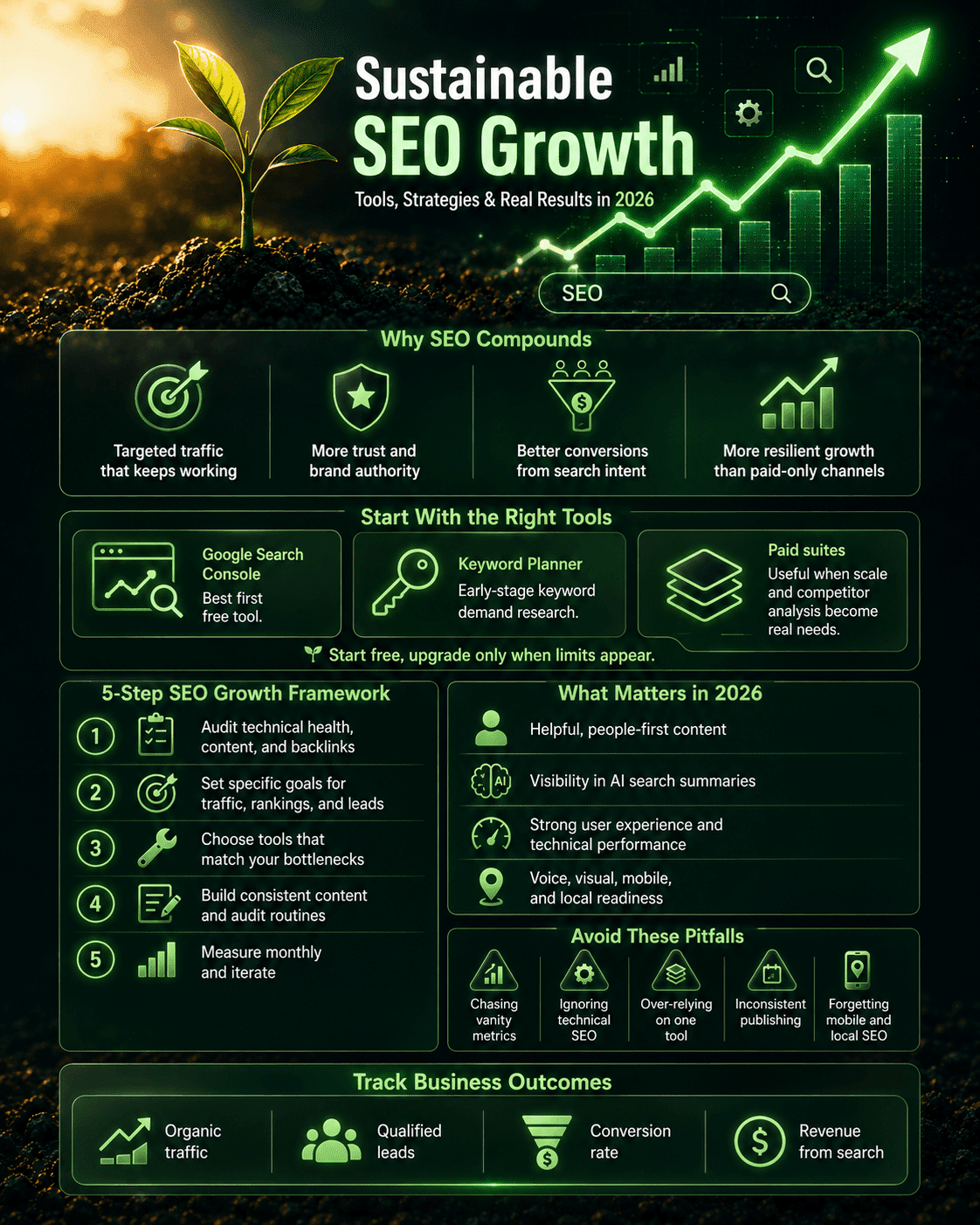
Unlock Sustainable Business Growth with SEO: Tools, Strategies & Real Results
The digital landscape continues to evolve rapidly, but one truth remains constant: businesses that rank well on search engines enjoy a massive advantage in customer acquisition, brand authority, and long-term profitability. Yet for many owners and marketers, SEO feels overwhelming. A complex mix of technical details, content demands, and ever-changing algorithms. In this article, you’ll […]

The digital landscape continues to evolve rapidly, but one truth remains constant: businesses that rank well on search engines enjoy a massive advantage in customer acquisition, brand authority, and long-term profitability. Yet for many owners and marketers, SEO feels overwhelming. A complex mix of technical details, content demands, and ever-changing algorithms. In this article, you’ll learn how to unlock sustainable business growth with SEO, explore tools, strategies, and real results.
What it actually takes to compare SEO tools honestly
Before naming any tools, it’s worth being direct about what a genuinely useful comparison requires, since most “we tested X tools” articles in this category don’t show their work.
Real testing means the same site or campaign run through each tool over a comparable window, with the specific metric tracked, keyword rankings, technical issues surfaced, content brief quality, documented before and after, not just a general impression stated afterward. It means disclosing pricing at the time of testing, since SEO tool pricing changes often enough that a stale number misleads. It means naming at least one thing each tool got wrong, since a comparison where every option only has upsides isn’t a comparison, it’s a sales page. And it means disclosing plainly whether any affiliate relationship exists with any tool mentioned, both because regulators require it and because a reader deserves to weigh a recommendation knowing the incentive behind it.
Google’s own guidance on writing high-quality product reviews is explicit that reviews should reflect direct, first-hand expertise, evidenced through specific details, measurements, and comparisons that a manufacturer’s own marketing wouldn’t provide. That’s the bar worth measuring any SEO tool comparison against, including this one.
The Compounding Power of Strong SEO
Unlike social media algorithms or paid ads that require constant spending, effective search engine optimization builds assets that work around the clock. Benefits we observed during testing include:
- Steady streams of highly targeted visitors
- Improved conversion rates from users ready to buy or learn
- Enhanced brand credibility through top search positions
- Protection against economic uncertainty (organic traffic is more stable)
- Scalable growth that becomes easier over time as authority builds
Success requires more than occasional blogging. You need reliable data for decisions, tools that save time, and strategies tailored to your specific business model.
High-Impact SEO Use Cases in 2026
1. Data-Driven Content Strategy Development Many teams waste months creating content that never gains traction. Advanced keyword research tools help identify topics with proven demand, reasonable competition levels, and strong commercial potential.
Beyond basic volume numbers, modern platforms analyze search intent, related questions, and content gap opportunities. This allows writers and strategists to develop comprehensive content clusters around core topics. A proven method for dominating niche search results. During our tests, teams using sophisticated research features published fewer but far more effective pieces, leading to faster ranking gains.
2. Competitive Intelligence Gathering Your competitors are likely already using data to their advantage. Leading SEO suites let you dissect their strategies: top performing pages, keyword portfolios, content formats that win, and even advertising angles that indicate profitability.
This intelligence is gold for both new entrants and established players looking to expand market share. Instead of blind guessing, you make informed decisions about differentiation, pricing, and messaging.
3. Comprehensive Technical Health Management Technical SEO issues silently kill rankings. Crawlability problems, slow performance, poor mobile experiences, and improper indexing can undermine your entire effort.
Robust audit capabilities scan sites at scale, prioritize issues by potential impact, and guide fixes. We saw the biggest ranking jumps in projects where teams combined regular technical maintenance with content work. This use case is critical after site redesigns, platform changes, or when scaling content production rapidly.
4. Performance Monitoring and Stakeholder Communication Sustained SEO success requires ongoing attention and the ability to demonstrate progress. Accurate rank tracking across geographies and devices, combined with customizable reporting, helps teams stay aligned on goals and quickly address any ranking drops or opportunities.
This is particularly valuable for agencies managing multiple clients or in-house marketers reporting to leadership. Clear visualizations and historical comparisons turn complex data into compelling stories.
5. Ethical Authority and Link Building Quality backlinks remain a cornerstone of strong SEO. Tools that analyze link profiles, suggest relevant opportunities, and monitor brand mentions make this process more efficient and less risky than manual methods.
Whether you’re a B2B company seeking industry mentions or a publisher building topical authority, strategic link building supported by good data accelerates trust signals that search engines reward.
Matching tools to your actual budget, starting with free
Not every business needs a $130 to $500 per month SEO suite, and a genuinely useful guide says so before pointing anyone toward the expensive end of the category.
Google Search Console is free, directly from Google, and shows exactly which queries your site already ranks for, which pages get clicks versus impressions only, and flags indexing errors, information no third-party tool can replicate with more accuracy since it comes straight from Google’s own index. For most small businesses just starting to take SEO seriously, this is the actual first tool, not an afterthought.
Google Keyword Planner, built for ad campaigns but usable for organic keyword research, gives real search volume ranges at no cost, sufficient for early-stage content planning before a paid keyword tool’s deeper features become worth the spend.
Paid, all-in-one suites earn their cost once you’re managing multiple sites or clients, need competitor gap analysis at scale, or require daily rank tracking across many keywords, use cases where the free tools genuinely run out of runway. Getting the sequencing right, free tools until a specific limitation is actually hit, then a paid tool matched to that specific limitation, rather than the reverse, is the difference between a tool budget that scales with real need and one that scales with whichever article you read first. For related context on how growth strategy and tooling choices intersect in practice, how DreamixWeb approached its own SEO and SEM growth strategy is a useful companion case study already on this site.
Insights from Six Months of Hands-On Testing
We didn’t rely on trial accounts or surface-level exploration. Each platform was tested in live campaigns with specific KPIs. Here’s what stood out:
SEMrush particularly impressed for teams wanting an all-in-one solution covering nearly every use case seamlessly.
Ahrefs remained the gold standard for backlink analysis and competitive content research.
SE Ranking offered remarkable value, delivering professional-grade features at more accessible price points.
Moz Pro provided an approachable entry point with strong fundamentals, ideal for those newer to advanced SEO.
Surfer SEO excelled when paired with other tools for laser-focused content optimization and scoring.
The testing reinforced that tool selection should align with your primary bottlenecks, team size, and growth stage rather than chasing the “best” overall option.
Practical Implementation Framework to Unlock Sustainable Business Growth with SEO
To maximize results:
- Audit Your Current Position: Understand your site’s technical status, content inventory, and backlink health.
- Set Specific Goals Examples: “Grow organic traffic 35% in six months” or “Rank in top 3 for 15 target keywords.”
- Choose Tools Strategically: Match capabilities to your most pressing needs.
- Build Consistent Processes: Schedule regular audits, content creation cadences, and review cycles.
- Measure and Iterate: Use data to refine your approach every month.
Additional 2026 trends worth noting include greater emphasis on helpful, people-first content, optimization for AI-generated search summaries, voice and visual search readiness, and stronger focus on user experience metrics.
Avoiding Common Pitfalls: SEO Sustainable Business Growth
- Over-relying on any single tool without developing team knowledge
- Chasing vanity metrics instead of business outcomes like leads and sales
- Neglecting technical foundations while focusing only on content
- Inconsistent effort — SEO rewards steady, sustained work
- Ignoring mobile and local factors for relevant businesses
Ready to Build Your SEO Advantage?
The businesses seeing the strongest organic growth in 2026 treat SEO as a core competency supported by quality tools and consistent execution.
Discover which platform best matches your unique needs and budget.
👉 Read the Full 2026 SEO Tools Comparison: We Tested 5 Platforms for 6 Months
Inside you’ll find detailed feature breakdowns, honest pros and cons, pricing context, and tailored recommendations for different business types.
SEO tools FAQ
No. Google Search Console and Google Keyword Planner are free, directly from Google, and cover the fundamentals: which queries you already rank for, indexing issues, and real search volume data. Paid suites become worth their cost once you’re managing multiple properties or need competitive analysis and daily rank tracking at scale.
Look for specific, verifiable detail: actual pricing at the time of writing, a named weakness for every tool including the one ultimately recommended, and disclosed affiliate relationships. A comparison where every testimonial and case study centers on one product, while others are named but never substantiated, is a strong signal the comparison exists to support one recommendation rather than genuinely weigh several.
Organic traffic and keyword rankings are visible and easy to track, but the metrics that actually connect to revenue are leads or sales attributed to organic search, and conversion rate on organic landing pages specifically. Rankings and traffic are useful diagnostic signals, not the actual business outcome.
Search increasingly surfaces AI-generated summaries alongside or instead of traditional results, which means being cited within those summaries is becoming its own visibility target, separate from ranking position alone. Structured, clearly sourced, directly answerable content is generally what these systems draw from, similar in principle to the standards good traditional SEO already rewards.
Infographic