MDF Cutting, CNC Routing and Spray Painting in London: A Practical Guide to Bespoke Furniture
A practical London guide to MDF cut to size, CNC shaker doors and PU spray painting, with board advice, sheen levels and a supplier checklist.

Bespoke furniture in London is usually made in three workshop steps: the boards are cut to size, shaped on a CNC router, then spray painted with a hard PU finish. How well each step is done decides whether a painted kitchen, a run of fitted wardrobes or a wall of panelling looks factory made or homemade, and you notice the difference every time you open a door.
This buyer’s guide is for interior designers, architects, joiners and homeowners ordering MDF cut to size, CNC cutting and MDF spray painting from a London workshop. It covers how parts move through the workshop, which board to specify, what CNC routing can do for shaker doors and panelling, how a PU spray finish compares with hand painting, what drives the price, where AI tools help, and how to vet a bespoke joinery supplier before you pay a deposit.
The short version
- Moisture-resistant MDF is the default for kitchens, bathrooms and utility rooms. Standard MDF is fine in dry rooms.
- One-piece CNC shaker doors have no frame joints, so there are no joint lines to crack through the paint.
- A PU spray finish is harder and smoother than brushed paint, but the two-pack paints most finishers use belong in a proper spray booth, not a garage.
- Ask every supplier to quote in the same units (per sheet or per part for cutting, per square metre for spraying), otherwise the quotes cannot be compared.
- Send drawings, not renders. A DXF file or a dimensioned cut list saves days of back and forth.
Table of contents
- The short version
- How bespoke furniture components are made, stage by stage
- Prepare drawings and cut lists a workshop can use
- Where AI helps on a bespoke furniture project, and where it does not
- Choosing the right board: MDF, MR MDF, MFC or plywood
- Precision MDF cutting and edge treatment
- CNC routing for shaker doors, panelling and screens
- Professional spray painting: how PU finishes work
- Spray painted vs hand painted furniture
- What drives the price of cutting, CNC and spraying
- One workshop or several suppliers?
- Bench rental for independent makers in London
- Common mistakes that cost money on bespoke joinery projects
- How to vet a London CNC and finishing supplier
- Questions about MDF spraying, CNC lead times and shaker doors
How bespoke furniture components are made, stage by stage
A typical London panel workshop works through six stages. Knowing them helps you write a clearer brief and spot the places where a quote is vague.
- Drawings and files. The workshop needs dimensions it can trust: a cut list, a dimensioned sketch, or CAD files such as DXF or DWG for anything that will be routed.
- Cutting and nesting. Software lays your parts out on standard 2440 x 1220 mm sheets to waste as little board as possible, then a panel saw or CNC machine cuts them.
- Edge treatment. Melamine and veneered boards get edge banding. MDF that will be painted usually has its edges sanded and sealed instead.
- CNC machining. Recesses, profiles, grooves, hinge holes and decorative patterns are routed into the cut panels.
- Preparation and spraying. Parts are sanded, primed and given several coats of PU paint in a booth with extraction.
- Curing, inspection and delivery. Finished parts are checked, wrapped once the paint is hard enough to handle, then delivered or collected.
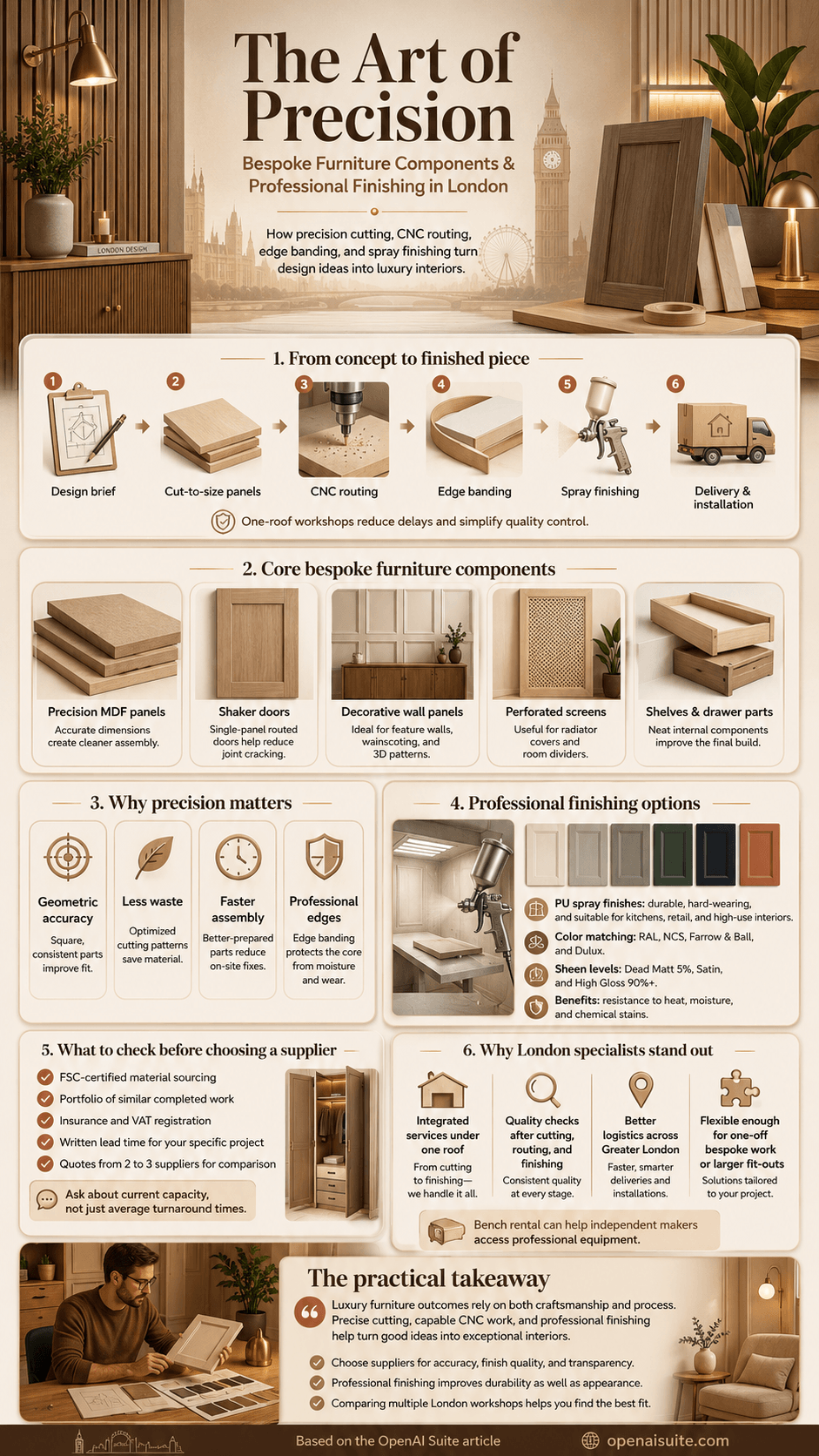
When all six stages happen under one roof, parts are not driven across London half finished. That removes a common cause of dents, delays and arguments between suppliers about who caused a problem. The trade-off is covered further down.
Prepare drawings and cut lists a workshop can use
The quickest way to lose a week is to send a mood board and ask for a price. A workshop quotes from dimensions, materials and quantities, so the brief has to contain them.
Measure on site before anyone draws. A design that looks right on screen still has to fit real walls, real floors and real door openings, and the workshop will build exactly what the drawing says.
What a good cut list includes
- Every part with its finished length, width and thickness in millimetres, always written in the same order.
- The material and grade for each part, for example 18 mm MR MDF or 18 mm white MFC.
- Edge treatment for each edge, not just each part. A shelf might need its front edge banded and the other three left raw.
- A quantity, a part name or number, and which face is on show.
- Positions for hinge holes, shelf pins and handles if you want the CNC machine to drill them.
For routed parts such as shaker doors, fluted panels or screens, send a DXF or DWG drawn at full size in millimetres. Many workshops will also take a PDF or an Illustrator file, but a clean CAD file avoids redrawing charges and misread dimensions.
Allow for London walls
Very few London walls are flat or plumb, especially in Victorian and Edwardian terraces. Build scribe allowances and filler panels into fitted furniture so the installer can trim to the wall on site. A carcass cut perfectly to a drawing that assumed square walls will still leave gaps.
Where AI helps on a bespoke furniture project, and where it does not
AI tools are now part of most design studios, and they can save real time on a joinery project if you give them the right jobs.
- Concept and client sign-off. AI tools for architecture and interior design can turn a sketch into a render or layout in minutes, which makes it easier to agree a look. A render still needs measured drawings before anyone cuts a board.
- A first draft of the cut list. An AI assistant can turn a dimensioned sketch into a tidy table of parts, materials and edge details. Check every figure yourself, because chatbots make arithmetic slips and know nothing about your walls.
- Nesting and machine code. The workshop’s own optimisation and CAM software handles this, not a chatbot. Your job is to supply clean dimensions or a DXF file.
- Colour. Phone apps and AI colour pickers read colour through a camera and show it on a screen, and both shift it. For a match you can rely on, give the finisher a RAL or NCS code or a physical sample. Many paint mixers read samples with a spectrophotometer.
Site measuring, scribing to uneven walls and judging a finish in daylight are still jobs for people.
Choosing the right board: MDF, MR MDF, MFC or plywood
The board decides how a part machines, how the paint sits on it and how it copes with steam and knocks. These are the materials London panel workshops cut most often.
| Board | Best for | Paint finish | Watch out for |
|---|---|---|---|
| Standard MDF | Wardrobes, alcove units, shelving and panelling in dry rooms | Excellent once the edges are sealed | Swells if it gets wet; raw edges soak up paint |
| Moisture-resistant (MR) MDF | Kitchens, bathrooms, utility rooms and CNC shaker doors | Excellent; the denser core gives cleaner routed edges | Resists humidity, not standing water; costs more |
| MFC (melamine-faced chipboard) | Carcasses, office furniture and cabinet interiors | Not made to be painted | Needs edge banding; chips if cut with a worn blade |
| Birch or poplar plywood | Exposed-edge designs, drawer boxes and strong shelving | Good, but grain can show through paint | Voids in cheaper grades; heavier |
| Veneered MDF | Natural wood looks on a stable panel | Lacquered or stained rather than painted | Needs matching veneer edging |
Two more things are worth asking for. The first is the formaldehyde emission class, especially for bedrooms and nurseries. E1 is the usual baseline in the UK, and lower-emission boards are available if a client wants them. The second is certified sourcing, which is covered in the supplier checklist below.
Precision MDF cutting and edge treatment
MDF cut to size is the least glamorous part of the job, but every later stage depends on it. If a carcass side is out by a millimetre, the doors will not hang straight however good the paint is. Workshops commonly quote tolerances of around plus or minus 0.5 mm on their panel saws and CNC machines, far tighter than a circular saw on a trestle in a client’s hallway.
Nesting is where cutting saves money. Optimisation software arranges your parts across full sheets so the offcuts are as small as possible, and on a kitchen or a run of wardrobes that can save whole sheets. Ask whether you are paying for full sheets or only the board you use, and whether usable offcuts come back to you.
Edge banding or sealed MDF edges?
Edge banding is a thin strip of ABS, PVC or real wood veneer glued to the cut edge of a panel. It is standard on MFC and veneered boards, where the raw edge is chipboard or a different colour from the face. Painted MDF is usually handled differently: the edges are sanded, sealed and primed, then sprayed along with the faces, so the colour wraps around the part with no visible line. Banding a painted MDF part only makes sense on an edge that takes heavy wear, and the joint between banding and board can show through the paint.
On MFC, many workshops now prefer ABS edging to PVC because it contains no chlorine and machines cleanly. Thickness matters too. Thin 0.4 to 1 mm edging suits hidden or low-wear edges, while 2 mm edging is better for edges that take knocks, such as drawer fronts and worktop-height shelves.
CNC routing for shaker doors, panelling and screens
A CNC router takes a cut panel and machines it from a digital file. Pockets, profiles, grooves, slots, holes and patterns that would take hours by hand come out identical every time. In furniture work, CNC routing is used most for the jobs below.
One-piece CNC shaker doors
A traditional shaker door has five pieces: two stiles, two rails and a centre panel, glued together. A CNC shaker door is routed from a single sheet of moisture-resistant MDF, with the recessed centre machined out. With no frame joints, there is nothing to open up as the house heats and cools, so you avoid the hairline cracks that often appear at the corners of painted five-piece doors after a winter or two. One-piece doors are also quicker to make in quantity, and every door in the kitchen matches.
The trade-off is detail. A router bit is round, so the inside corners of the recess have a small radius unless someone squares them by hand. Most people never notice. If you are matching existing period joinery with crisp corners, mention it before you order.
Wall panelling and fluted panels
Shaker-style wall panelling, wainscoting, fluted and reeded boards, geometric 3D patterns and slatted acoustic panels can all be routed from MDF, sprayed off site and fitted in a day or two. In an occupied flat or house, that means far less dust and disruption than building and painting panelling in the room.
Perforated screens and radiator covers
Fretwork screens, room dividers and radiator covers are classic CNC jobs. On a radiator cover, keep the open area of the pattern generous and leave gaps at the top and bottom so warm air can circulate, otherwise the room takes longer to heat. Use MR MDF here as well, because the cover sits in warm, sometimes damp air all winter.
Why CNC quality varies between workshops
The machine matters less than how it is set up and maintained. Sharp tooling, the right feed speed and a flat, well-held sheet give clean edges that need little sanding before paint. Larger machining centres now use sensors to adjust feed and speed while they cut, a technique explained in this overview of adaptive control on AI-driven CNC machines. Most furniture workshops do not need that level of automation, but you can still ask what they cut on and how often they change tooling. A good workshop will answer without hesitating.
Professional spray painting: how PU finishes work

Plenty of workshops cut wood. Fewer have their own spray booth, and that is the difference you can see. A spray-finished door has an even film with no brush marks, roller texture or drips on the edges, and it wears far better than most paint you can buy off the shelf. That finish is the main reason people choose kitchen door spraying over brushing, especially for new MDF kitchens.
Why finishers use polyurethane paint
Most professional furniture finishers spray polyurethane (PU) paint. Many PU systems are two-pack: the paint is mixed with a hardener just before spraying and cures chemically into a hard film that resists heat, moisture, cleaning sprays and knocks. That is why a PU spray finish is the usual choice for kitchen doors, bathroom furniture, reception desks and retail fittings.
Why this belongs in a spray booth, not a spare room
The hardener in many PU paints contains isocyanates. The Health and Safety Executive warns that spraying isocyanate-based polyurethane paints can produce very high exposure, and that occupational asthma is a significant risk for people who spray them. Professional finishers control this with spray booths, extraction, suitable respiratory protection and regular health checks. It is one of the clearest reasons to send MDF spray painting to a finishing workshop instead of tackling it in a garage.
Colour matching: RAL, NCS and paint brand colours
You are not limited to a supplier’s colour card. Finishers mix PU paint to standard systems such as RAL and NCS, and many will also match a colour from Farrow & Ball, Little Greene, Dulux or a physical sample you send them. Two cautions apply. A brand paint colour is matched, not identical, because the same pigment reads differently in a hard PU film than in a chalky wall emulsion. And sheen changes how a colour looks, so a dead matt and a satin version of the same RAL code will not appear quite the same. Ask for a sprayed sample board before you approve the full order.
Sheen levels explained
Sheen describes how much light a finish reflects, usually given as a percentage. The names are not standardised: one workshop’s satin is another’s gloss, so always confirm the number rather than the label. These ranges are a reasonable guide.
| Finish | Typical sheen | Where it works | Trade-off |
|---|---|---|---|
| Dead matt | About 5 to 10% | Contemporary and handleless kitchens, panelling | Shows greasy fingerprints sooner |
| Matt | About 10 to 20% | Most painted kitchens and wardrobes | A good balance of looks and practicality |
| Satin | About 20 to 35% | Busy family kitchens, utility and children’s rooms | Easier to wipe clean, slightly more reflective |
| Gloss | About 40 to 80% | Retail fittings and statement furniture | Shows dents and dust more |
| High gloss | 90% and above | Mirror-finish fronts and reception desks | Shows every flaw in the preparation |
Curing and aftercare
PU paint is touch dry quickly but takes longer to reach full hardness, often around a week depending on the product and the temperature. Treat new doors gently for the first few days. Avoid sticking tape to them, do not wrap them tightly in plastic, and clean them with a soft cloth and mild soapy water rather than abrasive creams. Ask your finisher for the cure time and care instructions for their paint system in writing.
Spray painted vs hand painted furniture
| Spray painted (PU, in a workshop) | Hand painted (on site) | |
|---|---|---|
| Finish | Smooth, even film with no brush marks | Visible brush or roller texture, even with good technique |
| Durability | Hard, chemical-resistant film suited to kitchens | Softer; chips and scuffs sooner on busy doors |
| Disruption at home | Doors and panels leave the house while carcasses stay | Painting happens in the room over several days |
| Cost | Higher per square metre, but lasts longer | Lower upfront on small jobs |
| Touch ups | Need matching paint and some skill to blend | Easy with the same tin |
| Best for | New kitchens, MDF furniture, panelling and shopfitting | Fixed period joinery that cannot be removed |
Hand painting still has its place. Fitted bookcases, architraves and period joinery built into alcoves usually cannot come out, so they get brushed in place. Anything new and removable is a strong candidate for spray painted MDF.
What drives the price of cutting, CNC and spraying
Workshops price each stage differently, which is why two quotes for the same kitchen can look miles apart.
- Cutting is usually priced per sheet or per part, with edge banding charged by the metre. The board you choose and how efficiently the parts nest make the biggest difference.
- CNC routing is priced by machine time or per part. Deep pockets, fine patterns and machining on both faces all take longer.
- Spraying is usually priced per square metre of surface. Finishing both faces, painted edges, detailed profiles, high gloss and two-tone work all add to it.
- Delivery can carry extra charges for upper floors without a lift, tight access or central London parking.
For a sense of scale, Perfect Panels, a panel processor that serves South London, Sussex and Kent, publishes guide prices of about £12 per square metre to prime flat MDF panels and about £60 per square metre for a coloured finish on flat panels at 25% gloss. Treat published figures as a starting point, check whether VAT is included, and get a written quote for your own cut list, because profiles, edges and finish level change the total.
One workshop or several suppliers?
You can buy cutting from a timber merchant, CNC routing from a specialist bureau and spraying from a separate finisher. It works, and on paper it can be cheaper. The cost shows up elsewhere: parts travel between sites, every move risks a dent, and when a door arrives out of square nobody agrees whose fault it is.
A workshop that cuts, routes, edges and sprays in one place keeps your parts in one building and on one schedule. As an example of how that works in practice, Easy Spray is a London workshop that has offered panel cutting, CNC machining, edge banding and PU spray finishing since 2011, with delivery and collection across Greater London. Its service pages state that cutting is typically accurate to plus or minus 0.5 mm, that spraying is priced per square metre with itemised quotes, and that most spray orders are finished within a few days to a week. Published numbers like these give you something concrete to measure other quotes against. If a supplier cannot tell you its tolerance, pricing unit or turnaround, make a note of it.
Editorial note: OpenAI Suite has no commercial arrangement with Easy Spray. The workshop is named because its service pages publish the specifications this guide discusses. Apply the checklist below to every supplier you consider, including this one.
A single workshop is not always the right call. A specialist finisher may offer a wider range of lacquers and effects, and a large CNC bureau may be faster on very high volumes. For most residential projects and small commercial fit-outs, though, one accountable supplier is easier to manage.
Bench rental for independent makers in London
Not everyone needs a finished product. Self-employed joiners, cabinet makers and furniture makers often need a professional space for a few weeks without the rent, business rates and machinery costs of their own unit. Some London panel and spraying workshops, including the one in the example above, offer bench rental on an as-needed basis, with access to tools and a workshop where clients can visit.
Before you sign up, check these points:
- What the price covers: a bench only, or machine time, dust extraction, storage and the spray booth as well.
- Whether you need your own public liability insurance (you usually do) and whether you get a machine induction.
- Whether renters can use the spray booth or have to book the in-house finishing service.
- Opening hours, notice periods and where work in progress is stored overnight.
- How dust is controlled. MDF dust is a recognised respiratory hazard, so extraction on the saws and sanders makes the workshop a safer place to spend your day.
Bench rental suits makers who are growing. Once you have staff, stock and repeat trade customers, tracking jobs, purchase orders and invoices in spreadsheets starts to break down, which is usually the point where an ERP system for growing companies becomes worth the setup time.
Common mistakes that cost money on bespoke joinery projects
- Approving a picture instead of a drawing. It is easy to fall for an AI interior render that looks finished but cannot actually be built, so check every image against measured drawings before you order.
- Specifying standard MDF in a kitchen or bathroom to save a little money. The first leak or steamy winter will cost more than the upgrade.
- Choosing a colour from a fan deck without seeing a sprayed sample at the sheen you want.
- Ordering five-piece MDF shaker doors for a painted kitchen, then being surprised by cracks at the joints.
- Forgetting fixings. Hinge holes, shelf-pin holes and handle positions are cheaper to drill on the CNC than by hand on site.
- Comparing quotes in different units, such as one priced per door and another per square metre.
- Ignoring delivery access. Upper-floor flats without a lift, narrow stairwells and central London parking rules affect both the delivery price and the largest panel that can get into the building.
How to vet a London CNC and finishing supplier
Whichever workshop you shortlist, run it through the same checks. They take an hour and can save a project.
- See comparable work. Finished kitchens or panelling with client references tell you more than product photos. Visit the workshop if you can.
- Get the materials in writing. Ask for the board brand and grade and the paint system they spray.
- Check certification, not claims. If your client wants responsibly sourced material, ask for MDF or plywood from FSC-certified suppliers and check that the invoice shows the FSC claim and the supplier’s certificate code. A general line about sustainability on a website is not the same thing.
- Confirm insurance and VAT. Public liability cover is standard. For commercial work you will also want a VAT-registered supplier and clear payment terms.
- Get a lead time tied to your job. Turnaround depends on order volume, cut list complexity and how busy the spray booth is. Ask what happens to your date if a large order lands or a machine breaks down, and whether a single vanity unit gets the same attention as a 500-panel fit-out.
- Ask how parts are inspected. A good workshop checks dimensions after cutting, after routing and after the final coat, and can tell you how it handles rejects.
- Agree who pays for errors. Many workshops recut their own mistakes free of charge. Find out what happens when the error is in your cut list.
- Compare at least two quotes. Prices and turnaround vary a lot across London. For anything bigger than a single unit, send the same cut list to two or three workshops.
How this guide was put together: it draws on Health and Safety Executive guidance on isocyanate paints, the published service pages and price lists of London panel workshops, and standard joinery practice. Prices, lead times and services change, so confirm the details with any workshop before you order.
Questions about MDF spraying, CNC lead times and shaker doors
It depends on order volume and complexity. Straightforward spray orders often take a few days to a week, while full kitchens or large panelling jobs with CNC routing take longer. The paint also needs a few days to harden before heavy use. Always get a written date for your specific job.
For painted furniture it often performs better. MR MDF is stable and does not move with the seasons the way solid timber does, so the paint is less likely to crack at joints, and a professionally applied PU finish is harder than most brushed paints. Durability still depends on preparation, the paint system and keeping water away from raw edges.
Most finishers price spraying per square metre, with extra charges for complex profiles, high gloss, two-colour work and painted edges. Cutting is usually priced per sheet or per part, and CNC work by machine time or per part. Because the units vary, ask every supplier to quote the same cut list in the same units.
Cut to size produces flat rectangular panels at exact dimensions. CNC routing machines shapes into or out of those panels, such as shaker door recesses, grooves, curves, fluted patterns and hinge holes. Most bespoke furniture projects need both.
Yes. Moisture-resistant MDF copes far better with steam and humidity, gives cleaner routed edges and is the usual board for kitchen, bathroom and utility room doors. It resists moisture but it is not waterproof, so the edges still need to be sealed and painted.
For painted MDF doors, usually yes. A one-piece door has no frame joints, so it avoids the hairline cracks that can appear at the corners of painted five-piece doors. The inside corners of the recess are slightly rounded by the router bit, which only matters if you need sharp period detail.
A DXF or DWG file drawn at full size in millimetres is the safest choice. Many workshops also accept PDF or Illustrator files or a dimensioned sketch, but they may charge to redraw them. For cutting only, a clear cut list with dimensions, quantities and edge details is enough.
You can spray water-based paints at home with care, but the hard two-pack PU finishes professionals use often contain isocyanates. The Health and Safety Executive treats spraying them as a serious asthma risk that calls for extraction and proper respiratory protection, so that finish belongs in a professional spray booth.
Many professional finishers can match Farrow and Ball, Little Greene, Dulux or a physical sample, as well as RAL and NCS codes. The colour is mixed into PU paint, so it will be very close rather than identical. Ask for a sprayed sample at your chosen sheen before approving the full order.
An AI assistant can turn a dimensioned sketch into a first draft of a cut list, which saves typing. It cannot measure your room and it can make arithmetic mistakes, so check every dimension before you send it. The CNC program itself is produced by the workshop’s own CAM software from your DXF file or cut list.
