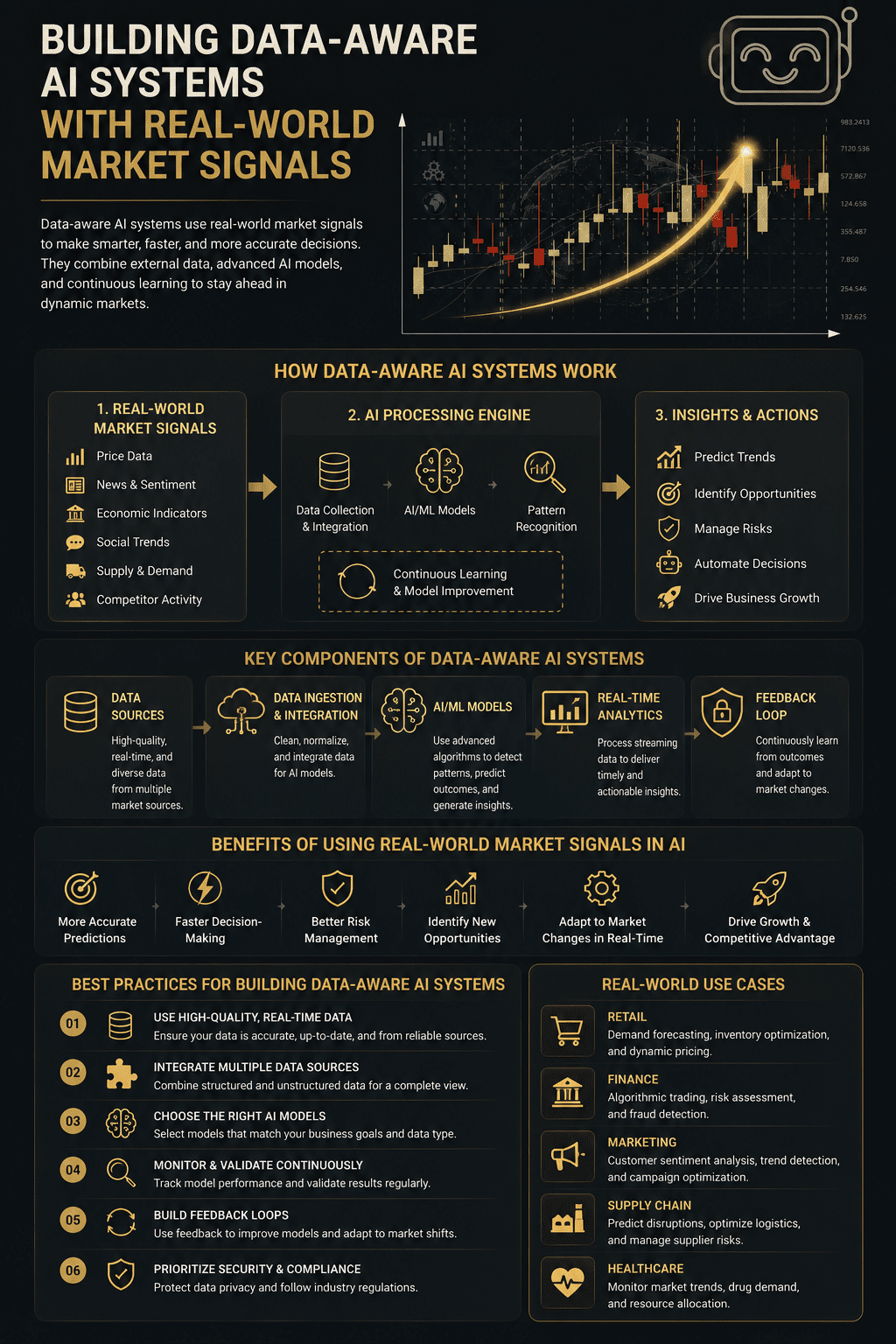
Building Data-Aware AI Systems with Real-World Market Signals
Stock market data is a high-velocity signal MLOps teams use to stress-test AI pipelines. Here’s how to actually build with it, stack included.

Modern AI systems are no longer limited to static datasets. As models move closer to real-world use, powering analytics, automation, and decision support, they increasingly benefit from live, structured signals that reflect what’s happening outside the training corpus. Market data is one such signal: it provides time-stamped, high-frequency information that can be used to test pipelines, validate models, and enrich AI-driven products with contextual awareness. In this article you’ll explore the process of building data-aware AI systems with real-world market signals.
For teams building data-aware AI tools, reliable stock market inputs are particularly useful. Price updates, volumes, and market micro-signals offer a continuous stream of events that can be under process by feature pipelines, anomaly detection systems, and monitoring layers. A practical reference for accessing structured equity pricing information can be found via a technical reference for stock price updates, which developers can use to prototype ingestion, caching, and event-driven workflows.
Other data sources worth considering
Finage is one practical option for accessing structured equity pricing data, but it’s worth knowing the broader landscape before committing to a single provider. Polygon.io and Alpha Vantage are both widely used alternatives offering real-time and historical market data APIs with free tiers suitable for prototyping, and IEX Cloud offers a similar option with a strong reputation for reliability at scale. The right choice depends on rate limits, historical depth, and whether the project needs equities specifically or broader asset coverage, worth comparing directly against your actual pipeline’s throughput requirements rather than defaulting to the first option found.
Why Market Signals Matter for AI Pipelines
Live market streams are ideal for testing real-time inference systems because they are:
- High-velocity: suitable for stress-testing ingestion and streaming layers.
- Time-sensitive: useful for validating latency budgets and alerting logic.
- Structured: easy to normalize for feature stores and downstream consumers.
These properties make market data a strong benchmark input for MLOps teams validating observability, retries, backfills, and idempotency in production pipelines. Even outside finance-specific use cases, the same patterns apply to IoT telemetry, sensor feeds, and event logs with real-world market signals using AI.
Practical AI Use Cases Building Data-Aware Systems
- Streaming feature engineering: Transform last-price updates into rolling features for model inputs.
- Anomaly detection: Flag abnormal volatility to validate alerting thresholds.
- Latency monitoring: Measure end-to-end time from ingestion to inference.
- Backtesting pipelines: Reproduce historical windows to validate model drift handling.
Implementation Notes
Adopt a decoupled architecture: ingest market events into a message broker, normalize into a feature store, and expose consumers to inference services. Add circuit breakers and rate limits to protect downstream systems. This pattern mirrors production-grade AI deployments and keeps experimentation close to real-world constraints.
A concrete stack for this pattern
The decoupled architecture described above, ingest into a message broker, normalize into a feature store, expose to inference services, has well-established open-source tooling behind each step, worth naming directly rather than leaving abstract.
Apache Kafka is the most common choice for the message broker layer specifically because it handles high-throughput, ordered event streams well, exactly the profile market data produces. Feast is a widely used open-source feature store that handles the normalization and serving layer, designed specifically to bridge streaming data into consistent features for both training and real-time inference. Pairing these two with whichever market data API is chosen gives a genuinely reproducible starting stack for the pattern this article describes, rather than a conceptual outline without a concrete path to implementation. For teams also thinking through the broader infrastructure cost picture, OpenAI Suite’s guide to self-hosting an LLM on a VPS covers a closely related infrastructure decision, controlling cost and ownership at the compute layer rather than the data layer.
Conclusion
AI products become more robust when trained and validated against live, structured signals. Using real-time market inputs to test data pipelines, observability, and inference paths helps teams build resilient systems that generalize beyond static datasets. This kind of testing is ultimately about preparing AI stacks for production realities, where timing, reliability, and data quality matter as much as model accuracy.
Data-aware AI systems FAQ
Market data is high-velocity, time-sensitive, and well-structured, making it a convenient stand-in for stress-testing ingestion, latency, and backfill handling in any pipeline, including ones ultimately built for IoT telemetry or event logs. Its main advantage is availability: it’s easy to access in real time and historically, unlike many production data sources that aren’t available until a system is already live.
Apache Kafka for the message broker layer and Feast for the feature store layer are both widely used, well-documented open-source options that pair naturally with a market data API for prototyping this pattern end to end.
Rate limits and historical data depth matter most for prototyping and backtesting specifically. Compare free-tier limits across providers like Finage, Polygon.io, Alpha Vantage, and IEX Cloud against your actual expected throughput before committing to one.
Infographic