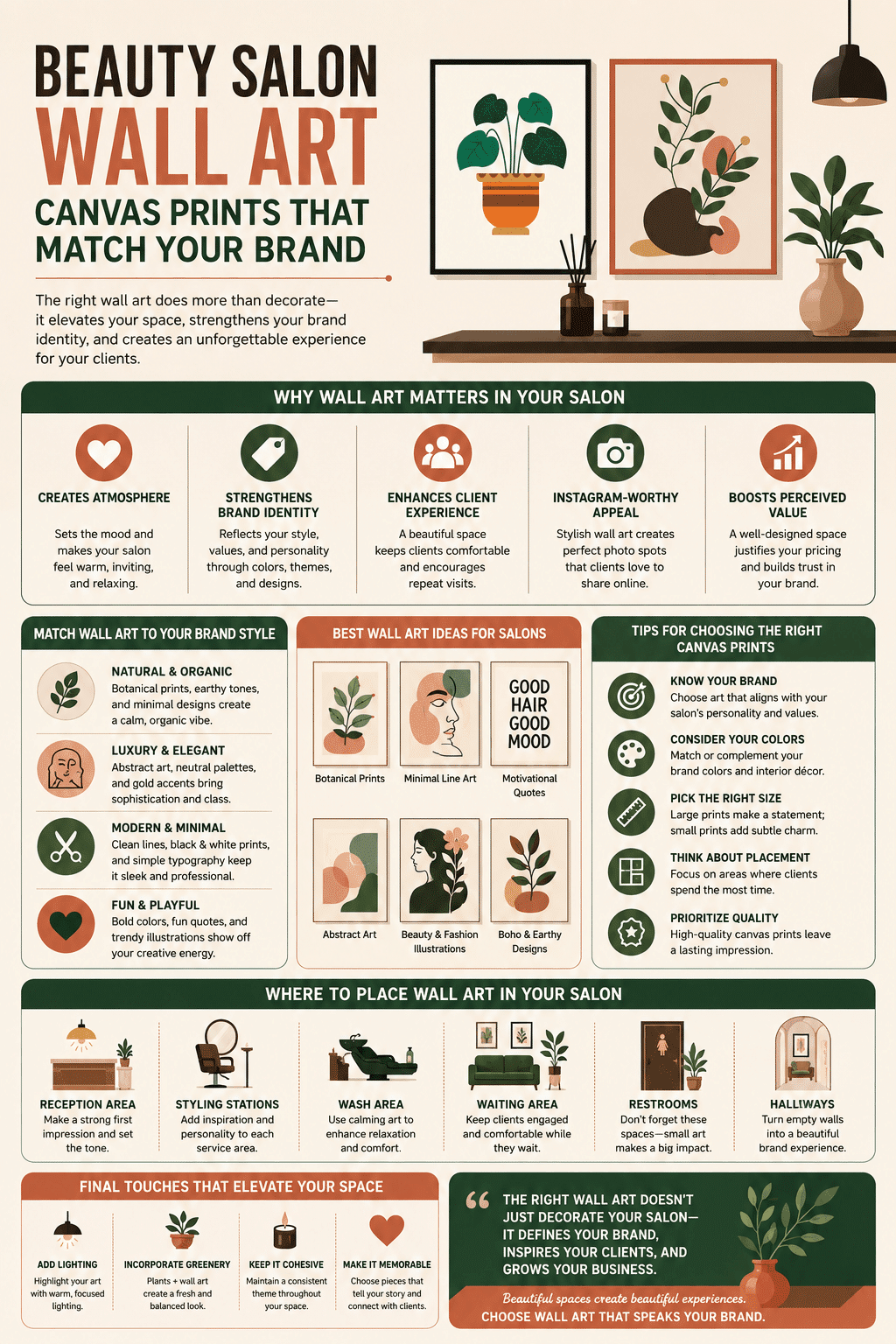
Beauty Salon Wall Art: Canvas Prints That Match Your Brand
Beauty Salon Wall Art Ideas: How to Choose Canvas Prints That Fit Your Space In a beauty salon, clients notice details fast. Lighting, mirrors, and seating set the mood, and wall art quietly supports that first impression. The right canvas prints can make a room feel consistent, tidy, and aligned with your brand without filling […]

Beauty Salon Wall Art Ideas: How to Choose Canvas Prints That Fit Your Space
In a beauty salon, clients notice details fast. Lighting, mirrors, and seating set the mood, and wall art quietly supports that first impression. The right canvas prints can make a room feel consistent, tidy, and aligned with your brand without filling every inch of wall space. In this article, you’ll learn all about beauty salon wall art and learn how to use canvas prints that match your brand.
If you want a focused place to start, browse the Beauty Salon Canvas Prints collection and pick a direction you can repeat across key walls.
Why wall art matters in a salon
It strengthens the reception area
A planned wall behind the desk signals care. One statement canvas or a balanced pair can make check-in feel polished.
It keeps styling stations visually calm
Mirrors and shelves already create strong lines. Simple, well-spaced artwork helps those lines look intentional rather than busy.
It supports brand color consistency
Canvas art can repeat your palette. So, neutrals, contrast, or soft tones. So the room feels cohesive from entry to stations.
Beauty salon wall art before you buy: a quick checklist
- Wall measurements: measure the usable width and height, and leave some open wall as a border.
- Viewing distance: longer viewing distances usually allow larger wall art.
- Lighting: check how your palette looks under the same bulbs used in the salon.
- Daily wear: plan placement away from splash zones and constant contact areas.
Theme directions that suit beauty salons
Minimal line art for a clean, modern look
Line-based artwork pairs well with glossy finishes and uncluttered counters, and it behaves nicely near mirrors. For a consistent feel across multiple walls, browse Minimalist Canvas Prints and repeat one format along a corridor or a row of stations.
Botanical forms for a softer corner
Botanical visuals work well near a consultation seat or a calmer zone. Keep shapes clear and colors aligned with your palette. If you want floral energy without a busy pattern, explore Floral Abstraction Canvas Art and choose one or two pieces in the same color family.
Abstract paintings that add energy without visual clutter
Abstract work can bring a modern mood when the palette is controlled. It is often strongest on a long wall where you want one focal point. A good range is Abstract Modern Wall Art, where you can pick bold shapes that still read clearly from a distance.
Fashion-forward portraits as a focal point
Portrait-based artwork can suit salons that lean toward fashion and editorial styling. Keep the background simple so the print reads well from a distance, and avoid overly busy patterns near product displays. A portrait canvas can work as the main piece in a waiting area, while simpler companion pieces can carry the same palette into the rest of the room.
Where to place canvas prints inside the salon
Reception and waiting area
This zone is ideal for a statement canvas. Keep the artwork center close to eye level from the main seating line.
Hallways and transitional walls
Use a small series rather than one tiny piece. Repeating the same size and spacing makes the corridor feel orderly.
Shampoo and wash station zones
Choose calmer compositions and place them away from direct splash risk. Medium formats usually feel balanced here.
Manicure, brow, and makeup areas
Clients sit close to the wall, so smaller formats or a tight set can work well. Especially when spacing stays consistent.
Formats that work especially well in salons
One large statement canvas
For an instant “finished” look, start with one large wall art piece on your main wall. A single large canvas print is easy to read from the entry and reduces the need to decorate every surface.
Two-piece sets for narrow walls
If a wall is broken up by doors or shelving, two matching pieces can keep balance. Use the same size, keep spacing equal, and center the pair as one unit above furniture.
Three-panel layouts for long seating areas
Three-panel canvas art can work well above a long bench because it repeats rhythm without feeling heavy. Keep the palette consistent across all panels.
Small grids for service zones
In manicure or brow areas, clients sit close to the wall. A small grid can add personality while staying controlled, as long as alignment and spacing are consistent.
Size and layout: making art look intentional
Most layout issues come from scale. Use these steps to plan a wall that feels deliberate:
- Pick one feature wall: often behind reception.
- Match artwork to furniture width: aim for about two-thirds to three-quarters of the width below it.
- Keep spacing consistent: identical gaps look cleaner than “by eye” spacing.
- Align with room lines: use mirror edges and station lines as references.
Color planning for salon wall decor
Neutrals with one accent
Neutral interiors often look best with artwork that repeats the base tones and adds one controlled accent color.
Black-and-white for a sharp look
Black-and-white pieces can suit many salon interiors. Keep contrast consistent across walls so the space reads as one room.
Repeat finishes
Repeat one or two finishes. Such as bright white surfaces, warm wood, or dark metal. So the artwork feels connected to the interior.
What to actually check before buying any canvas print for a commercial space
Regardless of which company you buy from, a few specific, vendor-neutral details determine whether a canvas print holds up in daily salon use.
Canvas weight and material matter more in a working studio than a home. Heavier poly-cotton blend canvases, generally in the 380 to 400 GSM range, resist sagging from humidity better than lighter canvases, an important distinction near wash stations and steamers. Ask directly what material and weight a vendor uses rather than assuming canvas means one standard product.
Ink type affects long-term color stability under salon lighting, which is often brighter and left on longer than typical home lighting. Pigment-based inks generally resist fading better than dye-based inks over time, worth asking about directly if the piece will sit under continuous salon lighting for years.
Stretcher bar construction affects whether a canvas stays taut over time. Kiln-dried wood resists warping from humidity changes better than non-kiln-dried alternatives, and a genuine gallery-wrap technique, where the image continues around the visible edges, gives a more finished look than a stapled or folded edge.
Asking these three questions of any vendor, not just accepting one company’s description of its own product as the standard, is the difference between a genuinely informed purchase and repeating marketing copy.
Common mistakes to avoid
Choosing artwork that is too small
Small pieces can disappear on wide walls. If you prefer smaller work, group it into a set so the total width fits the wall and the furniture below it.
Hanging artwork too high
Keep the center near eye level, then adjust for whether the main viewing point is seated or standing.
Mixing too many styles at once
Salons already have products, signage, and mirrors. Pick one main direction for most walls and reserve one feature wall for contrast.
Crowding mirrors and work areas
Mirrors reflect everything, so busy walls can double visual noise. Leave clean space near mirrors and avoid collisions with shelf lines and fixtures.
Care and upkeep in a working studio
Dust and day-to-day cleaning
Fine dust from products can settle on surfaces. Wipe gently with a soft, dry cloth and keep artwork away from direct spray areas.
Humidity and heat
Wash stations and dryers can change humidity and temperature in small zones. Keep canvas art away from direct heat and allow normal airflow.
A consideration specific to licensed salon spaces
One thing worth checking before finalizing wall art placement in a professional salon: many state cosmetology and barbering boards have specific sanitation requirements for surfaces near styling and treatment stations, and these requirements can vary meaningfully by state and by the specific service being performed nearby. Fabric-surfaced items, including canvas art, are sometimes treated differently from non-porous surfaces like glass or acrylic prints under these regulations, particularly in zones close to chemical services or direct client contact.
This is genuinely worth a quick check with your specific state board or your salon’s licensing inspector before finalizing placement near active service areas, rather than assuming any wall art format is automatically compliant. It costs nothing to ask and avoids a genuinely inconvenient surprise during an inspection.
Keeping the room tidy with artwork
- Leave breathing space: avoid placing art directly against mirrors, signage, or shelves.
- Use a grid for sets: straight lines are easier to maintain over time.
- Refresh with one swap: replace one feature piece instead of rearranging every wall.
FAQ
Use one large piece for a wide wall, or two medium pieces for a narrower wall.
It only needs to stay in the same color family under your lighting.
One large piece makes a clear focal point; a set works well on longer walls and corridors.
Place the center near eye level, and consider seated eye level in waiting areas.
Simple compositions are safest; line art and controlled abstract shapes read cleanly in reflections.
Yes, keep one shared element such as palette, size, or visual density.
Start with one focal piece, then add sets only where the wall is long enough.
Repeat one size, keep equal spacing, and lay the arrangement out before hanging.
Soft neutrals, muted tones, and controlled contrast tend to feel calm.
Choose one strong accent and keep the rest restrained
Yes—place it where it will not be bumped and keep the wall uncluttered.
Yes, if you leave space so labels and shelves do not visually collide with the artwork.
Canvas art adds depth; art prints can work well for smaller zones and sets.
Repeat one format across two or three walls, then use one feature piece to define the mood.
Start with a statement canvas for reception, then build a repeated set on one supporting wall.
Possibly, depending on your state’s cosmetology board requirements and how close the art sits to an active service area. Some jurisdictions treat porous, fabric-surfaced items differently from non-porous options like acrylic or glass-covered prints in zones near chemical services. Checking directly with your state board or licensing inspector before installation is worth the five minutes it takes.
Heavier poly-cotton blend canvases, generally in the 380 to 400 GSM range, resist sagging and warping from ambient humidity better than lighter-weight canvases. This matters more in salons than in typical home settings because of steam from wash stations and general moisture in the air.
Next step
Choose one palette, one format, and a feature wall, then expand from there. Start your selection in the Beauty Salon collection and build outward with repetition.
Infographic