Phantom Blade Zero Combat Explained: How to Read Action Game Reviews Before You Buy
How Phantom Blade Zero’s Sha-Chi, color cues and difficulty modes work, and what to check in any action game review before you buy.
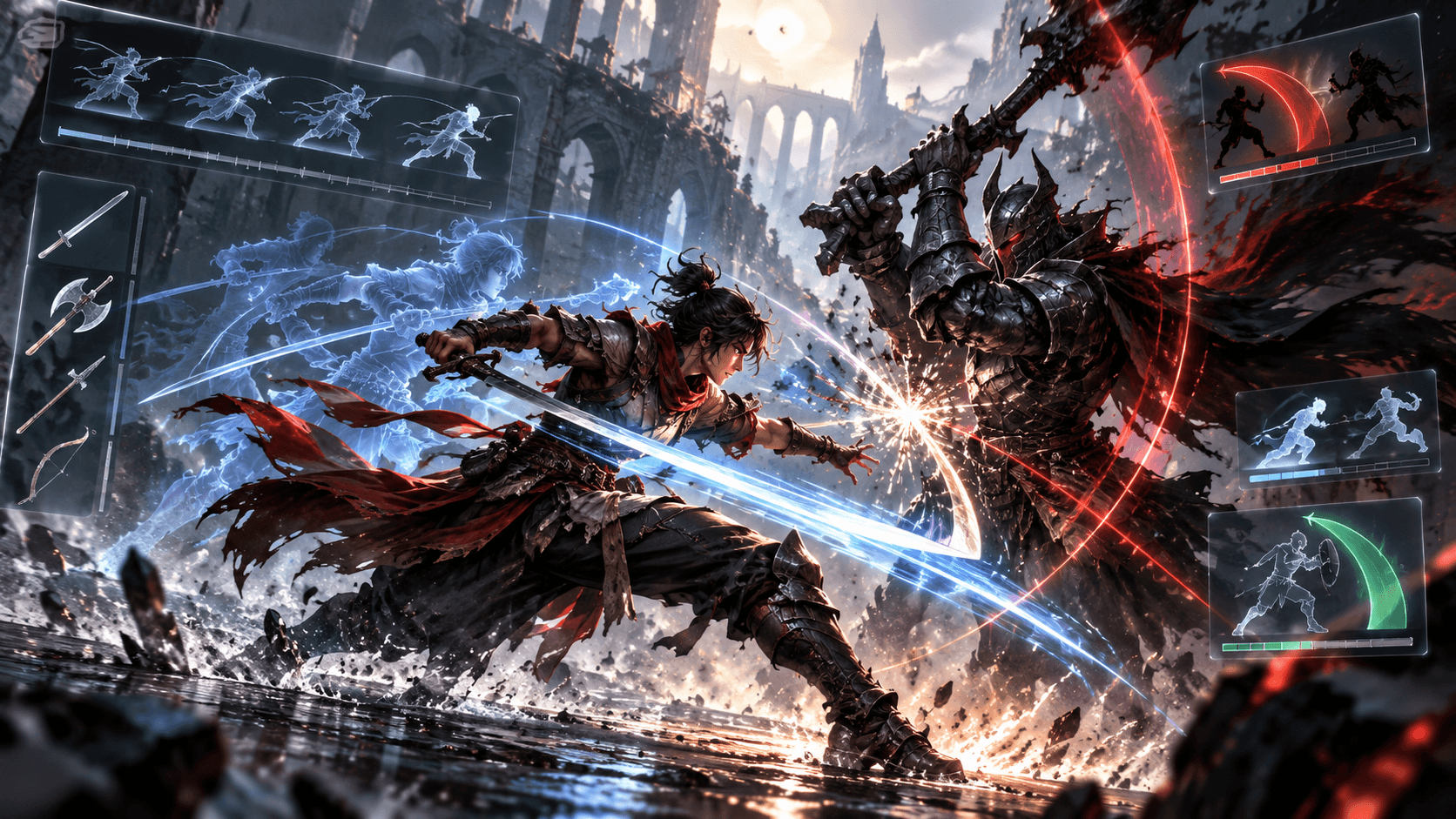
Trailers make every sword fight look perfect. They do not tell you whether the parry window still feels fair twenty hours in, whether the hardest mode is smarter or just tougher, or whether the PC version stutters in an area you have to cross three times.
This guide breaks down Phantom Blade Zero combat system by system: how Sha-Chi ties attack and defense together, what the blue and red attack cues ask of you, how the four difficulty modes and Hellwalker’s enemy AI change fights, and where launch reviews agree and disagree. It ends with a checklist you can use to judge combat in any action game review before you buy.
Table of Contents
- Phantom Blade Zero at a Glance
- How Phantom Blade Zero Combat Works
- Phantom Blade Zero Difficulty Modes and What Hellwalker’s Enemy AI Changes
- Game AI vs Generative AI: What S-Game’s Pledge Covers
- Where Phantom Blade Zero Reviews Agree and Where They Split
- Performance: The Part Trailers Never Show
- How to Judge Combat in Action Game Reviews
- Use Your Own Footage Like a Coach
- Is Phantom Blade Zero Worth It?
- Phantom Blade Zero Difficulty, Length, Weapons and AI: Quick Answers
Phantom Blade Zero at a Glance
- Developer: S-Game, led by founder and director Soulframe Liang, with Kenji Tanigaki as action director
- Platforms: PlayStation 5 and PC (Steam and Epic Games Store)
- Genre: single-player action RPG that S-Game calls Wuxia Action rather than a Soulslike
- Story setup: Soul, an elite assassin of the Order, is framed for his master’s murder, gravely wounded by his childhood friend Zuo Shang, and left with 66 days to live
- Length: roughly 25 to 30 hours for a full playthrough, according to S-Game’s director
- Arsenal: more than 30 primary weapons and 25 Phantom Edges
- Difficulty: four modes, from story-first Wayfarer to the 66 Days challenge
- Launch reception: 88 on Metacritic and 91 on OpenCritic in the first days after release
How Phantom Blade Zero Combat Works
Phantom Blade Zero combat rests on three connected systems: a shared resource, a color-coded defense and a four-weapon loadout. Once you see how they feed each other, most of what critics praise, and some of what they criticize, starts to make sense.
Sha-Chi: One Meter for Attack and Defense
Sha-Chi is the resource behind almost everything Soul does. You build it by landing hits and spend it on heavy techniques, Phantom Edge activations and each weapon’s Power Surge. Blocking drains it too, and that is the clever part of the design: holding guard is never free, so the game keeps nudging you toward precise answers instead of hiding behind a block.
Two details change how fights flow. Swapping your primary weapon mid-fight refills Sha-Chi, which turns weapon switching from a style choice into the basic rhythm of combat. Enemies also have Sha-Chi bars of their own, and clean parries drain them, so good defense is also how you break an opponent open.
Blue and Red Attacks, Parries and Ghoststep
Enemy attacks flash a color a split second before they land, and the color tells you the right response.
| Cue | Attack type | Can you block it? | Best response |
|---|---|---|---|
| Blue flash | Brutal Move | Yes, but it costs a large chunk of Sha-Chi | Parry with precise timing |
| Red flash | Killer Move | No | Dodge at the last moment |
Answer either one with the right timing and you can trigger Ghoststep, a reposition behind the attacker that opens a counter window. The wrong answer is worse than doing nothing: as the GAMES.GG combat guide points out, blocking a red attack still lets the hit through. Learning to parry blue and dodge red is the single most important skill in the game.
This is also where the sharpest criticism lands. FinalBoss’s PS5 review found that the color cues make defense very readable but felt that individual sword strikes lack a convincing sense of weight, so the movement impresses more than the contact. A score cannot carry that kind of observation.
Weapons, Phantom Edges and the Four-Slot Loadout
Soul carries two primary weapons, called Blades, and two secondary weapons, called Phantom Edges. S-Game’s State of Play presentation put the full arsenal at more than 30 Blades and 25 Phantom Edges, ranging from cannons and lances to axes, hammers and bows. Some Phantom Edges also open blocked paths, so parts of the world cannot be fully explored on a first visit.
For a combat breakdown, the count matters less than whether weapons change decisions. S-Game’s State of Play pointed to heavy blunt weapons as the answer to shielded enemies, so loadouts do respond to what you are fighting. At the same time, Liang has said the game can be finished with a single weapon, so variety rewards experimenting rather than forcing it. Upgrades can be reset and reinvested at no cost, which keeps that experimenting cheap.
Donnie Yen and the Choreography
Donnie Yen has worked as a creative consultant on the game’s kung fu since 2023 and plays Mó Yuan, Soul’s father, through facial and motion capture. S-Game also credited his stunt team for the fight choreography. Paired with Kenji Tanigaki’s action direction, that background explains why animation quality comes up as a highlight in so many reviews.
Phantom Blade Zero Difficulty Modes and What Hellwalker’s Enemy AI Changes
There are four Phantom Blade Zero difficulty modes, and the higher ones do more than inflate health bars.
| Mode | Built for | What changes |
|---|---|---|
| Wayfarer | Story-first players and newcomers | Less aggressive, less reactive enemies and easier stance breaks |
| Pathbreaker | Most first playthroughs | The standard challenge and the default setting |
| Hellwalker | Experienced action players | Adaptive enemy AI plus new boss skills and attack patterns |
| 66 Days | Veterans after a first clear | Hellwalker-level enemies with a cap of 66 deaths for the whole run |
Hellwalker is where the game’s enemy AI becomes the headline. In comments reported by GamingBolt, Liang described bosses on that tier as choosing their next move based on how their previous attack played out, and GamesRadar’s coverage framed the mode as feeling closer to fighting another player. 66 Days keeps the same enemy behavior and raises the stakes instead, since every death costs one of Soul’s remaining days. It unlocks after you finish the game once.
For readers, the practical takeaway is simple: a review played on Pathbreaker tells you very little about Hellwalker. If you plan to play on the top tier, look for coverage that says it was tested there. Tuning one cast of enemies to behave four different ways is a serious design problem, and if you are curious how teams prototype and playtest systems like this, our guide to how game development works, from first prototype to playtesting is a good starting point.
Game AI vs Generative AI: What S-Game’s Pledge Covers
Months before launch, S-Game publicly stated that Phantom Blade Zero was made without generative AI in its visual content. The studio credited human artists, cast members it scanned for character models, professional motion capture and hand-painted maps. The statement landed in the middle of a wider argument about consent and credit, the same concerns that explain why many artists object to generative AI.
On a site that covers AI tools, two points deserve to be kept apart. The pledge is about production: it describes how the art, animation and maps were made, and the animation quality critics keep praising is partly a result of that choice.
It also says nothing against game AI. Enemy behavior in action games is normally driven by systems that designers author to read the state of a fight and choose a response, and that is what makes Hellwalker hard. It is a different technology from the generative models that produce images or text, and coverage of the game often blurs the two.
Where Phantom Blade Zero Reviews Agree and Where They Split
At launch, Phantom Blade Zero averaged 88 on Metacritic and 91 on OpenCritic’s review aggregate, and the first wave of reviews contained no negative scores. VICE’s review roundup found the consensus strongest on combat and boss fights. Exploration earned praise too: Multiplayer.it pointed to Metroidvania-style design, and Push Square and GamingBolt both described the world as rewarding to explore.
The disagreements cluster in three areas:
- Story and script: Absolute Geeks found the story baffling, and Nerdsnack summed up the launch reviews as great kung fu with a messy story. GamingBreath flagged clunky English dialogue and noted that some of the best story beats sit in optional content that is easy to miss.
- Difficulty and design: Creative Bloq praised the kung fu but called parts of the design frustrating, and VICE’s roundup lists difficulty balance among the main complaints.
- Technical polish: frame rate is a recurring complaint, singled out in The Loadout’s summary of launch reviews, and it matters more than usual in a game built on split-second reads.
The useful habit is to read the spread, not the average. A 9 and a 7 that both love the combat but disagree about performance tell you more about your own purchase than either number alone. Any Phantom Blade Zero review that explains why it landed where it did is worth more than one that only reports the score.
Performance: The Part Trailers Never Show
In a game where the right answer depends on a color that appears a split second before impact, a dropped frame at the wrong moment is a missed parry. GamingBreath found PC frame rates generally stable in its review but flagged noticeable drops around the lake region, Soul occasionally getting stuck on geometry during stealth sections, and crashes on some fast travel attempts. Treat performance as platform-specific and check recent patch notes before you buy.
On a laptop, sustained graphics power matters more than the GPU name printed on the box. Our breakdown of gaming laptop requirements explains why two machines with the same graphics chip can run the same game very differently once they heat up.
How to Judge Combat in Action Game Reviews
Phantom Blade Zero shows why a score alone is a poor guide: critics agree on the fighting and split on almost everything around it. Use this game review checklist for any action game you are considering. A useful review should give you evidence on each point:
- Input response: can attacks be cancelled into a dodge or parry, or are you locked into long animations once you commit?
- Readable threats: can you tell what an enemy is about to do, and is the correct answer clear?
- Resource economy: what do attacking and defending cost, and how do you earn it back?
- Meaningful variety: do new weapons change how you approach a fight, or only how it looks?
- Difficulty design: do higher modes change enemy behavior, or just add health and damage?
- Performance on your platform: in a timing-based game, a frame drop is a gameplay problem, not a cosmetic one.
- Testing conditions: how many hours, on which difficulty, on which hardware?
The last point gets skipped most often, and it matters most. A verdict written after a few hours of play can miss how a system holds up later, the same trap that explains why first-impression reviews mislead buyers in other product categories. A combat breakdown that names its difficulty and hardware is worth more than a higher score that does not.
Use Your Own Footage Like a Coach
The most useful combat breakdown you will ever read is your own. Record a boss attempt on PS5 or PC, watch it back frame by frame if your player allows it, and tag every hit you took:
- Wrong read: did you try to parry a red attack or dodge a blue one?
- Wrong timing: right answer, but too early or too late?
- Empty meter: were you blocking with no Sha-Chi left because you forgot to swap weapons?
Patterns usually show up within two or three attempts, and fixing one category at a time works better than trying to fix everything at once. Professional teams follow the same process at scale, and AI tools that review match footage can now tag moments like these automatically, which saves time once you know what you are looking for.
Is Phantom Blade Zero Worth It?
Based on the launch coverage, it is an easy recommendation if you:
- Want fast, readable melee combat that rewards precise defense over button mashing
- Enjoy experimenting with loadouts, since upgrades can be reset at no cost
- Like difficulty modes that change how enemies behave, not just how much damage they take
It is worth waiting for patches or a sale if you:
- Care most about story delivery and polished dialogue
- Play on lower-end PC hardware and are sensitive to frame drops
- Dislike games that hide key story content in optional areas
Phantom Blade Zero Difficulty, Length, Weapons and AI: Quick Answers
Not by its developer’s definition. S-Game calls it Wuxia Action. It shares tough bosses and interconnected exploration with Soulslikes, but there is no currency to lose on death, defeated enemies do not respawn, and selectable difficulty modes are built in.
S-Game’s director puts a full playthrough at roughly 25 to 30 hours. Players who skip optional areas will finish faster, but some of the best story content sits off the main path.
More than 30 primary weapons, called Blades, and 25 secondary weapons, called Phantom Edges, according to S-Game’s State of Play. You carry two of each at a time and can swap loadouts outside combat.
Blue flashes mark Brutal Moves, which you can block at a heavy Sha-Chi cost but should parry. Red flashes mark Killer Moves, which cannot be blocked and must be dodged. Precise timing on either can trigger Ghoststep, a reposition behind the enemy that opens a counterattack.
Finish the game once. 66 Days then becomes available. It uses Hellwalker-level enemies and limits you to 66 deaths across the entire run.
S-Game says no generative AI was used for the game’s visual content, including art, character models and maps. The enemy AI that drives Hellwalker is conventional game AI, which is a separate technology.
No. Phantom Blade Zero is a standalone story, and S-Game designed it so newcomers can start here without knowing the Rainblood or Phantom Blade series.
Editorial note: openaisuite.com has no commercial arrangement with GamingBreath or any other outlet cited in this guide. Each outlet is named because its coverage supports a specific point above. This is an analysis of published coverage and S-Game’s official details, not a hands-on review, and scores, patches and performance can change after publication.
Sources: S-Game’s Phantom Blade Zero State of Play presentation and public statement on generative AI; developer comments reported by GamingBolt and GamesRadar; launch reviews, guides and roundups from OpenCritic, Metacritic, VICE, FinalBoss, GamingBreath, Creative Bloq, Absolute Geeks, Nerdsnack, The Loadout and GAMES.GG.
